Blog

Anthem Blue Cross To Limit Members’ PT Starting November 1


Are You a Patient with Anthem Blue Cross?

Do you use Anthem Blue Cross as your primary health insurance company? Have you received this letter in the mail?
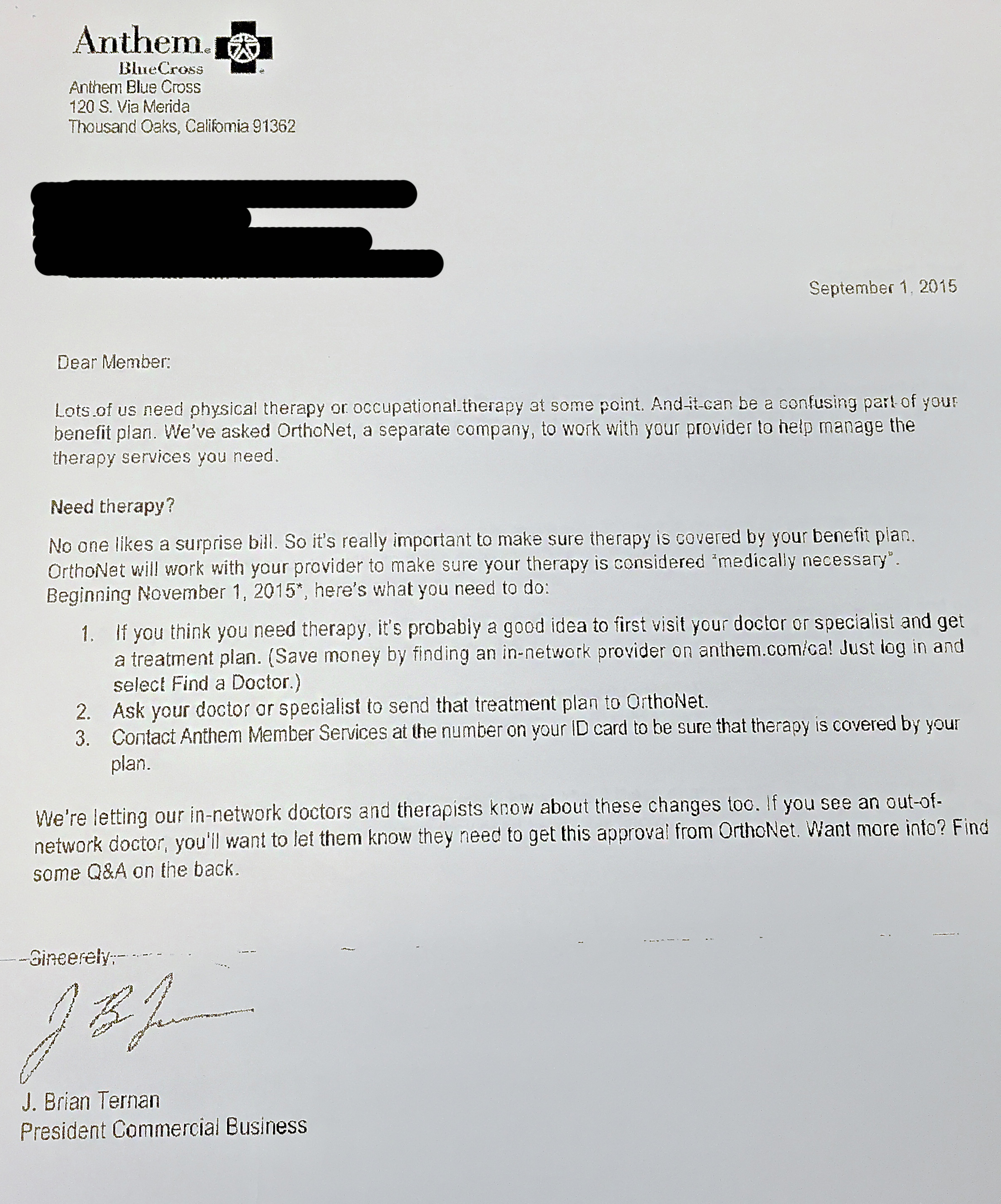
AnthemLetter2015

Confused? Angry? You should be! Essentially, the people you pay so you can have access to medical care are telling you they’re going to start limiting your access to medical care. By hiring a third-party to decide if your physical therapy treatment is “medically necessary” (a legal term, not a medical one), Anthem Blue Cross (BC) is opening up new channels for being able to avoid paying for your medical care.

At Rausch Physical Therapy, we work hard to provide exceptional, quality care that is easily and affordably accessible, and it’s troubling that this practice of limiting your access to medical care has become the norm for medical care insurance companies.


How Rausch PT currently handles insurance companies/payment

Regardless of what that letter above implies, since the passage of the Direct Access bill in 2014 Californians have not needed a doctor’s referral/prescription before coming into a physical therapy clinic for treatment. You can come to Rausch Physical Therapy at any time for any injuries or impairments that prohibit your mobility, function, and/or quality of life. The issues only arise when it comes to figuring out who pays for this treatment.

Ever since it opened in 2006, Rausch PT has been on the leading edge of forward-thinking healthcare, and Direct Access made possible what owner Kevin Rausch had always envisioned: all people having an easy entry point onto the road to rehabilitation and recovery.

Currently, once our patients come in our door they have two options to pay for their medical treatment:

  1. Pay an out-of-pocket cash rate
  2. Have their insurance help cover the cost of their visit; once we submit their claim to and receive approval from their insurance company, the patient is only responsible for their copayment or deductible.

Whichever payment option you choose, everyone from our front office staff to your physical therapist to our billing department is dedicated to providing you with the best experience and highest quality of care possible.

How the introduction of OrthoNet affects you

Following the lead of other large health insurance companies, BC has decided to bring in a third-party management company, in this case OrthoNet, to handle the authorization of its physical therapy treatment claims. It’s OrthoNet’s job to scrutinize every claim request we submit on behalf of a patient to determine if said visit is—by OrthoNet’s definition—”medically necessary.” After we submit your claim, OrthoNet has two business days to gather all the necessary “clinical information” and either approve or deny your request. If they do approve your claim, OrthoNet will then tell you exactly how many visits it should take you to get better in and subsequently will only pay for.

Please note that this change does not affect BlueCard or Blue Cross Blue Shield members.

Why is this troublesome?

Let’s use the curious cases of Jenny and John as examples to illustrate the potential pitfalls of this increasingly-popular decision by medical care insurance companies to hire third parties to manage their physical therapy claims.

Jenny’s Case

What happens if your claim is denied?

[toggle title=”Click to read…”]Jenny loves to run, but she pushed herself a little too hard this triathlon season and now has knee pain that’s started to limit her ability to train. As an Anthem Blue Cross member, Jenny decides to take advantage of those 60 physical therapy visits she’s allotted per year and immediately makes an appointment at Rausch PT. During Jenny’s first appointment, the front desk sends a request to OrthoNet to get approval for payment for Jenny’s appointment. Jenny sees her PT, and after his initial, hands-on evaluation, he believes Jenny will be back to running pain-free after four or five visits.

Meanwhile, someone at OrthoNet is reviewing Jenny’s case and decides physical therapy treatment for her chronic knee injury is not medically necessary. She does not need surgery (yet) so they deny paying for treatment. They cover the cost of the initial visit, but Jenny now must decide if she’s going to pay cash rate to continue with her compelling treatment plan that will allow her to continue doing what she loves.[/toggle]

John’s Case

What happens if your claim is approved?

[toggle title=”Click to read…”]John is a senior in high school and has sprained his ankle playing basketball. John’s mom received the letter above, and per Anthem Blue Cross’ suggestion she makes an appointment for John to see an in-network doctor. Two days and $150 later, John comes in to Rausch PT with doctor’s approval in hand, ready to start getting better.

On his first visit, we send a request to OrthoNet to get approval for payment for John’s appointment. John sees his PT, and after her initial, hands-on evaluation, she tells John he should be 100% after four or five visits and back on the court before playoffs start in two months.

Meanwhile, someone at OrthoNet is reviewing John’s claim, and two days later they send a payment approval notification. However, OrthoNet has determined that John’s sprain isn’t that bad, so he should be able to start feeling better after a couple visits. BC will only help pay for two appointments to treat his ankle.

John and his PT work hard in those two visits, but he’s still only at about 60%. Inevitably, John is put in a difficult position: does he continue treatment by paying out of pocket so he can make it back in time for playoffs, or does he stop treatment and retire his jersey—or worse yet, try to play anyways and potentially cause lasting damage?[/toggle]

The takeaway

It’s unfortunate that even if your physical therapistor even your doctor—understands your treatment as medically necessary, an outside company can still refuse to acknowledge it as so and require you pay for treatment on your own (on top of you still paying for health insurance.) It’s even more frustrating to us as a provider that we can be limited in the amount of treatment we can give people who come to us for help.

Our patients have and always will be top priority at Rausch Physical Therapy; our sole concern is getting you feeling better so you can get back to doing what you love. Our team of licensed physical therapists spent many years in school to receive their bachelor, master and doctorate degrees and licenses so they could diagnoses and relieve chronic pain and heal injuries to give someone a better quality of life. We don’t believe you should have to live with pain for any reason, especially if that reason is because an outside management company says treatment for your pain isn’t “medically necessary.”

What Rausch Physical Therapy is doing to help

  1. During the last week of October, our front desk staff will be contacting our Anthem Blue Cross patients who are already scheduled for treatment on or after November 1. Together, we’ll work to complete the additional paperwork required to request “prior authorization” so we can continue providing you with quality treatment through the end of the year.  Again, this change is effective November 1, 2015.
  2. At Rausch Physical Therapy, we believe that everyone should have easy, direct access to PT, a physical medicine and rehabilitation specialty that we see change lives every single day. To prepare for the potential influx of BC claim denials after November 1, we are currently working on rolling out new, innovative ways to give you, our valued patient, more payment options so you will never have to rely on referrals or allow your health insurance company to limit your health.


What can you, the patient, do to help?

  1. Raise a ruckus! Be proactive. Demand access to the care you pay for and deserve. Call the Anthem Blue Cross customer service number. Then email your friends, get on Facebook, Tweet, and share this.
  2. If your claim is denied for being “medically unnecessary… Fight back and appeal. According to the U.S. Government Accountability Office, you have a 50-50 chance of getting your appeal approved if it’s an issue of medical necessity. It may take a little longer, but if the amount of money is significant or the issue important enough to you, it is worth the time you take to make it right. Get the forms you need and fill them out and send them off. Rausch PT and/or your doctor can help by providing additional medical information to the request to show exactly why it is medically necessary. Don’t be intimidated by your insurance company; we’re here to help. Click here for the forms you need to file a complaint.

If you have any questions, please feel free to call our office at (949) 276-5401 and we’ll be happy to answer any concerns you may have to make this transition as easy as possible.

Common Physical Therapy Treatments

Aches, pains, and injuries can sideline you from the activities you love. But physical therapy offers a path back to movement and well-being. Here, we present you with a range of techniques, from hands-on therapy and therapeutic exercises to modalities like heat and electrical stimulation. By understanding these treatments, you can approach your physical therapy journey with confidence.

Physical therapists have a range of modalities, or treatment methods, they can choose from to help reduce pain and inflammation, as well as improve your endurance, strength, and range of motion as you rehab from a musculoskeletal injury or movement dysfunction.

Heat application, electrical stimulation, traction, and massage are just a few of the physical therapy modalities that may be used at different stages of your recovery. While some modalities may only be able to be used during a treatment session, others can also be done at home.

This article explores 12 common physical therapy modalities, including how and why they are used. If your therapist recommends one for you, they should be prepared to explain the reason for using the modality and what to expect from treatment.


Exercise

Exercise is a controlled physical stress applied to the body to help improve strength, range of motion, or flexibility.

Exercise can be passive or active.

  • Passive exercise is one that requires you to simply relax while another person, like a physical therapist, applies the stress. One example of this is a hamstring stretch where a person lifts your leg to elongate the hamstring muscle on the back of your thigh.
  • Active exercise is exercise that you perform under your own power. Walking on a treadmill, hip strengthening exercises, or straight leg raising exercises are all active exercises.

If you attend physical therapy in a clinic, at home, or while in the hospital, you will likely be engaged in some form of exercise to help improve your mobility. Home exercises are often also prescribed.

The home program is a group of exercises that you perform on your own. They can be very important to helping you return to normal function.


Ultrasound

Ultrasound is a deep heating treatment used to treat many musculoskeletal conditions like sprains, strains, or tendonitis.

Ultrasound is administered by your physical therapist using an ultrasound machine. A wand called a sound head is pressed gently against your skin and moved in small circular sweeps near the site of injury. A small amount of gel is used so the ultrasound waves are absorbed into the skin and muscles.


Electrical Stimulation and TENS

Electrical stimulation is occasionally used in physical therapy to help decrease pain around injured tissue.2 Transcutaneous electrical neuromuscular stimulation (TENS) is one well-known form.

There are two theories about how the stimulation works: the gate theory and the opiate theory.

Other forms of electrical stimulation may be used to contract muscles. This is called neuromuscular electrical stimulation (NMES) and is used to help your injured muscles “relearn” how to function properly.


Traction

Traction is used in the treatment of low back pain and neck pain to help decrease pain and improve mobility in the spine.

To use lumbar traction, you must be strapped into a mechanical machine. There is a vest that helps support your ribs and another device that wraps around your pelvis. The vest and pelvic device are stabilized with straps, and a mechanical force is applied with a machine.

Cervical traction is applied in either the sitting or lying position. If sitting, a harness is attached to the head and a pulley system is used with a small weight attached. The weight provides the traction force while you sit comfortably in a chair.

In lying, or supine, traction, a specific device is used. You must lie down on your back and strap your forehead into the device. Then, a pneumatic pump is used to help provide the traction force to your neck.

Theoretically, traction helps to separate the joints and disc spaces in the low back or neck, which in turn helps to decrease pressure on spinal nerves.


Joint Mobilization

Joint mobilization occurs when your physical therapist passively moves the joints of your body in specific directions. This can help to decrease pain and improve mobility.

While you may think of your joints moving as hinges, there is a gliding motion that also occurs between the joints of the body. This gliding motion is increased during joint mobilizations. The degree to which your therapist moves each joint depends on the amount of pressure and the direction of force applied to the joint.

While joint mobilization is a passive treatment, your physical therapist can teach you self-mobilization techniques so you can manage your problem independently. This can help you return to normal function quickly and offer you a strategy to prevent future problems.


Massage

Massage is using the hands to knead the injured tissues of your body to help decrease pain, improve circulation, and decrease muscle tension.

There are many massage techniques, including effleurage, petrissage, and trigger point massage.


Heat

Moist heat, or hot packs, may be applied to your body if you have an injury or after physical therapy exercises. The heat helps to increase circulation to the injured tissues, relax the muscles, and provide pain relief.

In a physical therapy clinic, hot packs are kept in a device called a hydrocollator. This is a large tank of hot water. The hot packs are cloth packs filled with a sand, clay and silica mixture. They absorb the hot water and are wrapped in terry cloth covers and towels before being applied to your body.

The hot pack is usually kept on the injured body part for 15 to 20 minutes.

Caution must be used when using hot packs as the skin may suffer burns if insufficient toweling is used during the application of the heat.


Ice

If you have an injury, cold packs or ice may be applied to your body to help decrease pain and control inflammation. Ice is usually used during the acute or initial phase of injury to limit localized swelling around tissues.

Cold packs are usually applied for 15 to 20 minutes. Like hot packs, care must be used to prevent skin damage from getting too cold.


Iontophoresis

Iontophoresis is a form of electrical stimulation that is used to deliver medication across the skin to inflamed or injured tissues.

Most often, a steroid like dexamethasone is used in the treatment of inflammation. This steroid can help decrease pain and swelling of tissues that occurs when they are inflamed.

Iontophoresis can be used in the treatment of other conditions as well, depending upon the medication that is used during treatment. It is not a replacement for active physical therapy, but can be added as part of an overall plan.


Laser or Light Therapy

Light therapy involves using light at a specific wavelength to help improve the healing process of injured tissues.8 The treatment is painless and usually lasts for approximately one to three minutes.

To apply light therapy, your physical therapist will hold the light-emitting wand directly over your injured body part and press a button to activate the light.

Light therapy can be used in the treatment of chronic pain, inflammation, or wound healing.

The theory behind light therapy is that photons of light carry energy, and this energy applied to injured tissues can help improve cellular processes and speed healing or decrease pain.


Kinesiology Taping

Kinesiology taping, or K-tape, is often used by physical therapists to augment your rehab program. The tape is made of a flexible fabric that stretches and pulls as you move.

Kinesiology tape is applied to the skin, and it can be kept in place for a few days.

It may be used for various purposes, including:

  • Muscle inhibition
  • Muscle facilitation
  • Bruising and swelling management
  • Pain relief

Since K-tape is a newer treatment modality, it has yet to be fully tested, and gains made with it may be due to the placebo effect.


Whirlpool

Whirlpools are a form of hydrotherapy and are used to help improve circulation, maintain clean wounds, or control inflammation.

Whirlpools can be hot or cold. The usual temperature for a hot whirlpool is between 98 and 110 degrees Fahrenheit. A cold whirlpool bath is typically 50 to 60 degrees Fahrenheit.

Whirlpool baths have a motor or agitator that helps move the water around the body part that is being treated. This motion can have a soothing effect, and can also be used in the treatment of wound debridement.

A typical whirlpool session involves placing your body part to be treated into the water and relaxing while the water swirls around it. Gentle exercises can be performed to help improve motion around the body part while it is in the whirlpool.

Care must be taken to ensure that the whirlpool bath is not too cold or hot, as temperature extremes can damage your skin during treatment.

Understanding your treatment options is key to a successful recovery. Our experts are here to offer you a personalized plan to address your specific pain. Call us today at 949-276-5401. For more tips, follow us on Instagram.


Reference: [https://www.verywellhealth.com/physical-therapy-treatments-and-modalities-2696683]

Strategies for Ocean Swims

Assess the conditions

As summer approaches, many triathletes are swimming in open water to prepare for upcoming races. Training in the pool is great to work on distance and technique. It is important to incorporate ocean water training to be confident in the conditions on the day of the race. Practicing a few swims at the race site will help you prepare mentally by becoming familiar with the surrounding environment and potential hazards. The more experience you have swimming in different ocean conditions, the more prepared you will be for race day.

Assessing ocean conditions is critical for successful swimming. One week before your event, check out the surf report! It is important to mentally and physically prepare for your upcoming ocean swim. Surfline.com is a great site for accurate forecasts.

 Getting in the water before the race has several benefits. First, you can assess the bottom to look for any inshore holes or rocks to avoid while entering during your race, the last thing you need is to sprain your ankle or twist your knee. Second, you can assess the power of the waves while also assessing the strength and direction of the ocean current. Assessing the current is one of the most critical things to do before an open water swim. This will help you gauge where you start on the beach to make the best water entry to hit the buoy without having to swim up the current. Assessing the current takes time and experience in the water, spend time getting comfortable in the ocean and getting a ‘feel’ for it. Third, taking a quick dunk in the water will help to avoid that initial shock when you hit the water at the start of the race. Lastly, I suggest asking local lifeguards about any possible hazards to be aware of during your water entry and exit to avoid possible injury.

Water Entry

Arguably, one of the most important parts of a competitive ocean swim is your water entry, not the amount of time you put in swimming laps. A good water entry starts with gauging were to enter the water after assessing the current.

A quick and efficient water entry through the surf line will separate you from the rest of the pack. Use high knees when running out through the surf line. As it starts getting more difficult to run, you want to start ‘dolphining’ through the surf line. ‘Dolphining’ is a technique used to get through the ‘impact zone’ efficiently. Start  ‘Dolphining’ in waist-deep water by diving with both arms over your head, grab the sand bottom to pull yourself forward while bringing your legs underneath your body to explode out of the water through the surf. Continue ‘Dolphining’ until the water gets too deep, then begin your swim. Swim with your head up through the surf line to keep an eye out for waves. In the case of an approaching ‘set’ of waves, it is always safer to swim toward the wave than away from it. Once past the waves, periodically take a few strokes with your head up to keep your eye on the buoy marker.

Rip currents

Rip currents can make or break you. While we are all taught to ‘stay out of rip currents’, these currents can be used to your advantage in getting through the impact zone more efficiently. Swimming with the outgoing rip current can save time and energy to swim faster through the surf line where waves generally don’t break. This technique should only be used by experienced ocean swimmers with good ocean knowledge and awareness.

 Water Exit

Once you round the buoy, use landmarks on the beach to swim straight. Make sure to avoid any rip currents swimming towards shore, getting stuck in a rip will cost you time and energy. If you find yourself swimming in sandy or foamy water not making any progress, chances are you are in a rip current. Swim parallel to shore to the blue water, then continue swimming towards shore.

In the impact zone, keep your head on a swivel by turning on your back or looking over your shoulder to look for oncoming waves. Bodysurfing can save a lot of time and energy in the impact zone. This takes time and experience to learn but can be a huge asset at the end of a swim. Continue swimming until your hand hits the sand, then start with high knees to exit the water. Remember, running is faster than swimming. Don’t fight the current, it will be faster to run back than to fight the current swimming.

Tips for ocean swims

  •       Check conditions before your swim
  •       Minimize your time in the ‘impact zone’
  •       Use landmarks to help swim straight
  •       Avoid rip currents on your way to the beach
  •       Practice ‘ins and outs’ to have faster water entries and exits
  •       Always swim with a partner

Clay Simons

clay@rauschpt.net

Did you know there’s no prescription needed from a doctor to see us – but we will communicate your progress and treatment to your doctor if you’d like us to!  (949) 276-5401

Disclaimer — All the information that you find on our blogs and social media pages is for informational purposes only and is not intended to be used as your personal professional diagnosis, or treatment. Come and see us for your excellent, personalized care! https://staging.rauschpt.net/

RauschPT

How To Relieve Stress And Restore Energy

Maybe you know some of the dangerous side effects of too much stress in your life — which can lead to such outcomes as weight gain, poor memory, and a whole host of mental and physical health issues. Life places many demands on us, affecting us in different ways and on many levels. Add to that, returning to ‘regular life’ after a year of a pandemic can also be hard! Start this new period of life fresh and renewed with a new ‘habit’. Incorporate ongoing massage to combat your stress! Rx Massage offers a wide range of therapeutic treatments for when you need that break.

You didn’t get to where you are in life without learning how to relieve stress along the way. But just because you’ve “been there, done that” doesn’t necessarily mean it is going to be easier this time around. Granted life experience will likely have taught you the old refrain, “this too shall pass” but that same life experience will also likely have taught you something about the active role you need to take to combat stress from time to time and how we could all stand to benefit from a stress-busting reboot.

I think we all know the dangerous side effects of too much stress in our lives. Stress is a major contributor to many poor health outcomes, such as diabetes, weight gain, hypertension, poor memory, and a whole host of mental health issues. Therefore, how we manage the stress in our lives, needs to be revisited with a fresh and new perspective, in the same way, we need to clean out and freshen up our closet every so often.

Below are my top 10 strategies to relieve stress and restore energy with a fresh look at some old favorites that are guaranteed to help you self-optimize for health and happiness in body, mind, and spirit.

1. Compartmentalize—Prioritization on Steroids

People think of the compartmentalizing tactic in different ways, and there are negative associations with this term. However, when I suggest that you compartmentalize to manage your stress—or better yet, relieve stress—what I am referring to is the idea that you block out certain parts of your life that are distracting you from what you need to do in your daily life.

For example, you are at work but also have some extraordinary stress in your private life due to ailing parents with no siblings to share in the caretaking. Managing this alongside your own family and professional responsibilities, which were already heavy enough, places an enormous amount of stress on you.

When you compartmentalize, you put up mental blinders to help you focus on the task in front of you with the knowledge that managing your parent’s living and financial situation will be handled in due time after work hours.

Learning how to block out these different realms of your life will help you prioritize and manage the work that is in front of you.

2. Get Outside, It’s Like Therapy

Simply getting outside in the fresh air will automatically bring down your stress levels and restore some lost energy. The research around this growing field known as ecotherapy is proving once again how powerful nature is and how we can improve our mental wellbeing along with our physical and spiritual health with time outdoors.

When you are outside, you are more likely to have increased activity levels and will be exposing yourself to the mood-boosting sun, which helps our body create vitamin D. Research on vitamin D indicates that those who are vitamin D deficient may be more susceptible to inflammatory illness, depression and lowered resistance to stress, and more and more of us are becoming vitamin D deficient across the United States.

Spending as little as 10 minutes outside every day can be enough to improve mood, mental focus, and decrease blood pressure. Think of the increased concentration and improved efficiency you will get as a return on investment that yields way better growth on your aptitude and attitude for life.

3. Do an Organization Reboot

We all know the secret to success is largely due to organization or at least some form of it. I would argue that organization is a process. We build structures to organize information and life events based on our current demands. Over the course of your life, this will vary and probably increase as your life becomes more complicated, which will force you to innovate and change things up as you go.

What was enough in college or your first job out of college may not be enough at this point in your life? Furthermore, many, many systems can help us organize, and too many can detract from their intended benefits.

Assessing and weeding out the unnecessary systems or consolidating from the many to one might just be the answer.

Is a family calendar on Google more efficient than the calendar hanging in the kitchen? Don’t just assume that the answer will be in tech. Sometimes the old-fashioned pen and paper is more practical and might also serve as a better physical reminder—think of the whiteboard in the kitchen vs the hidden “to-do list” on your smartphone with reminders that consistently fail.

Another strategy for your organization reboot is an organization self-assessment. First, what it is that you need help organizing, and what the intended outcome is? Is it for communication purposes—to make sure that everyone is on the same page—or is it to help you process and think about the workload in front of you? Answering these 2 questions will help you move forward as you think about what makes the most sense for you, your family, or your team at work.

Another way to approach an organization reboot is to ask other people how they stay organized. This is especially helpful when taking on new responsibilities that might come with a job change or a new family dynamic.

I did this in a new position I recently took and by collecting data on how other people approached their work (think of the complex systems in public education), I was able to create “a best practice” that worked for me and that I could share with my colleagues. Something that could earn you some extra kudos is a bonus, especially when you are the new kid on the block.

4. Engage Your Creative Brain

When we engage the creative parts of ourself we tap into the part of our brain that releases dopamine, which has a naturally calming, therapeutic effect. Needless to say, this will almost immediately help us to relax and will lower our stress levels. One of the premises for which art therapy has been well established.

In one study, in particular, it was found that after just 45 minutes of engaging with artistic materials, regardless of the level of production or artistic talent the person had, there was a notable decrease of cortisol in 75% of the participants.

Music therapy is another form of creative art that can relieve stress and restore our energy. Many of us use music to help us decompress or move into another part of our day or activity. Music also taps into this part of our brain that increases focus and can help us emulate the feeling or “vibe” we perceive in the music. As we know, upbeat music will help you feel more positive while slower music can help you feel more relaxed by easing some of the tension in your body.

There are tons of great playlists out there aimed at stress relief. The next time you are on your preferred music streaming service, test out a few and see which works for you. Needless to say, music is one of those things that we can have in the background while moving forward with other parts of our day.

Perhaps this is another area in need of a reboot that could enhance your stress relief routine.

5. Do You Need a Vacation or Weekend Away?

Vacation opportunities may not be as readily available as we would like. However, it doesn’t have to be a week in the tropics to feel the benefits of a short break from your everyday routine.

If we are optimizing our time with some of the above strategies, perhaps we might be able to sneak in that weekend getaway or even just a day trip with the family. Getting out of your everyday environment, especially when trying to build in some respite and relieve stress, can do wonders for our mind, body, and spirit.

We may love our homes, but they do represent the endless “to-do list” and remind us of all the things that contribute to our stress levels. Getting away from this environment where you can get outside and engage in some of your favorite activities with your favorite people will free your mind and your body.


Granted, COVID-19 has definitely hindered our road trip or vacation opportunities. However, with a little creativity, we can build in the little breaks that we need to relieve some stress, reconnect with the people who are important in our lives, and help us to feel ready for the next hurdle in front of us.

6. Meditation and Mindfulness, Make Them a Habit

Meditation and mindfulness can offer endless benefits to us emotionally and psychologically, which will naturally relieve stress. Many of those benefits include increased focus, relaxation, and a decrease in the mental clutter in your head.

One of the biggest challenges with mediation or mindfulness is that to feel the impact, we need to practice it consistently, which takes discipline. The people who are most successful at integrating mediation and mindfulness into their self-care and stress relief routines are people who build it into their daily practices.

And as is true with many strategies, we don’t need to spend hours doing it. Just 5 or 10 minutes a day can make a difference, but we do need to make sure we are doing it.

Maybe there is a 5 or 10-minute window at the end or beginning of your day where you could fit this consistently? There are lots of great apps to help guide you through your mediation with music and visualization.

7. Fight Off “Aloneliness” and Find Your Alone Time

I read an article recently about “aloneliness,” which is the opposite of loneliness. As an introvert, I have always been that person who replenishes her energy from time alone but never quite thought about the craving as a likening to loneliness for the introvert.

The benefits of alone time are science-backed and include those things that many times go out the window when we are stressed and overwhelmed—things like creativity, mental strength, and productivity. The COVID-19 pandemic has left many people without the opportunity to have their alone time, which could be another reason that you are feeling more stressed and less able to deal with your daily challenges.

You might need to be strategic, but you could build some alone time into your life with a walk outside to get lunch for example, which will also be incorporating strategy #2 on this list.

8. Find Balance in Your Life

Stress can turn our lives upside down and throw everything off-kilter. Finding your equilibrium, getting your bearings straight, and finding the balance in your life between the many demands of family, partner, work, and friends is essential.

If you are feeling increased stress, take a look at the demands around you and make sure that there is a balance between the different parts of your life—in particular, the areas where you find more nourishment for the soul.

Incorporating the well-known life coaching strategy “life wheel” is a great way to think about the different parts of your life to ensure that you are giving all areas the time and attention that they need.

9. Maintain Good Sleep Hygiene

It’s no secret that sleep can be your best friend or public enemy number one. As the saying goes, “what a difference a day can make” is in large part due to a restful night’s sleep. However, when we are stressed, sleep is one of the first things to get out of whack.

If you are going through a period of high stress, you are likely feeling an increase in outside or family demands. Finding the time to fit it all in may naturally creep into your sleeping hours or, on the other hand, the stress might keep you from being able to get a restful night’s sleep. Either of these two scenarios is a case where it might be good to take a look at your sleep routine and force you to be a little more protective of it.

Some of my go-to tips and strategies around maintaining healthy sleep hygiene are:

  1. Plan ahead
  2. Maintain your physical activity
  3. Limit alcohol
  4. Sleep in a cooler environment
  5. Get plenty of fresh air

So, before you get to thinking that you can sleep “later,” remember that healthy people and well-balanced lives have a healthy amount of sleep in their lives.

10. Animal Love

There’s tons of research out there about the benefits of having a pet, in particular, a dog or a cat. Taking care of a pet or any member of the animal kingdom can have such a positive impact on our mood and psychological well-being that our brain releases a hormone known as oxytocin, dubbed the love hormone.We get this hormone from other nurturing (human) relationships as well, but we cannot underestimate the impact this can have on us when we care for and connect with one of our four-legged buddies. A case in point is the fact that many pet owners report feeling a connection to their pet that rivals that of any significant human connection and, in some cases, can even be more significant than a human-to-human connection.[8]

Additionally, having a pet will likely promote other healthy habits. Some of which I spoke about above, such as being outside more often and increasing your physical activity. On a social level, connecting with friends and neighbors about your pet creates a shared connection—another protective factor in the fight against stress.

Bottom Line

Modern life places many demands on us which hits us in different ways during different periods of our lives. Maintaining our physical, mental, and spiritual well-being requires a fresh and renewed approach every so often.

If you take the time today—to take care of yourself for tomorrow by revamping the old worn-out items in your self-care toolbox—you will reap the benefits 20 fold! Learning how to relieve stress from our life is a process that we will need to revisit time and time again, each time getting better and better.

Reference: {https://www.lifehack.org/903519/how-to-relieve-stress-easily}


Need a break? We are here for you! With certified therapists and a relaxing environment, Rx Massage customizes each session to target your specific issues. Visit our Facebook page at www.facebook.com/rauschpt or call us at 949.336.1089 to book an appointment.

Did you know massage can massively speed up your healing, from training, injury, or surgery recovery? Massage has an overarching positive effect on so many aspects of your health. We have excellent memberships that make regular expert massages possible. Call us! (949) 276-5401

What to Do for Hand and Wrist Pain?

We tend to forget how important our hands and wrists are until we start feeling pain there. Due to office work, or sports like climbing or baseball, prolonged inflammation in your hands and wrists can be painful and lead to severe conditions. Learn more about ways to reduce hand and wrist discomfort. Having a physical therapist guide you through recovery is also essential to prevent the pain or lack of mobility from returning.

Office work is well known for being detrimental to people’s backs due to prolonged periods of sitting.

But, there’s another body part that excessive typing, texting, scrolling, and mouse-clicking wreak havoc on, too—the hands and wrists.

Hand and wrist pain is a notable side effect of office work that many people assume they have to live with. Thankfully, there are actually numerous ways to lessen office-work-induced hand and wrist pain, and ways to help prevent it.

Let’s look at why hand and wrist pain are so prevalent and what you can do about it.

Common Causes And Effects of Hand And Wrist Pain

There is an abundance of hand movement repetition in the tasks for office work, with the main activities performed being typing, scrolling or clicking with a mouse, and texting on a cell phone.

When we type, we use our fingers in an unnatural way, and we often keep them hovered awkwardly above the keyboard for prolonged periods of time. This puts stress on our wrists, and the typing itself overworks our fingers far more than anything else we generally do in life.

When we overuse our hands and wrists by typing, our bodies are put at risk of developing numerous conditions. These include:

  • Carpal tunnel syndrome
  • Trigger finger
  • Wrist tendonitis
  • Repetitive strain (or stress) injury

These effects are usually not permanent, but they can be very painful. Once you have frequent hand and wrist pain from typing, other activities in your life, such as exercise or sports, or even opening doors, might also be affected.

Additionally, the prolonged inflammation in your hands and wrists can lead to arthritis in the coming years.

Ways to Reduce Hand and Wrist Pain

In addition to life being better when you’re not in pain, it’s important to take steps to prevent that potential occurrence too. Luckily, there are numerous actions you can take to prevent your hand and wrist pain from worsening.

Pain Relieving Stretches

Pausing to stretch your hands and wrists can help bring back flexibility and can improve the blood flow that may be impacted by a lack of arm movement.

At the least, it’s wise to do some hand and wrist stretches at the start, middle, and end of your workday.

If you notice that stretching your hands and wrists reduces your pain, you may opt to stretch briefly every hour or two. In the same way, as it’s a good idea to get up and stand every hour to break up your sitting, it’s a good idea to keep your hands and wrists flexible as you use them throughout the day.

Wrist Stretching

Stretching your wrists is an easy way to reduce the pain in them caused by typing. Some examples of wrist stretch you can try are below:

  • Raise and lower your hands in a “stop” position with your arms outstretched in front of you.
  • Make and hold a fist.
  • Rotate your hand up and down while making a fist.

Hand and Finger Stretching

Stretching our hands and fingers isn’t something we tend to think a lot about unless we’re doing a sport that involves gripping, but it can be very helpful in reducing the pain from typing and texting all day.

Here are some ways to stretch your hands and fingers:

  • Straighten your fingers and palms flat against a surface and hold this position for thirty seconds.
  • Bend your fingertips down to make a bear claw shape and hold for 30 seconds.
  • Straighten your fingers and palm on a surface and slowly lift and lower each finger and thumb individually.

It can also be helpful to use a grip strengthener. To use one for hand stretching, you’ll hold it in your hands, squeeze, hold briefly, and release. This act of squeezing and relaxing helps to loosen the muscles. Grips strengtheners can also be used to reduce tension.

Strengthening Exercises

You don’t need a whole workout for your hands and wrists, but taking the time to strengthen this part of your body can have the effect of less pain due to overuse. You don’t need any gym equipment for these exercises.

Use Household Items

There are numerous household items that can be used to help strengthen your hands and wrists such as:

  • Rubber bands
  • Towels
  • A hammer

Exercises using those items can be done in just a few short minutes and are very simple, such as putting a rubber band around your fingers and then pushing your fingers out against it.

Wrist Curls

Unlike the small and simple moves with household items, wrist curls are a more common move for actual exercise workouts.

They can be beneficial to your hands and wrists as well as your forearms, which is the part they’re best known for strengthening.

The goal for this exercise isn’t to get sore, as it might be for some people when they use weights, but to slowly and gradually build strength so that your hands and wrists are in the best possible condition for the daily activities they perform.

Home Remedies For Pain

There are many inexpensive and easy ways to manage pain by reducing inflammation. You could take an over-the-counter pain reducer, which serves to temporarily lower inflammation or try one of the following remedies below.

Heat and Cold

Alternating between hot and cold treatments through the use of a heating pad and an ice pack can lower inflammation while also providing temporary relief from pain. In the same way that you’d use heat and cold to relieve a sports injury, you can do the same for hand and wrist pain caused by overuse.

Turmeric

This Ayurvedic root is well proven to relieve pain and inflammation. It has been used for millennia and is an incredibly effective natural pain reliever.

With a bright golden color and a mild flavor, you can use ground turmeric in your meals, drink shots of the fresh juice, or make it into tea.

Ginger

Also, an Ayurvedic root used for many generations as a pain and inflammation reducer, ginger has been proven effective for relieving symptoms of arthritis.

Similarly to turmeric, you can use ginger as a dried spice in your cooking, make a tea from the root or powder, or drink fresh juice shots.

Reduce Systemic Inflammation With Everyday Activities

When you make efforts to reduce inflammation, it won’t only be your hands and wrists that will thank you.

Reducing systemic inflammation improves health overall and helps lower your risk for an assortment of illnesses.

There are many ways to go about reducing inflammation on a daily basis. Some you can try include yoga, eating fewer inflammatory foods, managing stress, and getting a sufficient amount of sleep.

How to Prevent Hand and Wrist Pain

Now that you know of ways to reduce the wrist and hand pain you may already have, it’s helpful to know how to keep it gone once you get rid of it.

In addition to taking steps to lower inflammation in your body, and stretching and strengthening your wrists, proper positioning when typing and the use of wrist and hand supports can lower the chances of your pain returning.

Positioning

When sitting to type, start by making sure you’re using a supportive chair that allows for good posture. Having your back straight will assist with the positioning of your arms and wrists. You’ll want to keep your hands hovered lightly over the keyboard, not resting on it, and your fingers curved over the keys.

If you aren’t able to find a comfortable position, you can try a keyboard with a different shape than the one you currently use.

Cushioning

In addition to choosing a keyboard that feels comfortable for your hands, you may find extra comfort in a mouse cushion and a keyboard cushion.

Though a mouse cushion can be used while you are actively using your mouse, a keyboard cushion should only be used when you are paused on typing. That’s because if you use it while you’re typing, you’ll be pushing your wrists up at a sharp angle.

Utilize a keyboard cushion while scrolling with your mouse, taking a brief break in typing, or reading.

Wrist Support Products

There are several types of products that provide support to your hands and wrists. In order to find one that allows you enough mobility while simultaneously providing sufficient support, you may need to try a few on.

Support options for hands and wrists include stabilizers, wraps, and braces.

Your wrists and hands may be in pain, but they don’t have to be! Try one or more of these suggestions to keep yourself pain-free, no matter how much you type.

Reference: {https://www.verywellfit.com/what-to-do-for-hand-and-wrist-pain-5118083}


At Rausch PT, our physical therapists can formulate a recovery plan to help get you back on track – and there’s no prescription needed to see a PT. Visit our Facebook page at www.facebook.com/rauschpt or call us at 949.336.1089 to book an appointment.

If you find yourself in discomfort or think you could benefit from a personalized exercise plan, talk to a Physical Therapist.

Let’s talk! We are here to help. Give us a call for a complimentary assessment. Did you know there’s no prescription needed from a doctor to see us? (949) 276-5401

Health and Fitness Benefits of Flexibility Training

Can you touch your toes? Do a deep squat? If you classify yourself amongst the most inflexible people, remember that doesn’t get you off the hook as everyone can become flexible by putting some time into it. Flexibility is a skill that you can work on and improve at any age — and it should not be overlooked. It’s a key to whole-body health! Here is a helpful article with everything you need to know to work on your flexibility.

Flexibility is the range of motion in a joint or group of joints, or the ability to move joints effectively through a complete range of motion. Flexibility training includes stretching exercises to lengthen the muscles and may include activities like yoga or tai chi. Improving your flexibility can help you move more comfortably throughout the day.

Flexibility and Range of Motion

Flexibility training is stretching—lengthening and loosening muscles and connective tissues to improve flexibility. You probably know what it means when someone says they are flexible. It usually means that they can reach down and touch their toes or bend deeply into a squat. But the definition of flexibility is more complicated than simply being able to do a single stretch. True flexibility is the ability to move through a range of motion without pain.

Hyperflexibility (being too flexible) is a concern for some people, as it can cause instability in the joints. People who experience this need resistance training to strengthen muscles and joints.

That means that each joint and each group of muscles in your body might have a different range of motion (ROM) or a different level of flexibility. Range of motion is a measurement of how much a joint can move, both in terms of distance and direction. Along with other factors, your muscles’ ability to relax or contract affects your range of motion. If your muscles are inflexible, then your range of motion could be less than it should be.

Some areas of your body may be very tight, meaning that the muscles feel short and restricted. Some areas of your body may feel very loose, and you may be able to lengthen and move those muscles freely.

For example, you might be very flexible in the hamstrings, allowing you to bend over and touch your toes. But your thigh muscles (quadriceps) might be tight (inflexible), so it may be harder for you to stand up straight or bend backward. It’s vital to have balanced flexibility between the right and left of your body, and front and back.

Many people who work in an office develop inflexible hips as a result of sitting all day. This is one of the reasons that health experts recommend that you stand up and move for a few minutes every hour.

Benefits of Flexibility

Being flexible is a key aspect of physical health. With appropriately flexible tissues, your joints can move more freely, allowing more functional movement patterns. You’ll also be more likely to have the range of motion necessary to perform strength training exercises to their full potential, allowing for better results. Some benefits of flexibility training include:

  • Reduces injury risk
  • Lessens the risk of falls
  • Prevents and corrects muscle imbalances
  • Improves posture
  • Enhances joint range of motion
  • Improves athletic performance
  • Combats the effects of sitting for long periods
  • Reduces joint pain and strain

Types of Flexibility Training

There are different types of stretching to improve flexibility. Each has a slightly different purpose.

Static Stretching

You move into a position that lengthens a target muscle and hold the position for 15-60 seconds. It’s best to remember to breathe as you hold each stretch. Static stretching typically should only be done after muscles are warmed up, so do it after a workout. If stretching is the main workout, make sure it’s preceded by a proper warm-up. Some recent research suggests that short-duration static stretches are safe before a workout for most people—just not high-performance athletes.

Dynamic Stretching

You move in and out of a position that lengthens a target muscle. Dynamic stretching involves moving through a joint’s full range of motion either slowly or quickly to mimic a functional activity. Examples would be bodyweight squats or lunges, arm and leg swings, or hip circles.

Active Isolated Stretching (AIS)

Active isolated stretching is a technique that involves contracting the opposite muscle from the one you are stretching, holding it for two seconds, then relaxing, and repeating 8 to 10 times. The muscle contraction sends a signal to the opposite muscle to relax, letting you stretch more effectively without discomfort. Many athletes and active exercisers use active isolated stretching to prevent injuries or muscle imbalance.

Myofascial Release

Myofascial release exercises, such as foam rolling, can also help increase flexibility. It is thought that tight, tense areas in your body are due to adhesions of the fascia, a connective tissue. Using myofascial release can purportedly break up these adhesions, increase blood flow to the tissues, and release tension.

One type of stretching known as ballistic (bouncing) stretching is risky and not recommended as it has a higher potential to cause injuries.

How to Increase Flexibility

Stretching improves flexibility. But you don’t have to do hours of stretching to enjoy the benefits of flexibility training. You can take a stretching class or do an online video that focuses just on stretching exercises to improve range of motion throughout the body.

Many exercisers add a few minutes of stretching to the end of their daily workout to relax muscles and improve range of motion. Or you can take five to 10 minutes to stretch in the morning after you get out of bed. Just a few minutes of flexibility training each day can provide benefits.

For example, a lunge exercise strengthens the quadriceps on one leg but lengthens (stretches) the hip joint on the other. Different swimming strokes increase flexibility in the upper back and torso. And walking strengthens the lower body but also increases flexibility in the hip joint.

Another way to improve flexibility is to do various cardio and strength training exercises. Flexibility is inherent in many other activities such as yoga, pilates, and mobility work.

Never stretch to the point of pain; don’t force or overdo any movements. Improved flexibility will come with time and regular practice.

A Word From Verywell

Exercisers who include flexibility training as part of a balanced fitness program enjoy many benefits. Stretching exercises can help decrease stress and improve the way your body moves and feels throughout the day. Improved flexibility can even lead to better posture. 

All of these benefits help you to move more often throughout the day and burn more calories. So if you’re trying to lose weight, it’s smart to include flexibility exercises in your weight loss program.

Reference: {https://www.verywellfit.com/flexibility-definition-and-examples-3496108}


Work with a physical therapist to improve your flexibility and range of motion. Rausch PT physical therapists help to prepare your body for whatever it is you want to try next. Keep moving and living life to the fullest. Give us a call at 949-276-5401 or find us on Facebook at https://www.facebook.com/rauschpt/. Don’t forget: there’s no prescription needed to see a PT in California.

If you find yourself in discomfort or think you could benefit from a personalized exercise plan, talk to a Physical Therapist.

Let’s talk! We are here to help. Give us a call for a complimentary assessment. Did you know there’s no prescription needed from a doctor to see us? (949) 276-5401

Patient Spotlight – George Alvarez

George tested positive for COVID-19 in early November 2020 and was hospitalized for 36 days, on a ventilator for five of those days. He received physical therapy while in the hospital, which prepared him for his outpatient rehab. Three weeks after his release from the hospital in early January 2021, George began his physical therapy with Dr. Rebecca Gasca at our Laguna Niguel Rausch Physical Therapy location.

George had heard about Rausch Physical Therapy through a friend, and when he came in for his initial evaluation, he was extremely impressed with the outstanding, laser-focused evaluation that he received from Rebecca. She diagnosed that his back muscles were very tight due to COVID and that his balance needed improvement, as well as his weak core and weak leg muscles.

After recovering from COVID and his hospital stay, George had a ways to go in order to get back to the bike rides that he enjoyed so much. He spent his time with Rebecca working on balance, endurance, flexibility, and core strength. After all of his dedication and hard work, George now feels more energetic and flexible. Just last week, he was able to get back on his bike for his first ride since his recovery! George can not express enough how much his time working with Rebecca helped him get back to his peak physical strength and activity after COVID.


Rebecca

Dr. Rebecca Gasca

Let’s talk! We are here to help. Give us a call for a complimentary consultation. We would love to meet you.

Did you know there’s no prescription needed from a doctor to see us – but we will communicate your progress and treatment to your doctor if you’d like us too!
(949) 276-5401

RauschPT


Disclaimer — All the information that you find on our blogs and social media pages are for informational purposes only and are not intended to be used as your personal professional diagnosis, or treatment. Come and see us for your excellent, personalized care! https://rauschpt.net/

Should I keep running or stop?


How often have you heard a runner say my hip, ankle, knee hurt so I took some time off and it got better but then I started running again and it came back.

Running injuries are very different from the common injuries you hear about from football, basketball, or soccer. Rarely do they occur because of traumatic injury or a specific moment, most commonly it is an overuse injury caused by “training load error.” Basically what happened is the tissues you are stressing during running were overloaded for some reason be it mechanics, training stress, or tissue resiliency. The most important aspect to always look at is have you changed something about your running recently: mileage, intensity, frequency, or terrain? These factors change the accumulation of stress on your body and tissues, if you are not properly prepared for that then injuries will develop.

Pain is difficult to judge with running as there is always a level of discomfort/pain associated with running. So how can you tell if you can keep running, stop running, or as is most often the case alter how much or often you are running. The danger with stopping to run completely is you may not be helping the problem but actually making it worse. If you stop you will decondition the tissue you’ve injured and it will stop hurting but run the risk of restarting the same injury. This can lead to a bad cycle of run-injury-rest-run-reinjury etc. The best option is to alter what you’re doing and work on the tissues in order to strengthen them so that when you resume running at your goal mileage/intensity etc you will be able to handle the load.

The best way to judge what you need to change is to ask yourself a few questions about your
injury/pain.

1. Does it hurt all the time?

If it hurts all the time you probably should stop running and get it checked out by your PT.

2. How long does it take for the pain to start?

If it kicks on at X miles or after X minutes then just run less than that for a few weeks and gradually start lengthening it back out

3. Does your pain get worse if you keep running?

If your pain keeps getting worse the further you run then you probably should back off.  Keep an eye on whats happening but take it easy and probably get it checked out by your PT.

4. Are certain workouts better or worse?

Speedwork or hills is the only thing that irritates your injury? Avoid that specific type of running for a few weeks and then slowly try to ramp back into it.

5. Does your pain return to normal after?

If you stop running and everything feels fine again, give it a few days or a week. If it’s not improving then go see your PT.

Overall stopping to run is not always the best option, there are plenty of ways that you can modify what you’re doing in order to keep forward on your goals or keep active.

Rausch Physical Therapy remains your caring team and can accommodate you with a specific, personalized plan. Visit our Facebook page at https://www.facebook.com/rauschpt or call us at (949) 276-5401 to learn how we can help you. Don’t forget: there’s no prescription needed to see a PT in California.


Dr. Max Biessmann PT, DPT

Let’s talk! We are here to help. Give us a call for a complimentary consultation. We would love to meet you.

Did you know there’s no prescription needed from a doctor to see us – but we will communicate your progress and treatment to your doctor if you’d like us too!
(949) 276-5401

RauschPT


Balance

There are many aspects that are important in training for athletic endeavors including strength, flexibility, and speed. One area that can be forgotten is balance. Balance is very important because much of what we do while performing different sports activities involve being on one leg at a time even for a very small amount of time. Running for example is really a series of alternating single-leg balance. When you push off one leg and swing it forward towards its next step you are standing on the opposite leg for a split second. Adding the change of direction that many sports involve increases the need to be able to not only perform this series of single-leg balances but also to perform this while quickly moving from one direction to another. Improving balance helps to increase your ability to control and stabilize your body’s position during the demands of sports activities requiring these quick changes of direction movements.

As we age, balance continues to be very important. Falls in the older population can lead to catastrophic injuries including broken hips, legs, arms, shoulders, arms, wrists, and even head trauma. Balance training can be effective in limiting the risk of loss of balance leading to falls and decreasing the risk of potential injuries.

The easiest way to begin balance training is by performing a single leg balance on each leg. Start with 2-3 sets of 30-second hold and continue to progress your time if this is easy. Progression of challenging single-leg balance can be achieved by adding unstable surfaces including foam pads, ½ foam rolls, balance discs, and Bosu balls. Also, closing your eyes increases the challenge further by taking your vision away, a key component of balance.

Check-in with one of our physical therapists today and have someone on our team to help progress you with your balance and recovery!


If you find yourself in discomfort or think you could benefit from a personalized exercise plan, talk to a Physical Therapist.

Let’s talk! We are here to help. Give us a call for a complimentary assessment.
Did you know there’s no prescription needed from a doctor to see us?
(949) 276-5401


Patient Spotlight – Sam

Sam started coming to Rausch PT for her rehab back in January of 2019 because she had just recently recovered from an L4 Pars fracture from playing softball. She hadn’t been able to play softball for a while and was eager to get back at it.

Sam started her physical therapy by coming twice a week and working with Dr. Jonathan Meltzer in order to start strengthening and gaining mobility in her back. Within no time at all, she was feeling ten times better than she was before. The exercises and stretches that she did during her sessions with Jonathan helped her become as good as new, and now even better than she was before! Sam loved how Jonathan was able to implement softball drills into her therapy since it made it more engaging and better for when she started practicing again. She felt that everyone at Rausch were her cheerleaders and they continuously encouraged her to get better and better.

Sam can now play softball again as if she was never injured, and she actually found herself quite sad to be finishing up her treatment at Rausch PT. She felt the therapists had become her second family and they actually ended up encouraging her to do more with her free time since Covid-19. Because of this, Sam started a non-profit project called Letters of Love 19, where anyone can write virtual letters to healthcare professionals, thanking them for their work during these crazy and unprecedented times, and to nursing home staff and patients, sending them thoughts and prayers. Sam hasn’t really been able to go out much during this pandemic, so she thought she would give herself, and others in the same situation as her, a little something to do. She wanted everyone to have the opportunity to write a letter, so she made everything virtual. All you have to do is email your letter to write.to.lettersoflove19@gmail.com, and Sam will handwrite and mail out the letters for you! It is quick, safe, and easy, and will make someone’s day. In such scary times, it is important to spread love and not hate, so her goal is to spread love one letter at a time.


Dr. Jonathan Meltzer

Let’s talk! We are here to help. Give us a call for a complimentary consultation. We would love to meet you.

Did you know there’s no prescription needed from a doctor to see us – but we will communicate your progress and treatment to your doctor if you’d like us too!
(949) 276-5401


Disclaimer — All the information that you find on our blogs and social media pages is for informational purposes only and is not intended to be used as your personal professional diagnosis, or treatment. Come and see us for your excellent, personalized care! https://rauschpt.net/

Patient Spotlight – Carol Parsons

Prior to becoming a patient at Rausch Physical Therapy, Carol Parsons had gone to another Physical Therapy clinic for rehabilitation after having two major surgeries in a year: hip revision in September 2019 and spinal surgery in March 2020. She wasn’t satisfied with the quality of help and atmosphere at this first PT clinic. Due to Carol’s frustration, she decided to switch to Rausch Physical Therapy for her rehabilitation treatment. To her surprise, not only was Rausch Physical Therapy’s location more convenient, but she was also impressed with the largeness of the space, the friendliness of the staff, and the effectiveness of the one-on-one training that she had with her Physical Therapist, Dr. Rebecca Gasca. After Carol’s initial consultation she knew she was in for success, finally!

Carol suffered no back pain, but was still experiencing excruciating pain down her left leg. She initially started with therapy related to her back but presumed the pain was definitely from the hip area. Because of this, Dr. Rebecca Gasca came up with the best solution… Pelvic Floor Physical Therapy! Carol was thrilled that there was a possible cure for her pain. Previous to working with Rebecca, Carol had never heard about Pelvic Floor Physical Therapy, but she was willing to make it work. And with Rebecca‘s attention to detail and Carol’s determination, it really did work. Carol was so impressed with Rebecca’s determination! She was on a mission to help Carol get better and Carol could feel that ambition.

Carol likes to refer to Rebecca as her “angel”. Physical Therapy with Rebecca has altered her in such a positive way. Rebecca’s perseverance, incredible knowledge, dedication, positive encouragement, and her desire to succeed have led Carol to success!!


Rebecca

Dr. Rebecca Gasca

Let’s talk! We are here to help. Give us a call for a complimentary consultation. We would love to meet you.

Did you know there’s no prescription needed from a doctor to see us – but we will communicate your progress and treatment to your doctor if you’d like us too!
(949) 276-5401

RauschPT


Disclaimer — All the information that you find on our blogs and social media pages is for informational purposes only and is not intended to be used as your personal professional diagnosis, or treatment. Come and see us for your excellent, personalized care! https://rauschpt.net/

HTML – Jon’s Youth Baseball Injury Guest Post

Around the office, they call me “The Baseball Guy.” My years of clinical treatment of ballplayers at Rausch Physical Therapy and Sports Performance, coupled with my interest in biomechanical research, has motivated me to find new ways to reverse the alarming increase in youth baseball arm injuries. In fact, for the past two years I have been developing injury prevention programs for southern Orange County baseball leagues to help protect our youth’s elbows and shoulders.

And it looks like I am not the only one getting on base with this initiative. Major League Baseball and USA Baseball recently teamed up to launch their Pitch Smart program, which is designed to educate parents, coaches and young athletes about how to avoid overuse injuries. It includes information on pitching guidelines, injury risk factors, Tommy John surgery and more.


Did you know:

If you pitch more than 100 innings in a year, whether little league, club or showcase, it will increase your risk of injury by 3.5 times

If you pitch greater than 8 months in a year, it will increase risk of surgery by 5 times

The number one risk factor for injury

I have found that out of all the risk factors that can cause injury, the number one is pitching too much, both in a game and in any given year. New research is coming out every month about the correlation of throwing too much and arm injuries in little league athletes.

Kids should take off about 2-3 months of competitive pitching in a year and engage in other sports or active rest where they are still using their arms, just not in a pitching motion

As a healthcare professional, I believe that change needs to occur in the traditions and schedules of little league baseball across the nation. The Pitch Smart initiative proves to me—and hopefully to parents and coaches—how crucial injury awareness and prevention is. I want to take this information and use my skill to prevent, rehabilitate and treat the youth of little league baseball.

If you have any questions about throwing injury prevention or rehabilitation, please send me an email and I will be happy to answer them. For now, take care of those elbows and shoulders!

Sincerely, The Baseball Guy

Jonathan Meltzer, D.P.T. | jonathan@rauschpt.net


About the Author
Jonathan Meltzer graduated from the University of Redlands with a bachelor of arts in biology and a minor in physical education. Following graduation, Jonathan discovered his passion for physical therapy while working as a Physical Therapy Aide. After graduating top of his class from Loma Linda University in 2012 with a Doctorate in Physical Therapy, Jonathan began his career at Rausch Physical Therapy and Sports Performance. Jonathan’s goals are to identify limitations and treat his patients with the most recent and innovative techniques in order to maximize functional independence and obtain his patients’ individual goals.