
Blog

Seven Myths About Physical Therapy: Debunked

KR-BLOG
BY KEVIN RAUSCH, PT, PRESIDENT OF RAUSCH PHYSICAL THERAPY

If you haven’t been ordered to see a physical therapist by an MD, chances are you don’t know much about this particular field of health care. You probably only think of us when you’re fresh off an injury or in a hospital after surgery. You might think physical therapists, massage therapists, personal trainers and athletic trainers are all the same thing. Well, guess what? YOU ARE WRONG. Don’t feel bad! There are many, many people who are in the same misguided boat as you.

There are many types of physical therapy: neurological, in-hospital, pediatrics, and orthopedic, just to name a few. With so much variety and a lot of long-held misconceptions, most folks simply don’t know what a physical therapist does or realize how s/he can help them. So here are the top seven myths you hear about physical therapy: debunked.


Myth 1: Physical therapists are just personal trainers who do massages.

It takes a lot more than a weekend certification course to become a licensed physical therapist. Your physical therapist has had at least seven years of schooling (four years of undergrad and three years of “PT school.”) Some physical therapists—like the majority of our staff—actually have a doctorate degree. After nearly a decade of schooling, physical therapists then have to pass national and state licensing exams. So trust me when I say it takes a lot of time, money and perseverance before a physical therapist is allowed to get his/her hands on you!


Myth 2: You need a doctor’s prescription to come to physical therapy.

In the past you needed a doctor’s prescription before you could go to a physical therapy clinic for treatment. However, two years ago California enacted a law that allows full “Direct Access to Physical Therapy.” This means Californians can now go directly into a physical therapy clinic at any time for any aches, pains, sprains, etc. without having to get permission from their doctor first. Of course, there are some injuries that do require a doctor’s exam and treatment (and sometimes even surgery,) which is why we work closely with the absolute best physicians in our area.


Myth 3: You can only get treated at the physical therapy clinic your doctor recommends

While your doctor may recommend you go to a specific physical therapy clinic, you do not have to go there. You can request to go to any physical therapy clinic you want. Do your research and find the clinic that’s right for you, matches your lifestyle, and will be the best fit for your goals.


Myth 4: Physical therapy is only for post-surgery patients and old people.

Did you know physical therapy can fix stuff like migraines, chronic back pain, and old injuries? Most people simply don’t realize that physical therapists are able to alleviate things like chronic headaches. Physical therapists work on backs, knees, necks, ankles, elbows, shoulders… basically if it moves, we can fix it. If it’s stiff, weak or painful, you should already be in here.

“Pre-hab” is also a thing! In fact, most elite athletes work with a physical therapist on a weekly basis to prevent potentially-sidelining injuries. And no, we don’t order you to stop everything you’re doing, in fact we like you exercising! Your physical therapist can review your current regime and offer some suggestions for modifications to help keep you active.


Myth 5: Physical therapy is just a bunch of stretching.

If this is what you know as physical therapy, then you should go somewhere else. Physical therapy treatment should consist of a great exam, some soft tissue work, joint mobilization, biomechanical corrections, and activity or sport-specific exercise. Basically, your physical therapist should have his/her hands on you during every appointment and should come up with a goal-specific treatment plan to get you back to doing what you love.


Myth 6: Physical therapy hurts.

Many people are scared to see a physical therapist because they think we’re mean drill sergeants who want to torture you back to health. The truth is that the old saying “No Pain, No Gain” has no place in a physical therapy clinic! PT does not stand for “pain and torture” (Unless you forget to pay your copay.) Physical therapy is not supposed to hurt! It does often challenge you physically, but it should make you feel better, every time.


Myth 7: Chronic pain is something you have to live with.

So many people have a defeatist attitude when it comes to their bodies; they think that if their pain has been around for so long, their only option is to have surgery or just live with it. I see it often in ex-collegiate athletes who think because they’re not competing anymore, there’s no point in addressing their chronic pain/injuries; they “accept” they’ve “ruined” their bodies and settle for day-to-day pain and limited activity. I love it when I get a patient who tells me they had to give up playing their favorite sport years ago because of chronic pain, and then after a few months of physical therapy they’re back to doing what they love.

Remember, pain medication and surgery are not your only options, and you don’t have to suffer! It’s never too late to start physical therapy. In fact, fixing the tough, been-there-forever stuff is our favorite challenge at Rausch Physical Therapy.

[Click to view or download the PT Myth Infographic]

So, now that we’ve demystified physical therapy, take control of your wellness, pick up your phone and make an appointment to take care of YOU. Oh, and don’t forget to do your home exercise program!

All the best to your health,

Inbox-35061-messages-1987-unread


Kevin RauschAs the president and founder of Rausch Physical Therapy & Sports Performance, Kevin Rausch, PT, MPT takes great pride in the care of every single patient he treats. Kevin specializes in sacroiliac joint dysfunctions, running and cycling injuries, and return-to-sport planning for athletes. Since the first day he opened his clinic in 2006, Kevin has strived to provide the best in care, service and technology so as to strengthen his patients’ total body health and get them back to doing what they love.

Find Kevin on Google+

How to Alleviate Shoulder Pinching

JM-BLOG
BY JONATHAN MELTZER, DPT, RAUSCH PHYSICAL THERAPY

Have you ever felt an annoying or painful pinch in your shoulder when lifting your arm? Shoulder impingement is a common diagnosis that we at Rausch Physical Therapy treat in a surprisingly wide variety of people, from tennis players to swimmers to desk employees. I’ve even treated a businessman who felt a terrible pinch every time he put his luggage in the overhead bins while traveling. Do you present with this painful arch of motion?

What is Shoulder Impingement?

Imagine your shoulder as a ball-and-socket joint, where the ball is the arm and socket is a suction cup within the shoulder. When the arm moves through space, the ball is designed to sit in the suction cup to freely rotate and spin around. Injuries develop and patients will notice a pinch when the ball has migrated too far upward or backward so that it’s now hitting on the shoulder component every time the arm lifts to the 90° range. Once the ball clears the socket, the pain stops because there’s no longer compression at the top of the shoulder, hence the quick “pinch” feeling.

If you take a look at the diagram here, you’ll see:

  1. The rotator cuff muscle
  2. The bursa: a fluid filled cushion sac
  3. The acromion: the top of your shoulder blade


As you can see, these three structures have very little space between them to begin with. The more the ball resides in the superior position, the more these individual structures are going to become damaged. The chronic wear-and-tear on this impingement is similar to rubbing a rope on a rock over and over again; if impingement is left untreated, there could eventually be the development of a rotator cuff strain or even the potential for a full tear.

Who is at Risk for Shoulder Impingement?

For one, if you’re an overhead athlete (baseball, swimming, volleyball, etc.) you are constantly jamming the shoulder joint, which creates further compression of the rotator cuff. Or, if you are like the majority of Americans and sit at a desk for work, your shoulders start to roll forward from sitting in this position five days a week. Without postural correction, over time your body actually changes its alignment to round over, which again decreases the space in your joint and ultimately limits your overhead motion.

Three Stretches to Help Alleviate the Pinch

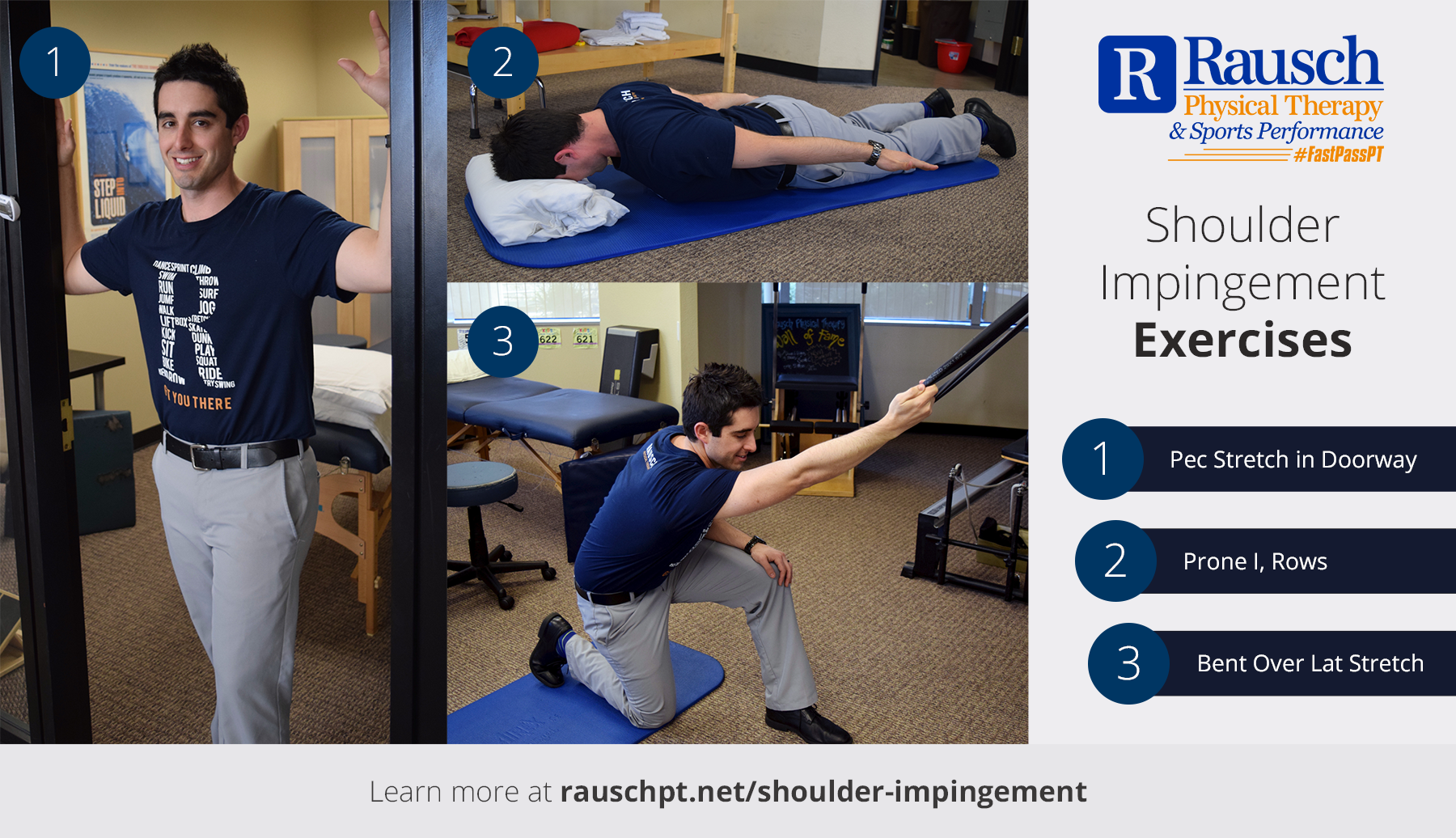
Here are three exercises to help alleviate shoulder impingement and encourage the recruitment of our shoulder blade muscles to improve posture:

2Jon-ShoulderImpingement-ExercisesClick to enlarge image

  1. Pec Stretch in Doorway: Lean forward in a doorway until stretch is felt (30 seconds x 3)
  2. Prone I, Rows: Laying on a flat surface, squeeze your shoulders blades together, then slightly lift your arms (15 reps x 2)
  3. Bent Over Lat Stretch: Grab band, turn palm up, kneel on opposite knee, then carefully lean back to feel stretch (30 seconds x 3)


In addition to these recommended stretches, you should also make modifications to certain activities that aggravate your shoulder, such as limiting overhead lifting and correcting your sitting posture throughout the day. If the painful arch continues, call us to make an appointment (no, you don’t need a doctor’s referral or Rx!) Our licensed physical therapists at Rausch Physical Therapy will quickly evaluate your specific injury and help alleviate pain and recommend additional exercises to help you finally find relief from chronic shoulder pain.


StaffHeadshot-JonJonathan Meltzer graduated from the University of Redlands with a bachelor of arts in biology and a minor in physical education. Following graduation, Jonathan discovered his passion for physical therapy while working as a Physical Therapy Aide. After graduating top of his class from Loma Linda University in 2012 with a Doctorate in Physical Therapy, Jonathan began his career at Rausch Physical Therapy and Sports Performance. Jonathan’s goals are to identify limitations and treat his patients with the most recent and innovative techniques in order to maximize functional independence and obtain his patients’ individual goals.


7 Ways to Avoid Injuries When Starting a New Exercise Program

LF-BLOG
BY LYNDSAY DEFILIPPO, DPT, RAUSCH PHYSICAL THERAPY

We have officially reached February! Are you still keeping up with that New Year’s Resolution to get back to the gym and get in shape in 2016? Hopefully you’re all answering with a resounding, “YES,” because healthy is where it’s at! For those of you who may have already broken your resolution, that’s okay, too! We still have quite a bit of 2016 left. Whether you’re looking to exercise more to get the body you want or to get back to your glory days of sporting, there are a few important notes to remember when kick starting a new workout regimen.

The beginning of the year is always a busy time for physical therapy clinics, not only because everyone starts fresh with their insurance, but also because so many people have a fierce new motivator (in the form of New Year Resolutions.) You probably notice how much more packed your gym, sports club, or Pilates class is with hopeful people looking to shed those extra holiday pounds, and with greater numbers of people exercising comes more injuries, and more patients for us! While we love our patients, we’d rather see you on the table for “pre-hab” not rehab, so here are a few tips for avoiding any New Year Resolution injuries.

7 Tips When Starting a New Exercise Regimen


1. Start slow, and don’t expect to begin where you left off.

Often we find that patients overdo it in the first few weeks of their program causing increased injury to the tissues. Some people write it off as “out of shape” pain, when in fact it could be a greater underlying issue. While it’s tempting to hit the ground sprinting on Day 1, don’t burn out your body or motivation! Take it slow that first month and allow your body to get used to working out again.

2. Have your form assessed by a professional.

Form evaluation is necessary for everything from running, lifting, swimming, throwing, etc. If you don’t have the necessary mobility, flexibility or stability, you can damage your body from the repetitive motions that cause stress on your joints, muscles and tendons. Having a professional evaluation by a sports performance expert will pay off in the long run by not only keeping you injury-free, but also by helping to improve your performance. We’re lucky to have running, biking and throwing analyses here at Rausch PT, but we can also assist with form in other areas as well.

3. Don’t compete with other people.

Your workout plan should cater to your body and your current abilities. A competitive drive is deep-seated in most of us, but when it comes to an advanced yoga pose and you are in your first ever class, swallow your pride and sit that one out. Start from the basics, ask for help and modifications, and I promise your body will thank you later.

4. Know your limits.

It’s okay to push your body to reach new levels, but you should always proceed within reason. Don’t ignore the signs where your body may be telling you to slow down, such as fatigue, excessive thirst, loss of motivation, long duration aches, pains, cramping, and even sleep disturbances and immune system crashes. There are also more serious side effects of overtraining which may require immediate medical assistance. You can read more about overtraining symptoms here.

5. Allow your body to recover.

This includes rest days, stretching and foam rolling before and after every workout, doing a nice dynamic warmup prior to exercise, staying hydrated, getting a good night’s sleep, and scheduling a therapeutic massage at least once a month. Your muscles and body are working hard for you, show them a little TLC!

6. Remember: Health starts in the kitchen.

I can’t stress enough how important it is to maintain a healthy diet that’s specific to your body. Avoid fad diets if you can and think long-term meal planning and healthy eating. Remember, you want this newfound routine of health to be for life! Also, don’t be afraid to seek help from a nutritionist who can craft a meal plan to match your lifestyle and your goals.

7. Switch it up and HAVE FUN!

If you find yourself getting bored with your exercise routine, change it up. If you’re a runner, try an upper-body-focused Pilates workout, or if you’re a swimmer, go for a bike ride. Cross-training will not only keep you entertained and your body guessing, it will also help you to avoid repetitive movements that can injure muscles.

If an injury should occur when getting back into an exercise routine, don’t wait for it to go away on its own or push through the pain. Make an appointment with your physical therapist; we here at Rausch Physical Therapy can quickly evaluate your injury and get you back on track toward your wellness goals.


StaffHeadshot-Lynds
Lyndsay DeFilippo PT, DPT, CKTP received her Doctorate of Physical Therapy from New York University in 2010. She’s a Graston Practitioner and a Certified Kinesiotaping Practitioner. Lyndsay looks at each injury as a constantly changing puzzle, which is only solved when her patient returns to what s/he loves doing. She enjoys helping with the full recovery process, which includes providing the education, tools and fundamentals to prevent re-injury and the potential for new injuries.


body, div, dl, dt, dd, h1, h2, h3, h4, h5, h6, p, pre, code, blockquote {
margin:0;
padding:0;
border-width:0;
}
body {
-epub-hyphens:auto;
}
div.Basic-Graphics-Frame {
border-color:#000000;
border-width:1px;
border-style:solid;
}
div.Basic-Text-Frame {
border-style:solid;
}
p.Basic-Paragraph {
color:#000000;
font-family:”Minion Pro”, serif;
font-size:12px;
font-style:normal;
font-variant:normal;
font-weight:normal;
line-height:1.2;
margin-bottom:0;
margin-left:0;
margin-right:0;
margin-top:0;
orphans:1;
page-break-after:auto;
page-break-before:auto;
text-align:left;
text-decoration:none;
text-indent:0;
text-transform:none;
widows:1;
}
p.ParaOverride-1 {
text-align:center;
}
span.CharOverride-1 {
font-family:”Open Sans”, sans-serif;
font-size:48px;
font-style:normal;
font-weight:normal;
}
#_idContainer000 {
height:169px;
left:0px;
position:absolute;
top:0px;
width:241px;
}
#_idContainer001 {
height:179px;
left:0.50px;
position:absolute;
top:0px;
width:251px;
z-index:0;
}
#_idContainer002 {
height:44px;
left:0px;
overflow:hidden;
position:absolute;
top:70.50px;
width:251px;
z-index:1;
}
#_idContainer003 {
display:inline-block;
height:179px;
position:relative;
width:252px;
}
div._idGenObjectStyleOverride-1 {
background-color:#ff0000;
border-width:5px;
}
div._idGenObjectLayout-1 {
text-align:center;
}

Client Spotlight: Julie Grable


On your first visit to Rausch Physical Therapy & Sports Performance, your PT will ask you what your goals are so s/he can develop a plan to help get you there. For Julie Grables, “there” was Athens, Greece.
Julie was all smiles after finishing her 10th full marathon, but her road to Athens gold wasn't easy.
Julie was all smiles after finishing her 10th full marathon, but her road to Athens gold wasn’t easy.

Julie Grable is no stranger to accomplishing spectacular goals in style. Last year she completed her 50th half marathon on her 50th birthday, so this year Julie knew she wanted to do something special to celebrate her 10th full marathon. With the New York, Chicago, Washington D.C. Marine Corps., and (3x) Los Angeles Marathons already under her bib, Julie’s husband suggested they go somewhere “exotic” for her 10th full marathon.

An Ancient Tale

The Athens Classic Marathon follows the route of the very first “marathon,” ran in 490 B.C. by Pheidippides, a Greek messenger. He ran from the battlefield in Marathon to Athens to announce that the Persians had been defeated in the Battle of Marathon. After running the distance and announcing victory to the government, legend has it he collapsed and died.

“A story that the Greek like to share with youespecially the collapsing and dying part—whenever you mention you’re in town for the Marathon!” Julie said.

Since she’d never ran an international race before, Julie quickly booked her spot for the ancient race in November and began training.

Tear-ible News

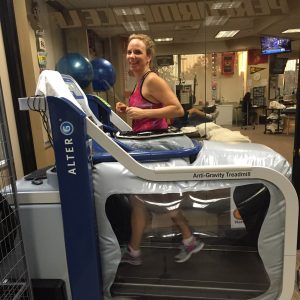
AlterG
Julie was able to use the AlterG to keep training for the Athens Marathon while injured.

However, after several months of painful running, Julie knew she had a problem. With four months left before the big day, she came into Rausch PT hoping to get back on track. Physical therapist Ashley Heller suggested Julie had a high hamstring strain. Two months after that, Julie went to get a MRI and was diagnosed with a high-grade tear.

“I had one other running-related injury years ago, and the suggestion from the physical therapist I saw then was, ‘Don’t run.’   Not an option!” she said.  “I love that Rausch [physical therapists] understand their clients’ goals and support them.”

Initially, Julie’s hope was to be back to pain-free running for the Athens Marathon; it quickly became clear that her sole goal was to manage the injury and get through training without making it worse.

“Without PT, the AlterG (Can you say love/hate relationship?) and the Rausch Team, I don’t think I would have even made it to the starting line,” she said. “In addition to the PT, Ashley helped me work on my running form and gave me lots of good tips to help with training and the race itself.”

Bravo, Jules

During her final appointment before the big race, Ashley taped up Julie’s hamstring for the 15-hour flight to Greece and sent her on her way. Since she had to significantly alter her training program to ensure she wouldn’t aggravate the injury, Julie says she felt very unprepared and undertrained on race day.

“I was even more nervous for this marathon than I was for my first one, probably because I know how far 26 miles is to run!”

Here’s what Julie had to say about race day:

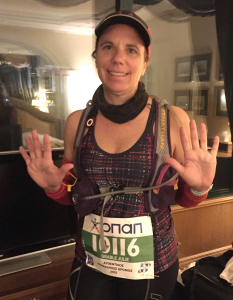
Medal
Julie ready to tackle her 10th full marathon in Athens, Greece.

I was SO nervous, but once I got to the starting line and saw all the festivities and started talking to other runners, my nerves calmed a bit. I knew I had eight hours to finish and my plan was, worse case, to walk the race.

When the race started, I immediately knew it was not going to be as bad as I thought. I listened carefully to Ashley’s voice  in my head telling me, “Slow down, take small prancing strides, walk when needed and you can do it.” I was shocked that I did not feel my hamstring until 11.73 miles (Yes, I know exactly when I felt the first twinge.) […]

It was amazing to run along thousands of runners from all over the world and to be cheered on by the locals yelling, “Bravo! Bravo!” Once I go into the City of Athens (around mile 23) I knew I was going to finish the race with plenty of time to spare. At that point my brain took over and I just dug in for the last three miles. The race finishes in the Panathenaic Stadium, which was host to the ancient Olympic games. There were crowds of people in the stands cheering, and I was scanning for my husband when all of the sudden I heard, “Jules! Jules!” and saw him waving and taking photos. I always cry when I finish my marathons, and this was no exception.

According to Julie, this experience was her most unique training season and race. While she finished 1:40 minutes longer than any of her previous marathons, Julie says she finished faster than she thought she would and “simply did not care.”

“I am thankful for the support of everyone at Rausch PT and know they will get me healthy for my next race. I have not ruled out the Vancouver Marathon in May 2016…”

Health Care Companies Don’t Care About Your Health

You are wasting your money, and you’ve been at it for a while now.

I’m talking about health insurance. Legally everyone has to have it, but really, what has your health insurance done for you lately? Odds are: not much.

The Issue with Insurance

Most people won’t get through their deductible this year, and a large population won’t even see a specialist at all. So, if you paid your $1000 monthly premium (the average family price) and were relatively healthy this year, you’ll have paid your insurance company more than $12,000 with little-to-no benefit in return (And remember, health insurance is not like cell phone minutesthere are no roll-over programs for unused premiums.) This scenario is exactly what your health insurance company hopes will happen.

Every day you are inundated with television commercials, social media ads and mailers sent to your home from big health insurance companies, such as UnitedHealthcare, Kaiser and Blue Cross. They want your premium, and it must be pretty big business since these companies spend hundreds of millions of dollars just to get little ‘ol you as their client. Obviously you’re valuable to them, and they clearly want you as a member, so why do they make it so difficult for you to actually use your benefits once you are a member?

The Cyclist and the Insurance Company

Quick story. Most of you know that Rausch Physical Therapy is the premiere place to rehab injured cyclists in Orange County. Well, we recently had a patient fresh off knee surgery (Let’s call him Joe.) Joe’s a young guy, great cyclist, and he was more than eager to get on the road to recovery so he could get back on the road—an ideal physical therapy patient. There was just one issue: Joe’s insurance. UnitedHealthcare only allotted Joe six PT visits post-surgery. That’s it! Six visits gets him three weeks of therapy; that’s barely enough time to get Joe to bend his knee all the way, let alone get him back on the bike.

Now, here’s the kicker: his insurance company, UnitedHealthcare, has its own professional men’s and women’s cycling teams. That’s right, UnitedHealthcare pays $10 million every year to put its name on a blue cycling kit, but refuses to pay for the PT Joe the Cyclist needs to get back to cycling. Joe’s monthly premiums help UnitedHealthcare pay for its sponsorship costs, and in return UnitedHealthcare limits Joe’s coverage. How is UnitedHealthcare taking care of Joe’s health at all in this situation?

How Insurance Companies “Manage” Your Care

To be fair, UnitedHealthcare is not the only offender in this insurance game. Recently Anthem Blue Cross (BC) sent out letters to its constituents notifying them that it had hired a company called OrthoNet to help manage their physical therapy benefits. Reading between the lines, “help manage” really meant “to help limit your right to direct access to PT and the benefits you pay for each month.” Luckily for BC members, this plot never had the chance to come to fruition because OrthoNet has been sued and brought up on charges in other states for arbitrarily limiting benefits to the members it had been hired to “help manage.”

So, why would BC hire such a bad egg? What was in it for them? Combine the OrthoNet debacle with Joe’s story, and it suggests that it turns out your health insurance company is not really interested in your wellness, but rather in its bottom line. Health insurance should not be this way! The people whose hands you put your life (and money) in should be about supporting and restoring your health, plain and simple.

Okay, Quick Recap…

  • You have to have health insurance.
  • Companies spend millions of dollars made up of your paychecks to try to get new clients instead of to pay for your care.
  • They don’t want/plan to actually pay for your health care, and they will try whatever it takes to not pay the providers that do care for you.


How to Beat the Insurance Game

Now I know this sounds like a lot of negativity, and sometimes it’s overwhelming to think about the frustrating state our health care system is in. However, there are a few things you can do to fight for your health and improve your well-being.

  1. Think ‘prevention’ and avoid unnecessary copays. Exercise every day, do yoga every week, get a massage every month, and eat well at every meal.
  2. Never let your insurance limitations limit your care. Most providers genuinely care about their patients’ well-being, and they will try to come up with a way to work around your insurance issues, such as a cash pay discount.
  3. Get the care you need, then demand payment from your insurance. While your provider will do its best to help, ultimately it’s up to YOU to get payment from your insurance company. As their client you’ll have a lot more pull in that conversation.
  4. Report any insurance issues to the California Department of Managed Health Care. Don’t be shy; these guys are here to help, and it’s the only way your insurance company will ever be held accountable. Click here for the forms you need to file a complaint.

So be proactive. Nurture your wellness daily, and demand access to the care you pay for and deserve. Don’t be intimidated by your insurance company; we’re here to help.

All the best to you and your family this holiday season and upcoming year.

Stay healthy and run faster,

Inbox-35061-messages-1987-unread


StaffBioPage-KevinAs the president and founder of Rausch Physical Therapy & Sports Performance, Kevin Rausch, PT, MPT takes great pride in the care of every single patient he treats. Kevin specializes in sacroiliac joint dysfunctions, running and cycling injuries, and return-to-sport planning for athletes. Since the first day he opened his clinic in 2006, Kevin has strived to provide the best in care, service and technology so as to strengthen his patients’ total body health and get them back to doing what they love.
Find Kevin on Google+


Best Foam Rolling Exercises for Surfers’ Shoulders

As a licensed physical therapist, my passion is helping others. I love being able to help my patients feel better so that they can get back to doing what they love. There’s nothing better… except maybe my other passion: surfing.

I started surfing competitively at a fairly young age, and I continued through high school and college. Nothing compares to that feeling you get when you make a big turn with a good board under your feet and spray in your face. Surfing continually pushes you physically and mentally; the more physically challenging, the more rewarding it is. But with two decades of competing under my wetsuit, I know how hard it is to continuously battle those waves year after year without suffering an injury or two along the way.

So, here are some pearls of wisdom from a surfing PT to improve your paddling mechanics and minimize your risk of injury.

Common Causes of Surfing-Related Injuries

Shoulder impingement is a common injury in sports that require repetitive overhead shoulder motions, such as surfing, paddling, swimming and baseball. Restoring proper shoulder alignment is essential to reducing the risk of impingement, tendonitis and instability.

Rounded Shoulder Posture

Over time, paddling can create muscle imbalances in surfers, which often results in “Rounded Shoulder Posture.” Rounded shoulders, also known as shoulder protraction, can interfere with proper shoulder mechanics for paddling. Tight internal rotators (pecs, lats and subscapularis) limit the shoulder’s ability to externally rotate when reaching overhead to paddle. This can ultimately lead to bursitis, impingement, tendonitis andif left unaddressed—potentially a rotator cuff tear.

Limited Thoracic Extension

Thoracic extension, or extension throughout the upper spine, is crucial to maximizing shoulder mobility and preventing joint dysfunctions in the shoulder and neck. Limited thoracic extension also contributes to Rounded Shoulder Posture and limits the range of motion us surfers need to elongate our stroke when paddling. By addressing restrictions in thoracic extension, you can improve the biomechanics of your shoulder to optimize strength and stability while paddling.

Five Foam Rolling Techniques to Improve Mobility for Paddling

The foam roller is a simple yet important piece of equipment that can be used in a variety of ways to target and stretch different muscles to help decrease the tissue tension and adhesions/knots you can get from paddling. Try these five foam rolling exercises for shoulders to help maintain flexibility, minimize Rounded Shoulder posture, and workout any knots/trigger points after a hard day of hitting the waves.

1. Foam Roll Pec Stretch and Lacrosse Ball Release

rauschpt.net | foam roll for surfers2. Foam Rolling Thoracic Spine with Extension

rauschpt.net | foam roll for surfers

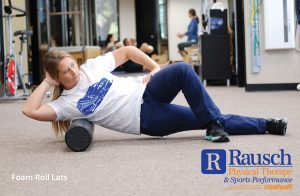
3. Foam Rolling Lats

rauschpt.net | foam roll for surfers

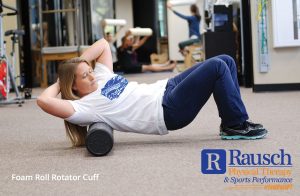
4. Foam Rolling Rotator Cuff (shoulder blade)

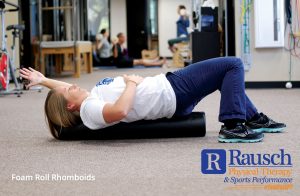
rauschpt.net | foam roll for surfers5. Foam Rolling Rhomboids (between shoulder blades)

rauschpt.net | foam roll for surfersSo, dust off that foam roller (or buy one after your next appointment at Rausch PT) and start using it! If you have any questions about foam rolling, come talk to me during your next PT session. Want to really get a good foam roll workout in? Take advantage of the new foam roll class at ABC Pilates, located in the same suite as Rausch PT.


StaffHeadshot-Ashley2Ashley Heller, MPT is the newest member of the Rausch PT team. She received her Masters of Physical Therapy degree at California State University, Long Beach and is passionate about working with patients with shoulder, knee and ankle injuries. With background in orthopedic-related injuries and post-operative rehabilitation, Ashley believes that the combination of manual therapy and personalized therapeutic exercise program is vital to recovery. As a physical therapist, it’s Ashley’s goal to help her patients better understand their injuries and the plan for their road to recovery.

Click to learn more about Ashley and our other physical therapists »


How to Alleviate Tender Trigger Points

We’ve all felt it, that radiating pain that shoots throughout your head and neck when you touch a small spot in your back muscle. You may have heard of trigger points, but what are they exactly, how do they impact your body, and—most importantly—how do you get rid of them?

Trigger points are bands of muscle fibers that are not happy; it’s like a traffic jam of tension that fatigues your body of energy. Trigger points are essentially are a build up of metabolic waste products that blocks blood flow, short circuiting the motor units with excessive neuronal impulses. Or, plain and simple, trigger points are those tender bits you always massage at the end of the day that never really seem to go away.

Active trigger points are tender without physical touch. The latent trigger points only hurt when pressed on them, like when you get a massage. The latter are more common with acute injuries and are a way for the body to protect itself, so be nice to these ones if you try to work them out yourself.

So now that you better understand why trigger points hurt, now how do you get rid of them? For my patients suffering from active or latent trigger points, I suggest the following three solutions:

Fix #1: Straighten Up

Poor posture is the root cause of trigger points for the majority of people. Start thinking about your posture throughout your day; whether you’re sitting at your desk or working out, correct postural alignment will reduce chronic strain. A good illustration of how the muscle acts according to your posture is the Upper Crossed Syndrome diagram. I show this picture to my patients to help them understand which are the stretched out, weaker muscles vs. the bound up, tight muscles.

Proper Posture 101

Try to imagine that there is a cable pulling you upward by the back of your head. Gently tuck your chin and roll your shoulders back and all-the-way down (Ease off a little so no strain is felt.) Next, find your neutral pelvis position: place your hands on your hips and find the middle between arching your back and rounding your back. This middle ground is the neutral pelvis that takes stress out of the muscles, ligaments, discs, and joints of the lower back.

Perfect posture is not easy to hold for long periods of time, so try building a new habit of getting up every 20 to 30 minutes to correct your posture. After about three months of actively correcting your posture, your body will automatically correct itself and with less difficulty.

Fix #2: Cross Train

Cross training is a great way to balance the body; by strengthening the opposite muscles used during your typical sport/activity, you’ll avoid overuse or burn out patterns. If you play a sport that requires a lot of lower body power, such as soccer, take a couple days to focus on working out your upper body.

Cross Training for Cyclists

If you’re a cyclist, a great cross training workout for scapular strengthening is what I call the “Three-way Band Exercise.” Start your workout on a trainer with a resistance band in your hands. Organize your posture and spread the band with thumbs facing backward with a slight shoulder-blade pinch. Don’t let the arms come forward; keep them in that “T” position to build the back muscles in parallel fiber alignment, which helps you keep your shoulders back during postures on the bike. Personally, I don’t start counting to 15 until I start to feel the burn. Don’t forget to get those shoulders down away from your ears when your doing this, just like they should be when you ride.

Fix #3: Have a Ball

I either have a tennis ball or lacrosse ball with me at all times to roll out knots. I typically like to lie on the ball and shop around until I find the tender bits along the inside of the shoulder blade (scapulae.) Then I’ll breath deeply into the tender area. I usually wait for about 50% reduction in pain or stiffness, and then move to another spot. Don’t do one spot for too long or it will get irritated later. Keep a ball in your car and soften up those spots as you drive home from work or a workout.

Trigger points are nasty, annoying things, but with a visit to a massage therapist, consult with a physical therapist, or just a little effort on your own part, you can work through it.


DustinDustin Hancock, DPT graduated from San Diego State University with a bachelor’s degree in kinesiology/nutrition. He went on to receive his doctorate in physical therapy in 2011 from University of St. Augustine, and began his career at Rausch Physical Therapy and Sports Performance in 2012. As a snowboarder and mountain bike enthusiast, Dustin specializes in treating extreme sport athletes. As a physical therapist, Dustin says he looks forward to being a companion every step of the way on his patient’s path to recovery.

Click to learn more about Dustin and our other physical therapists »


Staff Spotlight: Lawrence Van Lingen


Lawrence Van Lingen is the ART specialist at Rausch Physical Therapy & Sport Performance. He’s worked with Red Bull athletes, IRONMAN champions, and he can work with you, too.
Lawrence Van Lingen, ART Specialist for the Pros... and you, too!
Lawrence Van Lingen, ART Specialist for the Pros… and you, too!

When you first walk into Rausch Physical Therapy & Sports Performance you’ll notice a wall of glass to your right. Behind the very last door, emblazoned with the words “Clinical ART,” is where Lawrence Van Lingen works.

The room is small with bare walls, save for a few pieces of art, and it only contains a small desk and treatment table. It is… remarkably unremarkable. In fact, if it weren’t for the familiar face of a pro athlete popping in and out of that room every once in a while, you’d never suspect that the man inside of it was anything other than your average massage therapist.

The truth is, Lawrence is far from average; he’s a well-respected, highly sought after soft tissue therapist and performance consultant. His elite clients travel across the country—some even across the world—to visit his humble office hidden in the corner of Rausch PT.

So who exactly is Lawrence Van Lingen, why are professional athletes traveling from the other side of the globe to come see him, and most importantly, how can you get on his schedule, too?

Lawrence’s Past Life

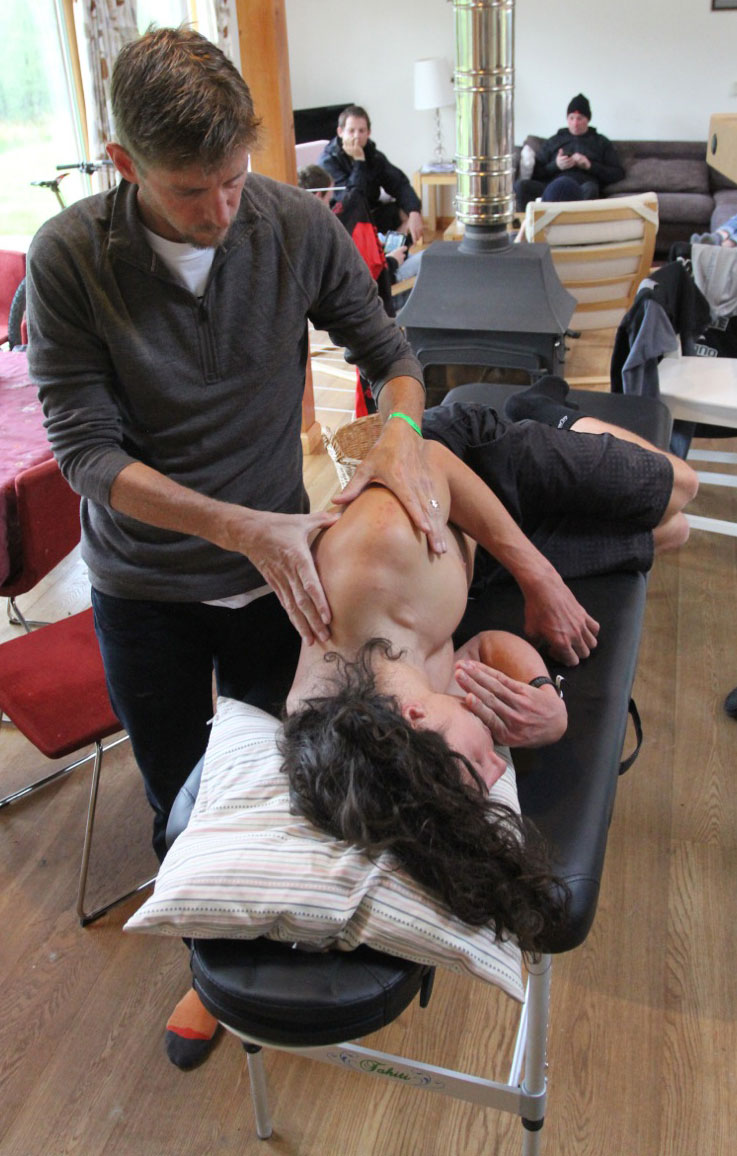
Lawrence working on Josh Bryceland, professional downhill mountain biker and Santa Cruz Syndicate Team Racer, at the World Cup in Scotland this past summer.

More than 20 years ago in his home-country of South Africa, Lawrence was highly involved in triathlon when he decided to become a sports chiropractor. His first clients were triathletes and his wife Gwen, an Olympic runner. Soon, word began to spread about the man with the magic touch, and Lawrence became the team chiropractor for a number of professional lifesaving, running, swim and triathlon teams.

It wasn’t until Lawrence himself competed as a professional IRONMAN for two years that his personal interest in sports performance began to creep into his chiropractic career. In 2013 Lawrence became High Performance Manager of Red Bull South Africa, working closely with the best professional endurance, adventure extreme sport athletes around.

“Those pro athletes hold you to a very high standard,” Lawrence said. “As soon as you don’t know what you’re doing, they’re gone.”

In this case, it was Lawrence who was gone; at the end of 2013 his wife took a job in the U.S., and Lawrence started his professional life over again as an ART specialist at Rausch Physical Therapy & Sports Performance. Lawrence says the team atmosphere and holistic approach Rausch PT offers its patients is what drew him in.

“I did my homework and knew I wanted to work at Rausch PT, as it’s the premier place for triathletes,” Lawrence said. “Clients can cohesively move from physical therapy to ART to Performance Lab services;  it’s ideal for me. I can’t work in isolation. I need that support.”

Lawrence at Rausch PT

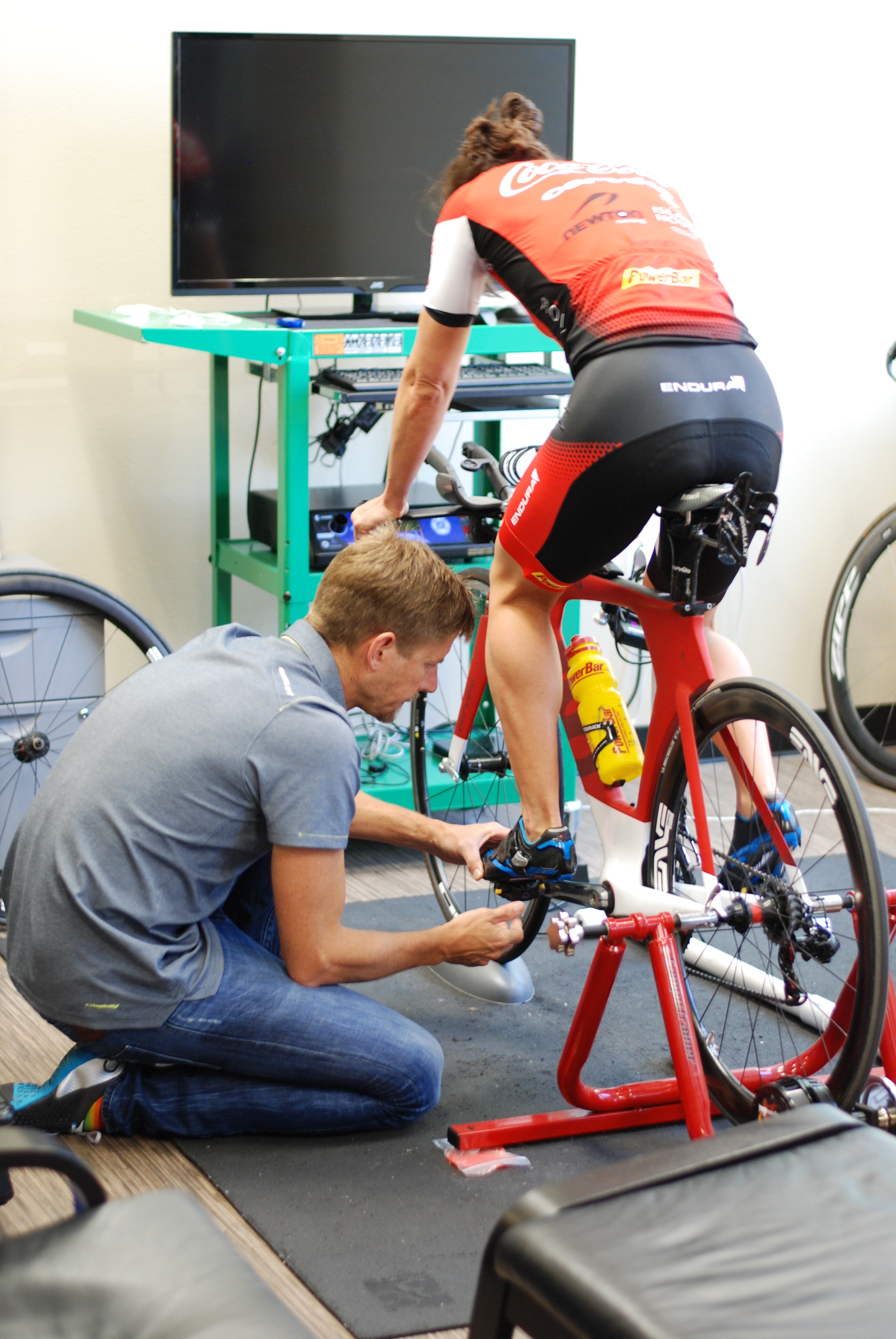
Lawrence performing a bike fit consultation with professional triathlete Rachel Joyce in May. Rachel came for ART with Lawrence after a serious foot injury; just last week she placed second at IRONMAN World Championship.

Lawrence still treats professional athletes these days. He works with the Santa Cruz Syndicate, one of the most well known professional downhill mountain bike racing teams, and endurance athletes travel from far and wide to get treatment from and consult with him.

“The pros who come see me now aren’t usually in pain, they’re just tired of being injured,” Lawrence said. “They want me to free up whatever’s been restricting their movement with ART not necessarily to relieve pain, but to enhance performance. Once you take away that looming fear of getting injured, they’re free to focus solely on how to use their bodies to go quicker.”

However, Lawrence says that ART isn’t just for elite athletes. In fact, you don’t have to be an athlete at all to hop on his schedule and feel the amazing benefits of soft tissue release.

“People underestimate how powerful ART can be,” he said. “Tissue adhesions are a silent bully; often you don’t feel it, but they can significantly influence your posture and patterns. Releasing those adhesions will literally change the way you move.”

Rausch PT physical therapists will often refer their patients to Lawrence if they have restrictions or soft tissue adhesions that need some extra special attention, and thanks to Rausch PT’s holistic care, Lawrence can refer patients back to physical therapy for continual care. Our athletic patients can take advantage of having access to the pros’ “secret weapon” and call in to get on his schedule for performance-enhancement purposes.

No matter who you are, how old you are, or what level of activity you’re at, Lawrence Van Lingen is waiting in that little corner office to help you get some release.

“Having someone like Lawrence on staff just elevates us to a whole other level,” Kevin Rausch, MPT and owner of Rausch Physical Therapy & Sports Performance, said. “To have access to someone with his background and expertise, it’s an incredible opportunity for our amateur triathletes and cyclists.”
Click here to learn more about ART

To schedule your own ART Session with Lawrence, call us at
(949) 276-5401


Understanding Frozen Shoulder and How to Fix It

A question that I commonly hear from patients with shoulder pain (and access to Google) is, “What is frozen shoulder?” The truth is, “frozen shoulder” is a common term that’s thrown around, but few people understand the condition or its causes.

What is “Frozen Shoulder?”

The medical term for frozen shoulder is “Adhesive Capsulitis,” and it effects the joint capsule of the shoulder. Every joint within the body contains a capsule surrounding it to provide structural stability; the shoulder joint is special in that it’s one of the most mobile joints in the body, which consequently requires a great deal of ligamentous (capsule) and muscular support to stabilize it.

Like all tissues within the body, the shoulder capsule will attempt to repair itself if damaged, going through the three phases of tissue regeneration: inflammation (swelling), proliferation (scar-tissue), and remodeling.

However, Adhesive Capsulitis is an abnormal inflammatory response; basically, the shoulder thinks it’s damaged, so it sends an unnecessary amount of new collagen (i.e. scar tissue) to the joint. This transforms the typically-mobile shoulder joint into a thick and adhesive one, which ultimately leads to pain and loss of mobility.

Signs You May Have Frozen Shoulder

While a stiff, painful shoulder could be caused by a number of things, many patients or their doctors will incorrectly diagnose it as frozen shoulder. However, the number one indicator that you truly have a frozen shoulder is if there’s a significant decrease in external rotation, especially compared to your other arm. Some other common symptoms include:

  • Significant decrease in range of motion, especially loss of external rotation (ability to life your arm overhead)
  • Gradual onset of pain lasting at least one month
  • Progressive pain in the shoulder that worsens and is not relieved at rest
  • Pain that interrupts sleep and/or makes it impossible to sleep on affected side

Again, it’s important to note that these symptoms can also be indicative of other shoulder issues, so you should have your physician or physical therapist do an evaluation to find out the true cause to ensure you get the proper treatment.

Causes of Frozen Shoulder

There are currently two categories of Adhesive Capsulitis, Primary Adhesive Capsulitis and Secondary Adhesive Capsulitis. Primary affects between 2% to 5.3% of the general population and has no known cause; it’s only characterized by a subtle and gradual onset that worsen over time and then resolves, usually within one to three years.

Secondary Adhesive Capsulitis is more common, affecting between 4.3% to 38% of the general population. It occurs in people who have incurred trauma or impingement to the shoulder, or who have had to immobilize their shoulder for a long period, such as after surgery or injury. People who have systemic complications, such as Thyroid Disease or Diabetes Mellitus, are also at risk.

While doctors aren’t sure why this happens to some people, it is more common to occur in:

  • People 40 and older, particularly women
  • People who have had a previous episode of Adhesive Capsulitis in the opposite shoulder
  • People who have concurrent systemic complications (i.e. Thyroid Disease, Diabetes Mellitus, Parkinson’s Disease, etc.)


Stages of Frozen Shoulder and Their Symptoms

Due to the naturally-occurring inflammatory condition of Adhesive Capsulitis, it’s important to understand which stage of “Frozen Shoulder” you’re in so you can make sure you get the appropriate treatment.

[one_third]

Stage 1: Freezing

Key indicator is pain with movement and at rest

Usually lasts for three to nine months

Gradual loss of motion in all directions

[/one_third]

[one_third]

Stage 2: Frozen

Characterized by pain with movement

Usually lasts for nine to 15 months

Inflammation of the joint capsule begins to lessen

[/one_third]

[one_third_last]

Stage 3: Thawing

Characterized by resolution of pain with residual stiffness

Usually lasts 15 to 24 months after onset

[/one_third_last]

Top Three Ways to Treat Frozen Shoulder

Depending on which stage you are in, the treatment for Adhesive Capsulitis can vary. Here are three of the most common and effective treatments for regaining a full, pain-free range of motion.

1. Take Anti-Inflammatory Medication

Because of this condition’s correlation with join inflammation, coupled with its gradual progressiveness, inflammatory medication (such as Advil, Motrin IB, etc.) can help relieve pain. For more severe cases, a cortisone injection (a localized injection of an anti-inflammatory medication) is available; consult with your primary care physician or physical therapists about this option.

2. If You’re in Pain: Modify Your Activity

During the painful freezing stage, you should modify the way you move throughout your day to help reduce the amount of irritation and inflammation to the joint. If a certain movement, such as reaching to grab a dish or swinging a tennis racket, causes a significant increase in pain, avoid it.

3. If You’re Just Stiff: Stretch It Out!

Once you’ve progressed into the thawing stage and can lift your arm without pain, then it’s time to start aggressively stretching out that shoulder! Since the shoulder capsule is comprised of dense connective tissue, it requires a prolonged stretch (five to 10 minutes) to create a lasting change in tissue length. As long as you are just feeling tightness/stiffness, NOT pain, then keep stretching. Research has shown that improving external rotation can improve motion in all directions and help get you pain free.

If you’re unsure, come visit us here at Rausch Physical Therapy; we can evaluate your particular and come up with a great home exercise program to get you back to pain-free movement.


StaffHeadshot-Sean2Sean Swopes graduated from CSU Fullerton with a bachelor of science in kinesiology. He went on to receive his doctorate in physical therapy in 2015 from University of St. Augustine, and began his career here at Rausch Physical Therapy and Sports Performance. Sean is also a certified Strength and Conditioning Specialist. As a physical therapist, Sean’s goal is to help his patients understand their musculoskeletal impairments and work together to improve them.
Click to learn more about Sean and our other physical therapists >>


October 21 – Natural Running Clinic


Great for runners and triathletes of all levels

Natural Running Clinics will help you discover the better way to run. Our running experts will give you the information and tools you need to decrease injuries, increase efficiency, and experience more enjoyable running. The clinic will focus on the key principles of posture, position, and cadence.

Group & individual coaching will be provided throughout the clinic with form cues to improve running. Come join us in your running gear and get on the road to better running!

[framedbox][one_third]

When

Wednesday, October 21
6:30 – 8 PM

[/one_third]
[one_third]

Where

RauschPT-Logo-2015

28202 Cabot Rd. Suite 150
Laguna Niguel, CA 92677

[/one_third]
[one_third_last]

Cost

SBRlogo

SBR Team Members
$15 per person

Non-Team Members
$20 per person

[button link=”https://clients.mindbodyonline.com/classic/ws?studioid=18756&stype=-106&sTG=25&sView=day&date=10/21/15″ size=”small” color=”blue” align=”center” target=”_blank” ]SIGN UP NOW[/button]

[/one_third_last][/framedbox]

jack

About the Instructor

Jack McPheron is an IRONMAN, marathoner, and Certified Natural Running Coach. Jack is passionate about helping other athletes discover the better way to run so they can decrease injury, increase efficiency, and enjoy the sport.

Lessons From Hiking Whitney

Mount Whitney is the highest peak in the lower 48  boasting nearly 15,000 feet in elevation, and second only to Mount McKinley in Alaska. Starting from the Whitney Portal, the hike is 10.7 miles to the summit. I recently had the opportunity to hike Mount Whitney, and it was an amazing experience. If you ever get the chance, do it! The beauty of the mountain is unreal, and the physical and mental challenges are unlike anything I have ever experienced.

Here are four tried and true tips for my fellow adventurers who are interested in hiking Mount Whitney:

    1. Get an early start. It’s recommended that hikers reach the summit by noon, so we started at 3 a.m. Early, I know, but I’d suggest the same start time to other hikers; it gives you time for rest breaks, puts you ahead of the crowds (trail congestion increases as the time gets later), helps you avoid bad weather on the summit, and gets you back down the mountain before nightfall.
    1. Bring water. 4-5 liters should be plenty, but water-needs depend on body size and fitness level.
    1. Find the right equipment. Hiking poles: absolute must. Hiking boots? A bit too much; a good pair of trail shoes did the trick for me. Also, I did this hike in July, so while I wore hiking pants, next time I’d just wear running tights. Layers are the key to comfort—tank top, long-sleeve shirt, jacket. Weather conditions vary depending on the time of year, which will effect your footwear and clothing choices. Ultimately, wear what you’re accustomed to hiking in.
      *I suggest doing a few training hikes in the gear you’re planning on wearing; that’s how I discovered the boots I’d planned on wearing were actually a horrible choice and avoided sore toes and blisters.*
  1. Last and most importantly: altitude sickness is REAL. Unfortunately, I wasn’t able to go as far as I wanted to  because I started experiencing symptoms of altitude sickness—a very real and dangerous thing when hiking at high-altitude.

The Deadly Truth About Altitude Sickness

There are two primary forms of altitude sickness: high-altitude pulmonary edema (HAPE) and high-altitude cerebral edema (HACE). HAPE is fluid accumulation in the lungs, while HACE is fluid accumulation in the brain; both can lead to a coma or death.

HAPE causes the obvious symptom of breathlessness (both with exercise and when at rest.) It can be deadly, especially when the breathlessness progresses to include elevated body temperature and coughing. HAPE has a high mortality rate in the absence of adequate emergency treatment.

HACE causes headache, dizziness, confusion and clumsiness. Drowsiness and loss of consciousness are major indications that HACE has reached a deadly level.

Often, these two conditions occur simultaneously, and again, this is very serious. Once symptoms start, they will progressively worsen and eventually lead to a coma or death. Immediate descent is the first course of action. Supplemental oxygen can be helpful in relieving symptoms and will essentially buy time.

How to Prevent Altitude Sickness

A prescription drug for altitude sickness does exist Acetazolamide (brand name Diamox.) The active ingredient is Dexamethasone, which prevents swelling in the brain and subsequently reduces symptoms. It is recommended that Diamox be taken several days prior to being at altitude as the side effects can be equally as bad and as deadly as the altitude sickness itself.

HACE occurs when your body fails to acclimatize while ascending to a high altitude; to prevent this, ascend slowly to allow the body more time to get used to the altitude. On the other hand, HAPE is difficult to prevent, as we don’t really know what makes some people more susceptible to it than others. Those with sleep apnea should be cautious, as should people who have experienced HAPE before.

Acute altitude sickness and all, it was an amazing trip. I would have saved myself the altitude sickness by training on Hypoxico Altitude Simulation System at the Performance Lab, which is something I will definitely do next time because we are already planning on going back.

[framedbox]Additional Links:


StaffHeadshot-Jessica copyJessica Snyder (PT, DPT, ATC, CSCS) received her Doctor of Physical Therapy degree at the University of St Augustine for Health Sciences – with an emphasis on orthopedics, movement science, and manual therapy. Jessica started her career as a Certified Athletic Trainer working with high school, college and professional athletes. She is also a Certified Strength and Conditioning Specialist (enhancing her ability to build custom strength, stability and performance-centered rehabilitation and return-to-sport programs) and Certified Natural Running Coach. Being a runner herself, Jessica specializes in running-related injuries, including the entire lower extremity. She is also passionate about treating headaches and neck/shoulder pain.