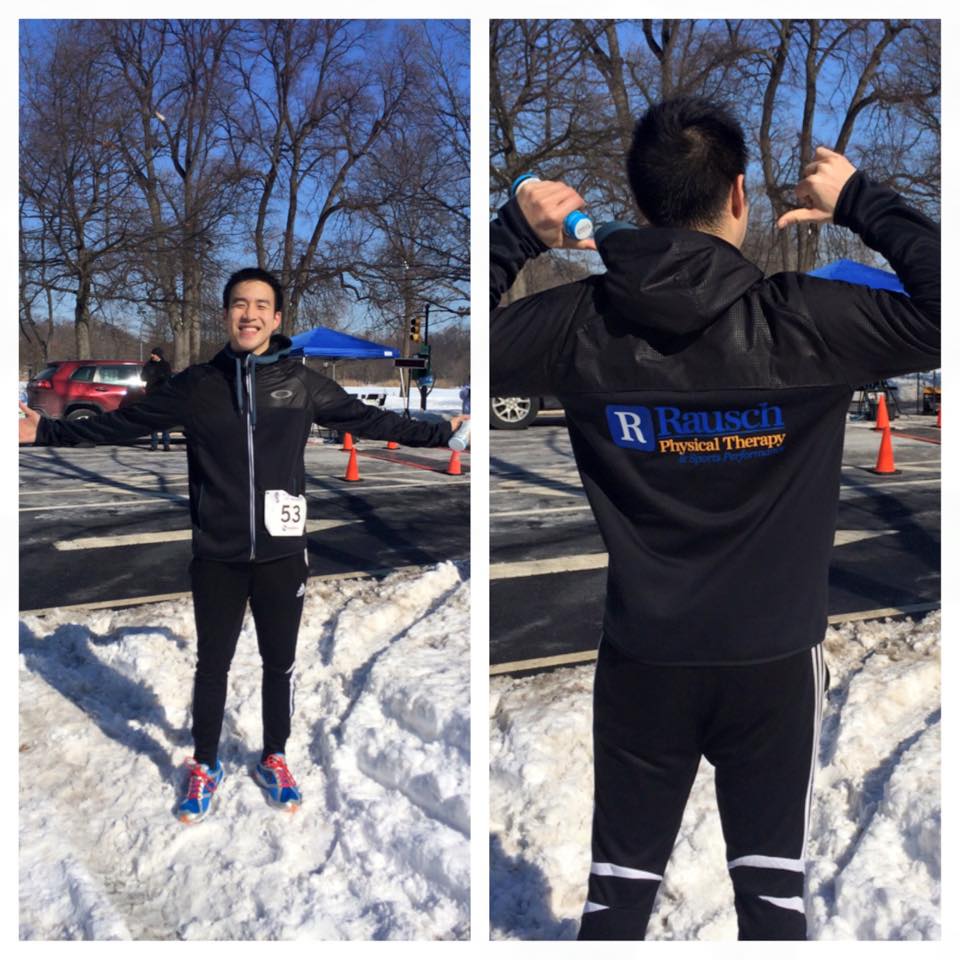
Justin: “Repping proper running mechanics and warmer weather all the way on the East Coast at the NYU Physical Therapy Annual 5k.”
[/one_half][one_half_last]
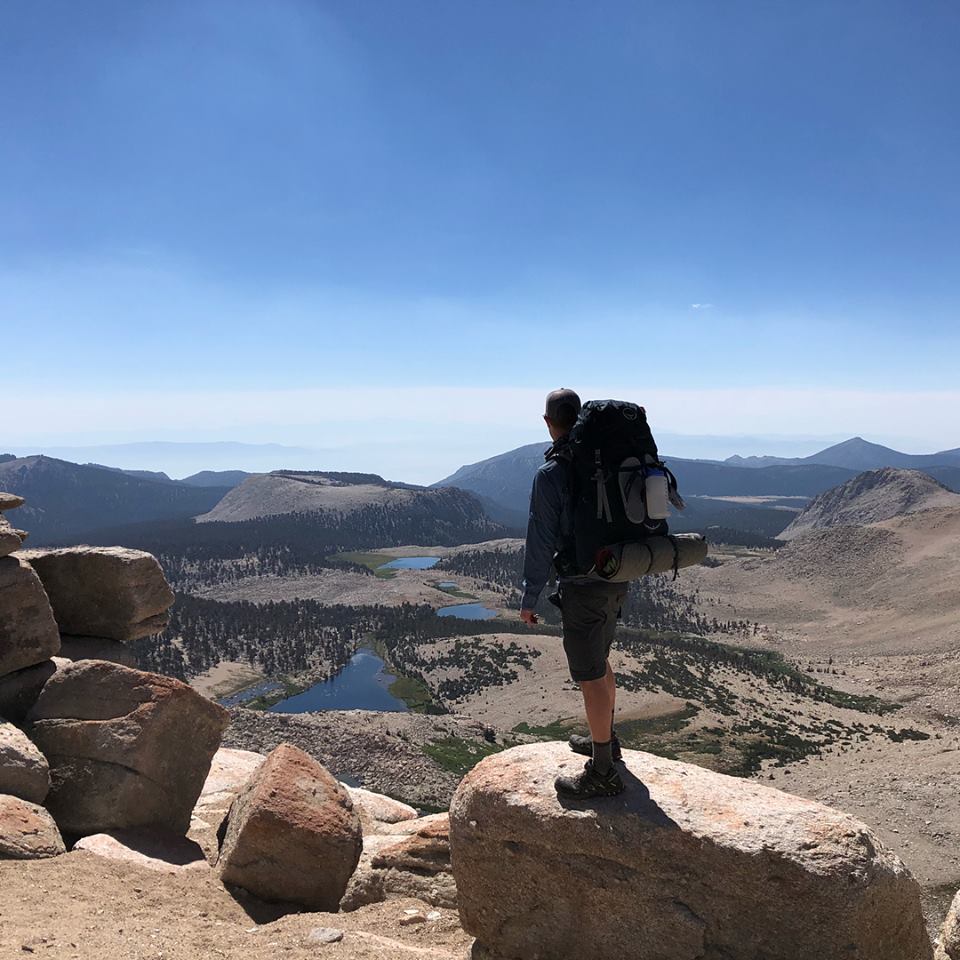
Kevin: “From the top at 11,053 ft to recovery from the surgery table… This team gets it DONE!”
[/one_half_last]
As much as we love seeing our clients in the clinic, nothing brings us more joy than seeing them out and back to doing what they love. Whether your goal is returning to the golf course, racing your first 5k, or trying to qualify for Kona, we’re here to get you there!
Justin: “Repping proper running mechanics and warmer weather all the way on the East Coast at the NYU Physical Therapy Annual 5k.”
[/one_half][one_half_last]
Kevin: “From the top at 11,053 ft to recovery from the surgery table… This team gets it DONE!”
[/one_half_last]
As much as we love seeing our clients in the clinic, nothing brings us more joy than seeing them out and back to doing what they love. Whether your goal is returning to the golf course, racing your first 5k, or trying to qualify for Kona, we’re here to get you there!
As a life-long outdoor enthusiast and doctor of physical therapy, PT Sean Swopes knows how dangerous and difficult high-altitude hiking can be for many people. Sean shares the unique way he prepared his body to battle the elements (and dreaded altitude sickness) while crossing off an item from his bucket list: summiting Mount Whitney.
BY SEAN SWOPES, PT, DPT, CSCS, RAUSCH PHYSICAL THERAPY
On July 16, I sought out to make a journey into the wild with my brother and father. The plan was to spend five days and four nights hiking our way north through the Eastern Sierras. Our experience would peak at the summit of Mount Whitney, reaching an ultimate elevation of 14,508 feet.
Anyone who’s done any amount of physical activity, whether it be hiking or cycling, will tell you that being at altitude changes everything. I’ve seen some of the most aerobically fit people fall apart once they’re at altitude. Having taken many trips to the Sierras throughout my life, I’ve learned this fact the hard way.
The months leading up to the hike, my main concerns were the distance and elevation. My main training modality was casual and competitive mountain biking, and while it did give me a big push for my cardiovascular training, I knew that alone wouldn’t prepare me for the 50+ miles I’d be walking with 50 pounds strapped to my back at 10,000+ feet.
Training Your Body to Adapt to Stress
Fortunately, during this trip, I felt great with no major signs of altitude sickness. I attribute this to not only mountain biking, but competitive mountain biking. The key difference is the extreme of how competition pushes the body to its limits. I hadn’t done any extensive altitude training within the weeks leading up to the trip, however I had taken my body—physically and aerobically—to it limits by racing at the Over the Hump series nearly every week this summer. That’s exactly what I was going to be putting my body through summiting three, 14,000+ feet mountains: Mount Langley, Mount Muir and Mount Whitney.
As a physical therapist, I like this concept of pushing your body to its limits as a training philosophy. I view the body as an instrument with a threshold of tolerance. As people age, their body tends to develop imbalances, weakness and stiffness, which decreases their body’s threshold for biomechanical stress (i.e. running, jumping, climbing, etc.) Consistent competitive racing forced my body to adapt and increased my body’s threshold, which enabled it to withstand more physical and aerobical stressors on my hike.
Still, there was one large unknown variable to conquer: altitude.
At high elevation, less oxygen can be inhaled per breath, which can cause hikers to experience early onset fatigue, or worse, altitude sickness. For most people, this takes effect when they get above 12,000 feet. To ensure my success at altitude, I got to the mountains three days early and went on two training hikes at 9,000-11,000 feet and slept at 8,000 feet; this allowed my body to acclimate.
The Challenge of Summiting Mount Whitney
If you look at Mount Whitney from the city of Lone Pine, just below the mountain range you’ll see two small peaks with a large peak just to the right. At the base of the two smaller peaks you are roughly at an elevation of 13,500 feet with 1,000 feet of elevation to gain over a distance of two miles. This is where most people feel the extreme effects of altitude, including my brother. He was hit with nausea, fatigue and a pounding headache, forcing him to turn around and head back to base camp.
With even more determination now, my father and I continued our ascent. It wasn’t until the last half-mile that he was met with his final challenge. The altitude was taking its effect on him, but luckily he wasn’t experiencing any other symptoms other than extreme fatigue. His body would feel fine at rest, however any physical exertion would drain his energy instantly. It was slow-going that last half-mile while he was forced to take breaks every 10 feet of hiking the variable rocky terrain, but in the end we both prevailed, reaching the summit and our goal destination at 14,508 feet.
The toughest endeavors always make the most memorable experiences. Think of your body as an instrument you are constantly fine tuning. Preparing for those tough, yet memorable life adventures to the top of any “mountain” in your life.
Nothing in the world is worth having or worth doing unless it means effort, pain, difficulty… I have never in my life envied a human being who led an easy life. I have envied a great many people who led difficult lives and led them well.
― Theodore Roosevelt
Sean Swopes, PT, DPT, CSCS graduated from CSU Fullerton with a bachelor of science in kinesiology. He went on to receive his doctorate in physical therapy in 2015 from University of St. Augustine, and began his career here at Rausch Physical Therapy and Sports Performance. Sean is also a certified Strength and Conditioning Specialist. As a physical therapist, Sean’s goal is to help his patients understand their musculoskeletal impairments and work together to improve them.
If we have no problem spending the time or money to take our cars in for a tune-up on a regular basis, why do so many people struggle doing the same for their body? PT Ruth Meltzer explains why putting your body on a maintenance program will benefit you in the long run.
BY RUTH MELTZER, PT, DPT, OCS, RAUSCH PHYSICAL THERAPY
Do you own a car? Do you take it in for regular tune-ups? Even if there aren’t any glaring issues, I bet you do take your vehicle in to the shop every x-amount of miles to get the tires aligned, change the oil, and have an expert take a peek under the hood to ensure everything is running how it should be.
We all know that proper maintenance helps avoid costly breakdowns, long-term mechanical problems, or *gasp* having to go days without a car while it’s getting fixed. So if we have no problem spending the time or money to care for our cars on a regular basis, why do so many people struggle doing it for their body? Do you really value a car more than your health!?
We need to change the way we think about our health and wellness and finally take charge of our bodies. “Wellness” is defined as “the quality or state of being healthy in body and mind, especially as the result of deliberate effort.” We need to deliberately make the choice to get healthy and stay that way. By being your own advocate and putting your body on a maintenance program—just like you do with your car—you can keep your (musculoskeletal) parts oiled, aligned and moving correctly to avoid costly breakdowns (injuries).
Direct Access and #FastPassPT
Let’s say you’ve signed up for a triathlon, but during your second week of training you notice your shoulder bothers you after every swim. However, you’re determined to keep training, so you ignore it for weeks until the pain has become so bad that you finally decide to go see your doctor. You wait weeks to get in to see her, just to have her tell you to schedule a physical therapy appointment. By this time, months of neglect have turned a minor issue into a major injury that will now take more time, money and energy to address.
This is just like an easily avoidable car breakdown. Your check-engine light comes on (first twinge of pain), but you ignore it because of time or money or just plain negligence. You keep trucking along, until that fateful day when you break down on the side of the road (injury). Now you have to wait hours (weeks) for a tow truck (doctor’s appointment) and pay for that. Then you have to pay the mechanic to figure out the problem and fix it (PT)! Your car (body) is out of commission for weeks, and you’re stuck Ubering around (putting your training on hold) thinking how all this could have been easily avoided with better care and maintenance.
It doesn’t have to happen like this! If you live in California or any other state with Direct Access laws, now is the time to take charge of your health and come in to physical therapy for regular tune ups before you get injured or at the first inkling of pain, no doctor prescription necessary.
What Does a Wellness “Tune-Up” Look Like?
At Rausch Physical Therapy, we call tune-ups “Wellness Checkups,” and we recommend one every six months. At your checkup, a doctor of physical therapy will do a quick assessment of your body’s flexibility, strength, control, and movement to identify and address any dysfunctions. You leave with an individualized plan of care and strength and stability exercises to do at home to help prevent any potential issues down the road.
As musculoskeletal experts, physical therapists treat the body as a whole; when you come in with knee pain, we know to look at your hip, pelvis, spine and foot to see how they might be affecting your knee joint. Getting regular tune-ups with your physical therapist will help keep your alignment in check to guarantee all your parts are working like they should be. Of course, if injury does happen, you can come DIRECTLY in to see your PT as soon as you feel it. The longer you wait, the more time your muscles have to create imbalances and cause long term dysfunctions.
I hope this summer you decide to start keeping up the maintenance on your body like you keep up your car. With proper care and upkeep, you can ensure your body is always able to continue doing what you love to do and ready to handle anything life throws your way. Come see me at Rausch PT, and I’ll help you get started on a successful wellness program!
Ruth Meltzer, PT, DPT, OCS is a licensed physical therapist at Rausch Physical Therapy & Sports Performance. She received her Doctorate of Physical Therapy degree at Loma Linda University in 2012 and received her orthopedic specialization in 2015. Ruth enjoys looking at functional movements and tailoring exercises and programs to help her patients as an individual not just a body part.
Just because you’re going to age doesn’t mean you have to be okay with aches, pains and giving up the activities you love! PT Kevin Capata shares how you can stay active and keep doing what you love as you grow older.
BY KEVIN CAPATA, DPT, RAUSCH PHYSICAL THERAPY
Every time I hear, “Don’t ever get old! It’s terrible!” I can’t help but think, “That’s a mindset problem.” Granted, I’m only 28 years old, but I compete in IRONMAN events and I can guarantee that the 75-year-old finisher would agree with me.
The truth is we are all human beings, which means we are ALL going to age, get weaker, have more aches and pains, and just generally slow down. It is hard to accept, but once you do you set yourself up for success to keep doing what you love as you age.
I can’t count the number of times I have heard a patient say their doctor has told them to stop running or doing stair repeats at their favorite beach, but that it is exactly those things that keep them motivated through their day with a smile on their face. In these cases, I say, “Forget what the Doc said! Let’s figure out a way to manage whatever your limiting factor may be so you can keep at it!”
Whatever your age, here are three ways you can manage your aches, pains, dysfunctions or diagnoses better so you can maintain or improve your quality of life for years to come.
#1 – Develop a Movement Practice
To be able to continue enjoying your favorite activities, such as running, surfing, hiking, Yoga, etc., STOP DOING NOTHING when you are not participating in those activities!
It has become all too common to sit on our butts all day long, often behind some sort of screen. Most people sit in front of their computer at work for eight hours, then they go home and sit on their butt to eat dinner, only to then go sit on their butt to watch TV while scrolling mindlessly away on their phone (that’s TWO screens at the same time!) I have now addressed this problem in nearly every article I have written, and the solution comes down to the same two answers every time: effort and good habits.
Start to become aware of how often you maintain one position throughout the day, and change it as often as possible. There are so many easy ways you can do this, such as:
Setting an alarm every 10 minutes at work to get up or just change your position
Taking the cushions off your couch and putting them on the ground to remind you to lay on the floor and stretch or use your foam roller
Requesting a high-top table at your favorite restaurant so you’re not sitting in the exact same type of chair as you did at work all day
They seem so simple, but these small changes can have drastic long-term effects in the way you move and feel. Stay dedicated to your movement practice, and one day YOU can be that badass 80 year old you see every weekend charging up the local trails while smiling ear to ear.
#2 – Go to Sleep!
We all know how important it is for our health and well-being to get enough sleep on a regular basis—so why don’t people do it? It even seems to be a common theme amongst my patients (who are already in pain to begin with) to sacrifice sleep for almost anything and everything else.
It blows my mind that people can view the fact that they only get four to five hours of sleep per night as a sign that they are extra productive or working harder than everyone else. If this sounds like you, read 10 Reasons Why Good Sleep is Important, then try to still justify your lack of sleep as anything positive.
To start making some positive changes towards the quality of sleep you are getting, try these suggestions:
Stop using/looking at electronic devices at least 30 minutes before bed. Yes, it is possible! Instead, read a book, listen to relaxing music while you stretch or foam roll, or even try out that lost art form of talking to your loved ones.
No bright lights at least 30 minutes before bed.
Take the TV out of the bedroom! It does NOT belong in there (for more than one reason…)
Go to bed/wake up around the same time every night/morning. Our bodies adapt to a specific circadian rhythm—use this to your advantage!
Get at least seven hours each night… MINIMUM!
Just as developing a movement practice requires a change in mindset, so does making sure you get adequate sleep. It might be hard when you start off (especially that whole no-phone-before-bed thing) but future-you will thank you.
#3 – Reduce Your Daily Stressors
Let’s say you have had nagging neck pain ever since you strained it while playing a game of pickup basketball with your coworkers, but it has been two weeks, and it seems like it is finally starting to feel better. Then, all in one week, your boss drops three huge deadlines on you, you get a speeding ticket rushing to pick up the kids from school, and, oh yeah, your mother-in-law is in town staying at your house. All of a sudden, your neck pain has come roaring back with a vengeance! You have not done anything from a musculoskeletal perspective to cause an increase in dysfunction or strain, but nevertheless the pain is as worse than ever. Why?
It has been proven that excessive stress can have serious short and long-term effects on both your mental and physical health. Health magazine lists 25 Surprising Ways Stress Affects Your Health and states about 70% of doctor visits and 80% of serious illnesses may be exacerbated or linked to stress.
Just like all human beings age, all human beings stress. Stress can be beneficial, such as when it activates your “fight or flight” response say if for some reason you are getting chased down by a mountain lion on a trail run. However, daily psychological stress can hurt your health. Once again, it is your mindset that can really make a big difference in how you manage and reduce the impact of daily stressors on your life. One of my favorite quotes is by Marcus Aurelius, “You have power over your mind, not outside events. Realize this and you will find strength.”
Here are two quick ways you can rest your mindset to reduce stress on a daily basis:
Start some sort of mindfulness or meditation practice. This can be as easy as setting aside five minutes of your day to find a quiet environment, close your eyes, and take in some full and deep belly breaths.
STOP and check your stress. When feeling overwhelmed, anxious or worried about a task, STOP and ask yourself, “Will stressing about this help me get things done better, quicker, more efficiently or effectively?” If the answer is no, reset your mindset and make a plan to just get it done.
Following my advice above (develop a movement practice and get adequate sleep) will also help reduce stress, all of which will help you remain active and lively til the end!
Conclusion
By following these three simple guidelines, you can get on track towards developing the habits, tools, and mindset necessary to enjoy an active, fun, and healthy lifestyle at every age. Honestly, with the way our nation’s healthcare has been going these days, it is now more important than ever that you take full control of your own health and well-being to ensure you’re not just living, but living well.
If you need help getting started, come in to Rausch Physical Therapy and meet with me or one of our other physical therapists. We are one of the few people whose entire job is to be your wellness coordinator and keep you on track to not only help you get healthy, but stay healthy—for life!
Kevin Capata, PT, DPT, CSCS is a licensed physical therapist at Rausch Physical Therapy & Sports Performance. After receiving his Doctor of Physical Therapy degree at Columbia University, Kevin started his career at Rausch PT, where he used to work as a physical therapy aide. Now, Kevin enjoys helping his patients recognize and fix movement faults to help them overcome their injury or pain, as well as empowering them with the knowledge and tools to prevent re-injury or potential new injuries.
This post has an accompanying article, “This Soft-Tissue Maintenance Routine Will Keep You On Your Bike Longer.” Click here to read it now on the Over the Hump blog.
As mountain bikers, we put our bodies through the ringer. Introducing a soft-tissue mobilization technique like foam rolling can help you avoid limiting aches and pains so you can stay on the bike longer, train harder, and reduce your recovery time.
Recovery and maintenance programs aren’t always convenient, but I personally make it a point to implement them in my training to ensure I get to join the riding group every weekend and race stronger at Over the Hump. The daily grind takes a big toll on our bodies and will cause imbalances, whether it’s from poor posture at your desk, lack of cross training or focusing too much on strength training. This is why it’s critical for all MTB riders to actively pursue some form of mobility maintenance routine to keep their bodies balanced and their seat on the trails.
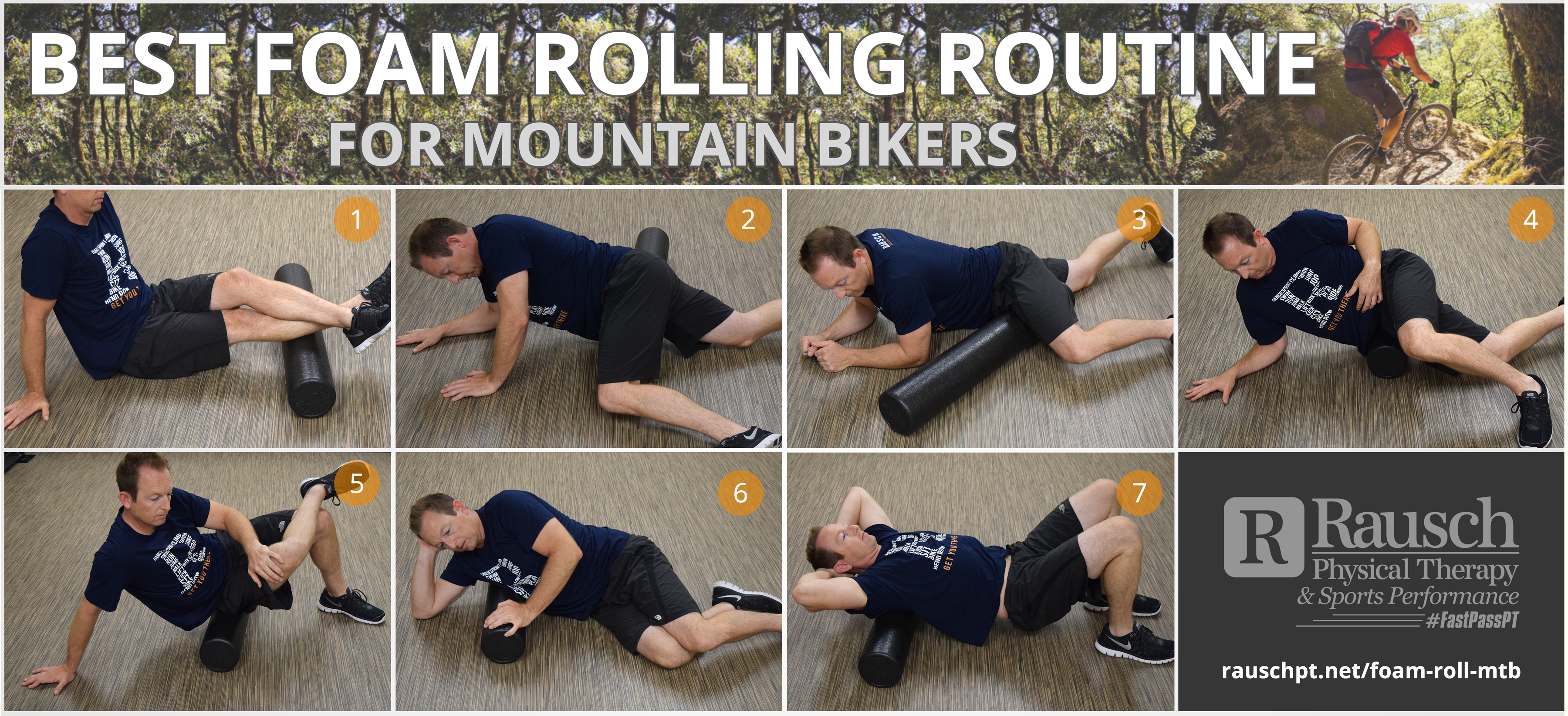
Best Foam Rolling Routines for Mountain Bikers
When you feel sore after you train hard or go for a long ride, it’s because your muscles are literally tearing apart to restructure fiber alignment for greater tolerance to that stress. This microfiber tearing will cause a formation of more cross-links so that you become stronger (Good!) However, if you don’t then work on those specific tissues after training—say, with a foam roller—they’ll become glued down in a mal-aligned direction, and you’ll lose mobility (Bad.)
The foam roller is one of my favorite tools for working out your muscle and tissue on a routine basis; it’s cheap, easy, and you can do it yourself. Ideally, you should spend time working out the tissues that are tight for five to 10 minutes daily, or until you feel about a 50% reduction in pain. After a long ride, you should also spend a little extra time focusing on the areas you worked hard.
Here are the muscles I specifically attack with the foam roller after every mountain bike ride:
Tensor fasciae latae (TFL).Helps work the IT band and hip flexor complex)
Gluteals/piriformis
Latissimus dorsi
Thoracic Spine extension. Great for avoiding the dreaded Rounded Shoulder posture.
* PRO TIP: When foam rolling, focus on going across the tissue fibers (i.e. laterally rather than up and down.) This lateral rolling will emphasis on “going against the grain” and most mimics a manual therapy technique called cross friction. This will restructure the muscle fiber alignment and keeps things sliding-and-gliding freely.
By incorporating the foam roller into your daily routine, you can reduce your risk of injuries, improve recovery time and overall athleticism—best of all, it will help you feel less old! So be specific, be consistent, and respect mobility with cross friction-based foam rolling.
This post has an accompanying article, “This Soft-Tissue Maintenance Routine Will Keep You On Your Bike Longer.” Click here to read it now on the Over the Hump blog.
Dustin Hancock, DPT graduated from San Diego State University with a bachelor’s degree in kinesiology/nutrition. He went on to receive his doctorate in physical therapy in 2011 from University of St. Augustine, and began his career at Rausch Physical Therapy and Sports Performance in 2012. As a snowboarder and mountain bike enthusiast, Dustin specializes in treating extreme sport athletes. As a physical therapist, Dustin says he looks forward to being a companion every step of the way on his patient’s path to recovery.
BY LYNDSAY DEFILIPPO, DPT, RAUSCH PHYSICAL THERAPY
If you have ever undergone physical therapy, chances are that at one time or another you have received a home exercise program (HEP) from your therapist. As a physical therapist, I do my best to stress to my patients how crucial HEPs are to their recovery, but despite my best efforts I’ve found that only a small percentage of patients ever complete their program. And I get it! The whole reason you schedule a PT appointment is so you can focus on your recovery for a solid hour because outside those clinic doors you have a busy life and schedule. Sure you’ll plan to do your HEP after work, or after you put the kids to sleep, or before bed, or you’ll wake up early tomorrow… but slowly it disappears off the “to-do” list. Unfortunately when that happens, your recovery ebbs and flows instead of you making continued progress.
So, stop sabotaging your recovery! Completing your HEP will aid in a quicker, more successful long-term recovery. Once you’ve decided to commit yourself to your health, wellness and recovery, it’s actually very easy to incorporate a program into your daily routine, even with the busiest of schedules and with little to no equipment.
I’ve made a list of the four most common HEP-related complaints I hear on a daily basis, as well as some accompanying tips and tricks on how to stay compliant with your HEP simply by getting creative and making the choice to commit to YOU!
Complaint 1: I don’t have time to perform the program every day.
Solution: Incorporate portions of your program throughout your day.
If you don’t have time to complete all your exercises in one sitting, try spreading them throughout the day instead. Practice your single leg balance, heel raises, toe yoga, arch lifts, etc. while brushing your teeth. While you’re waiting in line for your morning coffee, stuck in traffic, or taking a break from the computer, do your chin tucks, neck stretches, or shoulder squeezes. If you’re a student and are unable to participate in the demands of gym class or sports because of your injury, perform your home program during practice/class time. Finding those little spaces in your day to sneak in an exercise or two will ensure you are keeping up with your program—without jeopardizing your free time.
Complaint 2: There are just so many exercises…
Solution: Ask your PT to prioritize your exercise list.
As you get better and are able to do more, your HEP also progresses and consequently might seem more lengthy than it was in the first few sessions. I find that a huge list of exercises often gives patients anxiety, which is one of the reasons I tend to start my patients off with two to three exercises, then build accordingly. Although the basic fundamentals are always important as they are your building blocks, you can discuss with your therapist the most important exercises for you to complete at your current status and break them up throughout the day.
Complaint 3: How am I supposed to perform the exercises if I don’t have the equipment!?
Solution: Not all exercises require the exact equipment we have at the clinic—get creative!
By substituting in household items, you can still target certain muscle groups and movements and ensure you continue making progress without any clinical equipment. For example:
Clinic Equipment
Household Substitute
STRETCH OUT STRAP
Yoga strap, dog leash, belt from a bathrobe, regular belt, or long beach towel
1 LB. WEIGHT
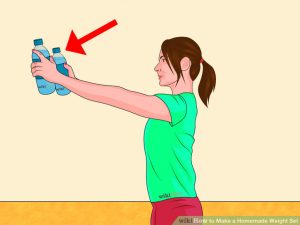
Full water bottle or soup can
CABLE COLUMN
Resistance bands strapped over a door
FOAM MAT
Bath towel folded multiple times or a pillow on a carpeted or secure surface
(Avoid placing on slick surfaces to decrease your chances of slipping!)
CUFF WEIGHT
Insert a soup can or other weighted object in a purse or small bag; hang off your ankle for leg lifts, knee extensions, etc.
SLIDERS
Washcloth or towel on a hardwood floor
CALF SLANT BOARD
Using a yoga strap/leash/belt/towel, perform the calf stretches in sitting position
**IMPORTANT** As with all exercise safety, please ask your therapist if you can substitute equipment, as this blog is only a recommendation and does not apply to all medical cases.
Complaint 4: I’m going on a work trip/vacation, so I won’t be able to do my HEP
Solution: Home exercise programs are designed to be done anywhere.
Most clinics will give you a print out of your home exercise program sheet, or in our clinic’s case, make it accessible online at homeprograms.net. This means that your HEP is accessible anywhere.The substitutions above are also great ways to stick to your program while you’re traveling, as most hotels offer water bottles, bathrobes with belts, towels, etc.
With summer coming up, incorporate and utilize your environment.
If your family lives in the pool all summer… Ask your PT if you would benefit from a water program.
Heading on a tropical vacation? Sand acts as an unstable/uneven surface to promote balance and proprioceptive training.
If your trip requires a long flight… It’s always good to incorporate a program to avoid prolonged sitting and potential for blood clots, such as frequent walking breaks, ankle pumps, heel raises, marching in place, etc.
BONUS QUESTION! BUT, if I were to purchase items, which do you recommend most?
Depending on the injury you are recovering from and the outlined program that your PT has developed for you, a few must have items I would recommend for continued health include:
Foam roller
Lacrosse ball
Stretch out strap
Portable resistance-style bands
At the end of the day, your PT cares about your recovery and s/he would not personally create your individualized home program if s/he didn’t think it would be beneficial. It’s important to also invest in your health and take all aspects of recovery seriously. Like all things, once you make the changes and incorporate your exercises into daily life, it will become routine and therefore easier to adhere to on a daily basis. You will also reap the rewards, and return to the things you love most that have inevitably been altered since your injury.
Lyndsay DeFilippo PT, DPT, CKTP received her Doctorate of Physical Therapy from New York University in 2010. She’s a Graston Practitioner and a Certified Kinesiotaping Practitioner. Lyndsay looks at each injury as a constantly changing puzzle, which is only solved when her patient returns to what s/he loves doing. She enjoys helping with the full recovery process, which includes providing the education, tools and fundamentals to prevent re-injury and the potential for new injuries.
Have you ever felt an annoying or painful pinch in your shoulder when lifting your arm? Shoulder impingement is a common diagnosis that we at Rausch Physical Therapy treat in a surprisingly wide variety of people, from tennis players to swimmers to desk employees. I’ve even treated a businessman who felt a terrible pinch every time he put his luggage in the overhead bins while traveling. Do you present with this painful arch of motion?
What is Shoulder Impingement?
Imagine your shoulder as a ball-and-socket joint, where the ball is the arm and socket is a suction cup within the shoulder. When the arm moves through space, the ball is designed to sit in the suction cup to freely rotate and spin around. Injuries develop and patients will notice a pinch when the ball has migrated too far upward or backward so that it’s now hitting on the shoulder component every time the arm lifts to the 90° range. Once the ball clears the socket, the pain stops because there’s no longer compression at the top of the shoulder, hence the quick “pinch” feeling.
If you take a look at the diagram here, you’ll see:
The rotator cuff muscle
The bursa: a fluid filled cushion sac
The acromion: the top of your shoulder blade
As you can see, these three structures have very little space between them to begin with. The more the ball resides in the superior position, the more these individual structures are going to become damaged. The chronic wear-and-tear on this impingement is similar to rubbing a rope on a rock over and over again; if impingement is left untreated, there could eventually be the development of a rotator cuff strain or even the potential for a full tear.
Who is at Risk for Shoulder Impingement?
For one, if you’re an overhead athlete (baseball, swimming, volleyball, etc.) you are constantly jamming the shoulder joint, which creates further compression of the rotator cuff. Or, if you are like the majority of Americans and sit at a desk for work, your shoulders start to roll forward from sitting in this position five days a week. Without postural correction, over time your body actually changes its alignment to round over, which again decreases the space in your joint and ultimately limits your overhead motion.
Three Stretches to Help Alleviate the Pinch
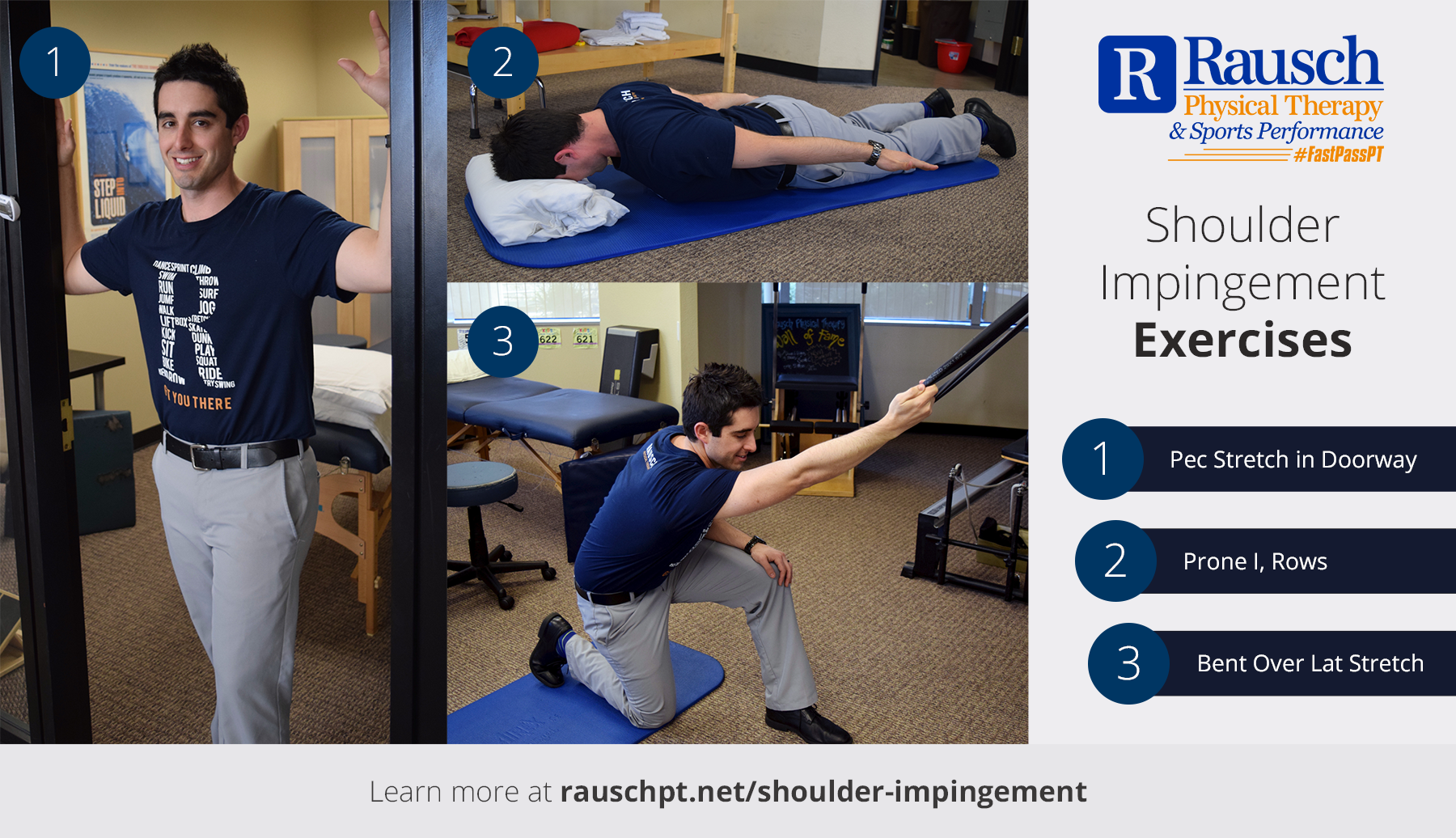
Here are three exercises to help alleviate shoulder impingement and encourage the recruitment of our shoulder blade muscles to improve posture:
Pec Stretch in Doorway: Lean forward in a doorway until stretch is felt (30 seconds x 3)
Prone I, Rows: Laying on a flat surface, squeeze your shoulders blades together, then slightly lift your arms (15 reps x 2)
Bent Over Lat Stretch: Grab band, turn palm up, kneel on opposite knee, then carefully lean back to feel stretch (30 seconds x 3)
In addition to these recommended stretches, you should also make modifications to certain activities that aggravate your shoulder, such as limiting overhead lifting and correcting your sitting posture throughout the day. If the painful arch continues, call us to make an appointment (no, you don’t need a doctor’s referral or Rx!) Our licensed physical therapists at Rausch Physical Therapy will quickly evaluate your specific injury and help alleviate pain and recommend additional exercises to help you finally find relief from chronic shoulder pain.
Jonathan Meltzer graduated from the University of Redlands with a bachelor of arts in biology and a minor in physical education. Following graduation, Jonathan discovered his passion for physical therapy while working as a Physical Therapy Aide. After graduating top of his class from Loma Linda University in 2012 with a Doctorate in Physical Therapy, Jonathan began his career at Rausch Physical Therapy and Sports Performance. Jonathan’s goals are to identify limitations and treat his patients with the most recent and innovative techniques in order to maximize functional independence and obtain his patients’ individual goals.
BY LYNDSAY DEFILIPPO, DPT, RAUSCH PHYSICAL THERAPY
We have officially reached February! Are you still keeping up with that New Year’s Resolution to get back to the gym and get in shape in 2016? Hopefully you’re all answering with a resounding, “YES,” because healthy is where it’s at! For those of you who may have already broken your resolution, that’s okay, too! We still have quite a bit of 2016 left. Whether you’re looking to exercise more to get the body you want or to get back to your glory days of sporting, there are a few important notes to remember when kick starting a new workout regimen.
The beginning of the year is always a busy time for physical therapy clinics, not only because everyone starts fresh with their insurance, but also because so many people have a fierce new motivator (in the form of New Year Resolutions.) You probably notice how much more packed your gym, sports club, or Pilates class is with hopeful people looking to shed those extra holiday pounds, and with greater numbers of people exercising comes more injuries, and more patients for us! While we love our patients, we’d rather see you on the table for “pre-hab” not rehab, so here are a few tips for avoiding any New Year Resolution injuries.
7 Tips When Starting a New Exercise Regimen
1. Start slow, and don’t expect to begin where you left off.
Often we find that patients overdo it in the first few weeks of their program causing increased injury to the tissues. Some people write it off as “out of shape” pain, when in fact it could be a greater underlying issue. While it’s tempting to hit the ground sprinting on Day 1, don’t burn out your body or motivation! Take it slow that first month and allow your body to get used to working out again.
2. Have your form assessed by a professional.
Form evaluation is necessary for everything from running, lifting, swimming, throwing, etc. If you don’t have the necessary mobility, flexibility or stability, you can damage your body from the repetitive motions that cause stress on your joints, muscles and tendons. Having a professional evaluation by a sports performance expert will pay off in the long run by not only keeping you injury-free, but also by helping to improve your performance. We’re lucky to have running, biking and throwing analyses here at Rausch PT, but we can also assist with form in other areas as well.
3. Don’t compete with other people.
Your workout plan should cater to your body and your current abilities. A competitive drive is deep-seated in most of us, but when it comes to an advanced yoga pose and you are in your first ever class, swallow your pride and sit that one out. Start from the basics, ask for help and modifications, and I promise your body will thank you later.
4. Know your limits.
It’s okay to push your body to reach new levels, but you should always proceed within reason. Don’t ignore the signs where your body may be telling you to slow down, such as fatigue, excessive thirst, loss of motivation, long duration aches, pains, cramping, and even sleep disturbances and immune system crashes. There are also more serious side effects of overtraining which may require immediate medical assistance. You can read more about overtraining symptoms here.
5. Allow your body to recover.
This includes rest days, stretching and foam rolling before and after every workout, doing a nice dynamic warmup prior to exercise, staying hydrated, getting a good night’s sleep, and scheduling a therapeutic massage at least once a month. Your muscles and body are working hard for you, show them a little TLC!
6. Remember: Health starts in the kitchen.
I can’t stress enough how important it is to maintain a healthy diet that’s specific to your body. Avoid fad diets if you can and think long-term meal planning and healthy eating. Remember, you want this newfound routine of health to be for life! Also, don’t be afraid to seek help from a nutritionist who can craft a meal plan to match your lifestyle and your goals.
7. Switch it up and HAVE FUN!
If you find yourself getting bored with your exercise routine, change it up. If you’re a runner, try an upper-body-focused Pilates workout, or if you’re a swimmer, go for a bike ride. Cross-training will not only keep you entertained and your body guessing, it will also help you to avoid repetitive movements that can injure muscles.
If an injury should occur when getting back into an exercise routine, don’t wait for it to go away on its own or push through the pain. Make an appointment with your physical therapist; we here at Rausch Physical Therapy can quickly evaluate your injury and get you back on track toward your wellness goals.
Lyndsay DeFilippo PT, DPT, CKTP received her Doctorate of Physical Therapy from New York University in 2010. She’s a Graston Practitioner and a Certified Kinesiotaping Practitioner. Lyndsay looks at each injury as a constantly changing puzzle, which is only solved when her patient returns to what s/he loves doing. She enjoys helping with the full recovery process, which includes providing the education, tools and fundamentals to prevent re-injury and the potential for new injuries.
Mount Whitney is the highest peak in the lower 48 boasting nearly 15,000 feet in elevation, and second only to Mount McKinley in Alaska. Starting from the Whitney Portal, the hike is 10.7 miles to the summit. I recently had the opportunity to hike Mount Whitney, and it was an amazing experience. If you ever get the chance, do it! The beauty of the mountain is unreal, and the physical and mental challenges are unlike anything I have ever experienced.
Here are four tried and true tips for my fellow adventurers who are interested in hiking Mount Whitney:
Get an early start. It’s recommended that hikers reach the summit by noon, so we started at 3 a.m. Early, I know, but I’d suggest the same start time to other hikers; it gives you time for rest breaks, puts you ahead of the crowds (trail congestion increases as the time gets later), helps you avoid bad weather on the summit, and gets you back down the mountain before nightfall.
Bring water. 4-5 liters should be plenty, but water-needs depend on body size and fitness level.
Find the right equipment. Hiking poles: absolute must. Hiking boots? A bit too much; a good pair of trail shoes did the trick for me. Also, I did this hike in July, so while I wore hiking pants, next time I’d just wear running tights. Layers are the key to comfort—tank top, long-sleeve shirt, jacket. Weather conditions vary depending on the time of year, which will effect your footwear and clothing choices. Ultimately, wear what you’re accustomed to hiking in. *I suggest doing a few training hikes in the gear you’re planning on wearing; that’s how I discovered the boots I’d planned on wearing were actually a horrible choice and avoided sore toes and blisters.*
Last and most importantly: altitude sickness is REAL. Unfortunately, I wasn’t able to go as far as I wanted to because I started experiencing symptoms of altitude sickness—a very real and dangerous thing when hiking at high-altitude.
The Deadly Truth About Altitude Sickness
There are two primary forms of altitude sickness: high-altitude pulmonary edema (HAPE) and high-altitude cerebral edema (HACE). HAPE is fluid accumulation in the lungs, while HACE is fluid accumulation in the brain; both can lead to a coma or death.
HAPE causes the obvious symptom of breathlessness (both with exercise and when at rest.) It can be deadly, especially when the breathlessness progresses to include elevated body temperature and coughing. HAPE has a high mortality rate in the absence of adequate emergency treatment.
HACE causes headache, dizziness, confusion and clumsiness. Drowsiness and loss of consciousness are major indications that HACE has reached a deadly level.
Often, these two conditions occur simultaneously, and again, this is very serious. Once symptoms start, they will progressively worsen and eventually lead to a coma or death. Immediate descent is the first course of action. Supplemental oxygen can be helpful in relieving symptoms and will essentially buy time.
How to Prevent Altitude Sickness
A prescription drug for altitude sickness does exist Acetazolamide (brand name Diamox.) The active ingredient is Dexamethasone, which prevents swelling in the brain and subsequently reduces symptoms. It is recommended that Diamox be taken several days prior to being at altitude as the side effects can be equally as bad and as deadly as the altitude sickness itself.
HACE occurs when your body fails to acclimatize while ascending to a high altitude; to prevent this, ascend slowly to allow the body more time to get used to the altitude. On the other hand, HAPE is difficult to prevent, as we don’t really know what makes some people more susceptible to it than others. Those with sleep apnea should be cautious, as should people who have experienced HAPE before.
Acute altitude sickness and all, it was an amazing trip. I would have saved myself the altitude sickness by training on Hypoxico Altitude Simulation System at the Performance Lab, which is something I will definitely do next time because we are already planning on going back.
Jessica Snyder (PT, DPT, ATC, CSCS) received her Doctor of Physical Therapy degree at the University of St Augustine for Health Sciences – with an emphasis on orthopedics, movement science, and manual therapy. Jessica started her career as a Certified Athletic Trainer working with high school, college and professional athletes. She is also a Certified Strength and Conditioning Specialist (enhancing her ability to build custom strength, stability and performance-centered rehabilitation and return-to-sport programs) and Certified Natural Running Coach. Being a runner herself, Jessica specializes in running-related injuries, including the entire lower extremity. She is also passionate about treating headaches and neck/shoulder pain.
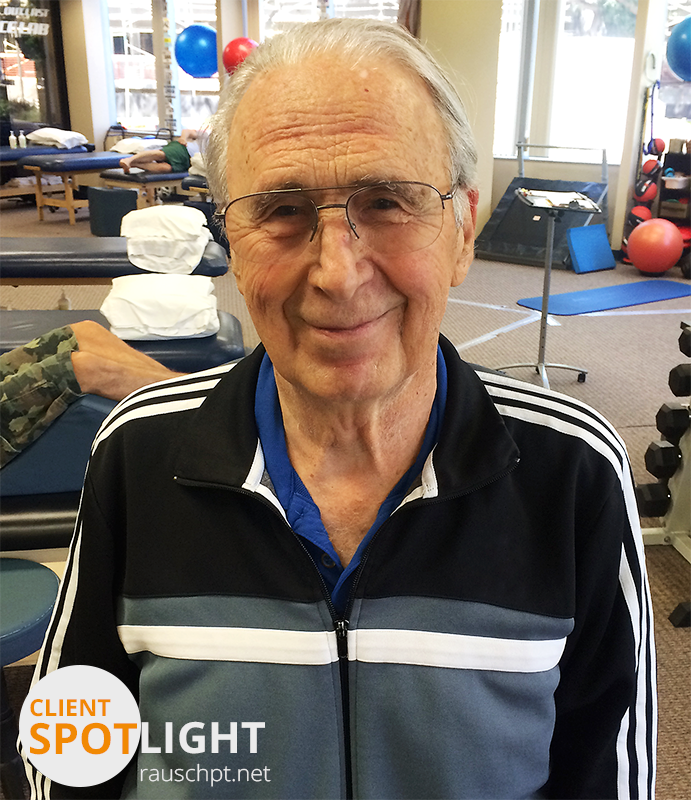
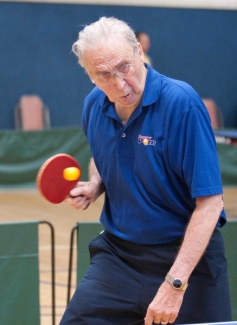
83-year-old Ken Dewhirst is at Rausch PT to strengthen his knee so he can dethrone the current U.S. Table Tennis Champion.
Rausch Physical Therapy & Sports Performance client Ken Dewhirst is gearing up for the comeback of his life. But to be the best, he needs to feel his best first.
“I need to be faster, stronger to be number one.” – Ken Dewhirst
Ken Dewhirst wants you to know that he can get around just fine, thank you very much. At 83 years old, Ken’s here at physical therapy for one reason only: so he can be number one.
Laguna Niguel-resident Ken is currently ranked in the Top 20 in the USA Table Tennis (USATT) Ratings for Men 80+. Ken was rated number four in the country but was sidelined by injury last year. However, Ken has recently made moves to start his climb back to the top, and his first stop? Rausch PT.
“I’m here because I want to up my level and get better so I can be the best in my age group,” Ken said. “I need to be faster, stronger to be number one.”
Ken grew up playing tennis, excelling in high school but eventually gave it up to focus on his college education. He and Rosemarie, his wife of 57 years, spent their days working, raising their children, and traveling the world. But when Ken retired at the age of 60, he knew he had to find something new to keep his mind and body active.
After doing a little research, Ken came across table tennis. He decided to give it a shot… and ranked in his very first tournament. Ever since then, Ken has been working with famous coaches and beating opponents half his age, all the while moving up the ranks.
Ken Dewhirst in 2009 moving at the speed of players half his age. (WAYNE MAH, FOR THE OC REGISTER.)
“His goal was to reach the middle of the rankings of all age groups,” biggest fan/critic Rosemarie said. “Well, he did that. So now we need a new goal.”
So what’s next on the list for this octogenarian? Dethrone the new kid on the block. At a spry 80 years old, George Braithwaite recently moved into the 80+ group, which has Ken chomping at the bit for a chance to prove himself. Ken says that while George plays at a higher level than him, he has to try.
“[George] is good. I’ll need to play a faster game against him.”
To get there, Ken knows he has to strengthen his knee to have any chance of beating the champ. He’s only visited Rausch Physical Therapy & Sports Performance a couple times so far, but he says he’s confident that his physical therapist Dustin is going to get him off the table so he can get back to the tables.
If you are an athlete, odds are you have at one time or another been sidelined by an injury. The frustration that comes with being unable to train and compete can lead to a loss in motivation and a longer recovery process. To combat this, athletes should learn to use visual relaxation and performance techniques and practice them diligently.
There are many forms of relaxation training that athletes can use to help accelerate rehabilitation after injury, including kinesthetic (progressive muscle relaxation), mindfulness (breathing techniques), auditory (listening to calming voices), hypno-relaxation (using hypnosis to induce relaxation, and visual methods (including imagery).
Visual relaxation methods to speed up recovery
Remembered imagery. Remember a pleasant and relaxing time in your life. Re-experience it. Become fully absorbed, focusing on what you see, smell, hear and feel against your skin as you visualize that calming scene.
Constructed imagery. Imagine a pleasant or relaxing scene in your mind. Step into the picture and experience the scene fully.
Hypnotherapy using imagery. Make up a recording or listen to one by a professional hypnotherapist, that includes visualizing healing red blood cells surrounding the injured muscle, tendon, bone, etc. with nutrients, directed at rapid reduction of inflammation and total healing.
Injured athletes should experiment with all available relaxation methods to find the ones that are most comfortable and beneficial. A combination of methods can be used; it’s up to athletes to decide which ones are best suited for them. Once the athlete has become comfortable with a specific technique, it then must be practiced for maximum results.
Three steps to visualize sport performance while injured
If you’re injured, you can still visualize championship-level performance and begin to lay hypnotic tracks in your subconscious mind that will carry over once you’re physically able to perform. Here are some easy steps for visual performance training while you’re still injured:
Watch videos of yourself performing, especially ones highlighting best previous performances. If a personal highlight reel isn’t available, watch training videos of other great athletes in action.
Close your eyes and imagine your ideal performance. Really get a good sense of what you look like and feel like when you perform.
Practice this imagery using the actual time sequence of your average performance. For example, if you’re a track athlete, “run a race” on a stationary bike. If the race is for 400 meters, “race” on a bike for 50 seconds and at the same time visualize your performance.
You may feel a little silly at first, but trust me, this works.
Staying motivated during rehabilitation
After being injured, athletes can lose a sense of identity and become depressed from not being able to compete. That’s why constant feedback and support from coaches and teammates is so crucial to helping an injured athlete stay motivated. Coaches should encourage injured players to make appearances at practices, and athletes need to be proactive about remaining involved in the team and its progress. Coaches can assign certain duties at practice, involve them in strategy sessions, or let them assist in keeping stats. If an athlete has an upper body injury, they can jump on an exercise bike at practice sites to both maintain endurance and still be a part of the team.
If you stay motivated, practice your visual relaxation and performance techniques, and keep up with your physical therapy treatment, you will be ready to physically compete again before you know it.
Jack N. Singer, Ph.D. is a licensed and certified Clinical/Sport Psychologist and Performance Success Coach, based in Mission Viejo, CA.For more information and a FREE 15 minute consultation for all Rausch PT clients and family, contact Jack at 949-481-5660. www.drjacksinger.com








 Kevin Capata, PT, DPT, CSCS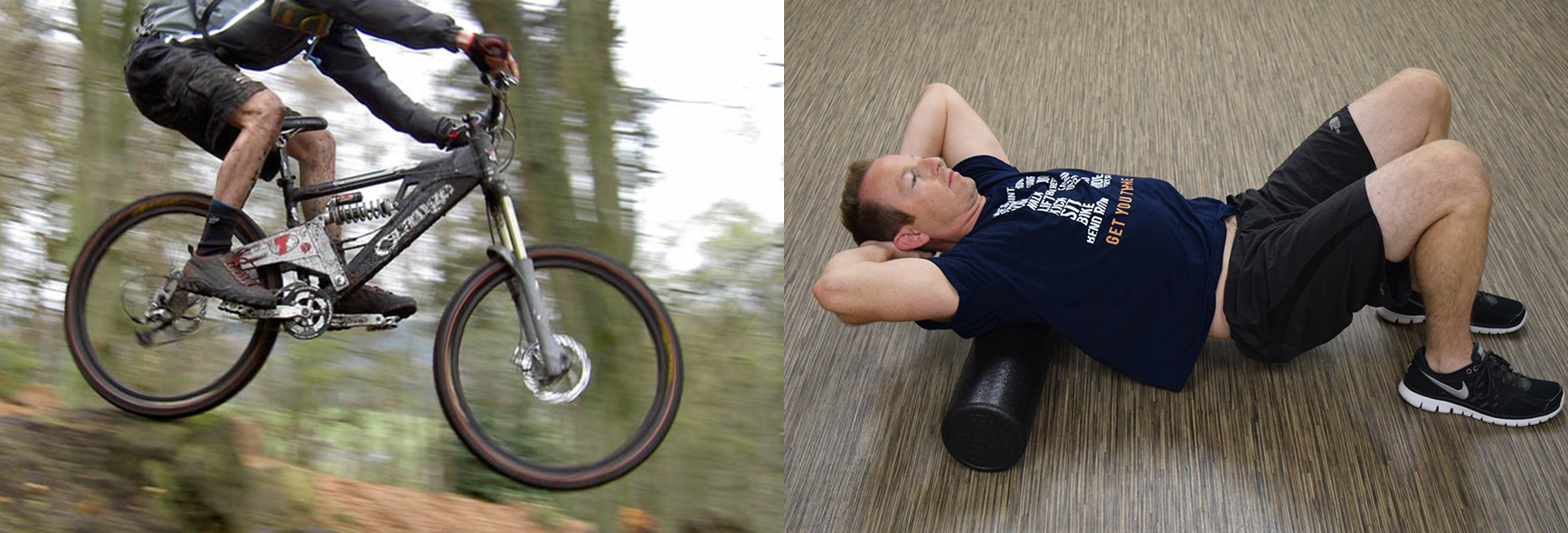

 Dustin Hancock, DPT graduated from San Diego State University with a bachelor’s degree in kinesiology/nutrition. He went on to receive his doctorate in physical therapy in 2011 from University of St. Augustine, and began his career at