Blog

How To Increase Your Stamina For Running

Running is an activity that unites people of all age groups across the world. However, some might find it hard to get started or improve. That’s why knowing how to develop running stamina becomes essential. Read more about some heartily followed Golden Rules on how to increase your running performance. Also, a good physical therapist will provide you the tools and resources to build resilience and physical capacity for your exercising routine. That’s us! Come see us to avoid injury, recover, or enhance your performance.

Exercise keeps you healthy in mind and body. Engaging in any kind of sport, whether it is swimming, running, basketball or football, requires stamina. Running is an activity, which unites people of all age groups across the world. Therefore, knowing how to develop running stamina becomes of the essence.

Exercise keeps you healthy in mind and body. Engaging in any kind of sport, whether it is swimming, running, basketball or football, requires stamina. Running is an activity, which unites people of all age groups across the world. Therefore, knowing how to develop running stamina becomes of the essence.

Running stamina is a word that is universally used to express your body’s capacity to sustain effort or to cover huge distances at a fast pace. Running is a sport that encourages us to challenge ourselves each day and improve from being a novice to an experienced and skilled runner. You are at the perfect destination if you’re looking to find some tricks and tips about improving your running stamina. Read our blog to learn how to run more miles, faster, with the same effort.

Table of Contents

  1. How to Increase your Stamina for Running – In general
  2. How to Increase Running Stamina – For Beginners
  3. How to Increase Running Stamina – For Speed
  4. How to Increase Running Stamina – On a Treadmill
  5. Other Running Tips and Techniques
  6. FAQs

1. How to Increase your Stamina for Running – In general

Follow the following golden rules to increase your general stamina for running:

  • Slow and steady wins the race: Patience is key when it comes to improving your running stamina and time. Set small milestones for yourself. For instance, if you run a mile every day, increase it by 10% the following week. An incremental increase will help you avoid injury and will increase your lung capacity.
  • Be consistent: Consistency is an integral part of any sport. Develop a running schedule and keep up with it. You can also include other exercise regimens if you want.
  • Walk, walk and walk: Walking significantly improves running stamina and builds endurance. You should include walking in your daily routine, as it is a stepping-stone to improved running stamina.
  • Interval RunsMany health experts suggest interval runs which increase efficiency and aid you in covering long distances without being bummed out. All you need to do is alternate between walking and running or between slow and fast running. It is that simple!

2. How to Increase Running Stamina – For Beginners

As a beginner, there are certain things that you should always keep in your mind. Eventually, they will become a habit for you. Begin improving your posture, muscle strength and balance.

  • Gradually increase mileageYou should work towards eventually improving mileage as it ensures improved stamina and also reduces the risk of injuries.
  • Eat healthy: Running requires an ample amount of calories. A balanced diet of vitamins, minerals and proteins is essential for you. Avoid junk foods and packed foods with preservatives.
  • Warm-up: Warming-up is not an option. Exercises like spot jumping and body rotations are a necessity as they help avoid injury.

3. How to Increase Running Stamina – For Speed

You can increase your running speed and endurance through the following ways:

  • Ensure speed in long runs:  Experts suggest that fatigue is a given at the end of your running sessions. So, try to defeat it by maintaining your pace even in the last few minutes of your workout.
  • SprintsSprint intervals facilitate endurance and speed in runners. This training is quite intense and is recommended for trained runners.
  • Strength and drill Training:  Strength training strengthens your leg muscles and prepares them for injury-free running. Drill training like acceleration strides boost your running speed and improve coordination.

4. How to Increase Running Stamina – on Trademill

Follow the suggestions mentioned below to improve your treadmill running stamina:

  • Stay hydrated While working out on a treadmill, the cooling effect on your body is less as compared to when you are outdoors. Therefore, staying hydrated before and after your running sessions is crucial.
  • Incline: Running on the treadmill requires a particular posture and style. Inclining your body to a specific degree can increase your stamina on the treadmill. Certain experts suggest an incline of 0.5 to 1%.
  • LIT and HIT: Health experts suggest a healthy combination of low and high-intensity training to burn extra calories and improve your stamina. HIT is exhausting but very productive. These training routines transform your body and improve your endurance. Try them out today!

5. Other Running Tips and Techniques

These bonus tips for increasing your running speed, stamina and endurance can make your life easier

  • You can always mix it up! Go out for running on alternate days of the week or combine your running sessions with other workouts.
  • Ensure that your running shoes haven’t lost their grip as that can lead to serious injuries. It is better to be safe than sorry!
  • Your mental strength plays as much a role in your health as physical exercise. If you hit a plateau, don’t lose faith in yourself. Your optimism and mental strategy can help you overcome any snag. Be patient and continue training.
  • Listening to music while running can be a great source of enthusiasm and resilience. Run to the rhythm and beats of the song to exercise longer and better!
  • Stamping your feet on the ground while running can cause a lot of pain. Try to land softly, on your heels. Being comfortable while exercising is very important.

6. Frequently Asked Questions (FAQs)

  • How can I increase my lung capacity for running?

First and foremost, start slow. Remember that running naturally deprives the body of oxygen. If you’re a beginner, it is normal to feel breathless. The greater is your lung capacity, the more oxygen they can hold. Therefore, it is imperative to improve your lung capacity to build stamina. There are a plethora of breathing exercises, which can increase the endurance and capacity of your lungs. Try them out today! Also, make sure that you use both your nose and your mouth to breathe. The more air in your lungs, the more is your stamina.

  • What should I do before running?

Stretching your body and warming up is extremely important before running. Giving yourself a head start improves your stamina and endurance. Some common warm-up exercises include single-leg squatting, walking hip stretch, lizard and walking lunge. Warming up activates the systems of the body, increases alertness and loosens the muscles so that the chances of injuries are less. Even simple warm-up sessions with exercises like spot jumping are essential. No matter what sport you engage in, always remember to warm up first. Keep this in mind and all is golden!

  • What is a good running technique?

A good running technique is clean, saves energy, increases endurance and speed, and reduces the risks of an injury. An important component of your running technique is your posture. Make sure that your upper body is straight, your eyes look ahead and your shoulders are relaxed.

You also need to ensure that you have a strong core. Incorporate core-strengthening exercises in your routine to train your core and provide stability to your body. Finally, indulge in ABC drills. These are exercises that improve your coordination. For instance, a straight-leg run involves keeping your body straight, pointing toes upwards and swinging your arms next to your body.

Whether you are a beginner or an expert, the running techniques and tips that we discussed can positively impact your running stamina. If you’re running on a treadmill or in the park, technique always comes into play.
Without the right technique, you might be simply wasting your time exercising without any concrete results. At times, it’s better to work smarter than work harder.

We want to remind you that any kind of workout that you engage in takes time to give results.
Improvement is not a magic wand that will go swish! And boom! You’ve lost 10 pounds. It doesn’t work like that. Be resilient and consistent with your running schedule. Once you are ready to put your heart and soul into the activity, the above-mentioned tips and techniques will guide you along the way to becoming a running maestro! Run smarter, better, longer and faster!

Whether you are a 5k beginner or a competitive marathoner, it’s important to keep in mind all the ways to avoid injuries. Our team can teach you more about how your running can benefit from physical therapy. Schedule an appointment at (949) 276-5401 or contact us on our Facebook page. 

Don’t forget, we have a Tuesday Night Run (TNR) group full of AWESOME people — all levels of runners! We meet at 6 PM (Rausch Physical Therapy – 30100 Town Center Dr #Y/Z, Laguna Niguel, CA 92677) and have a great time! Learn more on our Facebook page.


Reference: [https://blog.decathlon.in/articles/how-to-increase-your-stamina-for-running#article-body]


4 ways you make running harder than it should be and how to fix them

We are always looking for ways to get faster while running, but instead of looking at the things to make you faster, let’s focus on the things that are slowing you down — and work to minimize their effects. 

Sitting too much:

We spend a lot of time sitting: sitting in the car, sitting at work, sitting at school, and sitting in front of the TV. The list goes on and on. Sitting may be comfortable and a useful low energy position, but it can be killing your running ability. By sitting on your glutes, you are deactivating the most powerful and important muscle for running. You are putting your hip flexors in a shortened position which will reduce your ability to extend your hips, another key part of running. 

The Fix:

Get up and move!! This is one of the easiest ways to combat too much sitting. Get up and move around every 20 min or so, add some deep squats, lunge anything to get you out of that seated position for a litte. This is where a sit-to-stand desk can come in handy, allowing you to spend time in alternate positions. Also, shoot for a minimum of 5000 steps a day. These can add up quickly: Just walk to places you would otherwise drive to, park a little farther away or go for a short walk during your lunch break. 

Slumping while sitting:

As if sitting by itself wasn’t bad enough, we tend to sit in a slumped posture with our heads jutted forward to try and be closer to the computer screen or looking down at a desk all day. This will make everything mentioned above worse, plus it affects your upper body posture. Your head will move forward, which will place more strain on your lower back as you try to hold your “bowling ball” with outstretched arms instead of close and stacked over your pelvis. Your shoulders are rounded which will reduce your ability to complete a natural arm swing motion while both running and walking.

The Fix:

Again, getting up and moving around is the most important fix. No posture is truly bad, the only bad part is how long you stay in any given posture. Check the ergonomics of your desk, and make sure you bring your computer screen towards your face — not your face towards the screen. Stretch your pecs in the doorway or while lying on a foam roll to balance out the rounded posture. 

Bad footwear:

Many people spend a lot of time discussing the importance of X or Y type of running shoes and why each one is special or “faster”. But no one really puts much focus on the shoes they wear most of the day. You can wreak havoc on your feet by wearing hard, stiff, lifted heel shoes all day that stiffen up and weaken your feet’s joints and muscles, making it hard for your feet to complete their job as your initial contact to the ground while running. 

The Fix:

Try and get shoes with thin and flexible soles that allow your feet to move freely on the ground and adjust to variances in terrain and make the muscles of your feet work. Even better: Try to fit in some barefoot time every day. You can add a little bit of barefoot running in grass or sand to the end of your runs to help your feet remain strong and flexible, allowing you to run better. 

You just run to run: 

Running is a great way to exercise and improve your overall fitness, but there are many things outside of running you can and should do to prepare yourself to run further, better and faster. Ideally, you get into running with some level of fitness behind you or you build your way slowly and with the proper progressions. Instead, you run the same speed, distance, and/or route over and over. 

The Fix:

Get your running form looked at by a professional to optimize your stride and become more aware of how you’re running. It’s also to mix up the distances and paces at which you run to create varying stresses that your body must adapt to in order to make you a stronger and more resilient runner. There are also plenty of great strengthening and alternative aerobic training activities that can greatly improve your running. 

Also, remember that physical therapy can also be a preventative approach! A licensed physical therapist can help evaluate and assess you for any mobility restrictions or muscular imbalances and recommend a proper program!


Clay Simons

clay@rauschpt.net

Did you know there’s no prescription needed from a doctor to see us – but we will communicate your progress and treatment to your doctor if you’d like us to!  (949) 276-5401

Disclaimer — All the information that you find on our blogs and social media pages is for informational purposes only and is not intended to be used as your personal professional diagnosis, or treatment. Come and see us for your excellent, personalized care! RauschPT.net

9 Running Dos and Don’ts During the COVID-19 Pandemic

Here at Rausch PT, we hope you are doing well and know how hard it may seem to stay in shape at the moment.

Between working from home and barely leaving the house, the current COVID-19 pandemic sure has uprooted the daily lives of many runners. Although most large races that were set to take place this spring have been postponed or canceled, many runners are still eager and willing to get outside for their daily workouts, especially if it’s the only time they go outside all day. While health officials enforcing the current guidelines have deemed exercising outdoors safe, there are certain precautions you should take to keep yourself and others safe.

Do run by yourself. Aside from weekend long runs, I’ve been doing this for years. Trust me; it’s not that bad! Taking an hour or so to clear your mind and appreciate nature will prepare you to tackle your day once you get back.

Don’t run in large groups. Health experts are advising that people avoid coming into contact with anyone they don’t live with, so you really shouldn’t be meeting up with a single running buddy, let alone a large running club.

Do try to run at “off-peak” hours. Here in Houston, our local and ever-popular Memorial Park has seen extreme crowding since the closing of most public businesses. Needless to say, there’s no “social distancing” going on when this is happening. While you might be tempted to sleep in late just because you can now that you’re home, it’s probably better to stick to traditional early morning hours for running if possible.

Don’t run if you’re sick. If you’re at risk of potentially spreading the virus, stay home! You could potentially expose someone who is at high risk, such as elderly and immunocompromised people—or even someone who is completely healthy; the coronavirus doesn’t discriminate.

Don’t touch anything on your run. Carry your own water bottle rather than relying on public fountains, and avoid touching traffic light buttons to cross the street. Use your sleeve or elbow if you have to.

Do give yourself plenty of space to distance yourself from any other runners. This one is actually pretty easy, especially if you’re running on wide streets or trails. You can still give your usual running mates a nod or a wave while passing from an appropriate distance—6 feet.

Don’t go to the gym and run on the treadmill. Chances are your gym is closed anyway. But if it’s not, know that gyms can be one of the germiest places you can visit during this time, and it’s best to steer clear. If you’re lucky enough to have a home treadmill, take advantage of it, but don’t forget to wipe it clean before and after every use

Don’t run the course anyway in place of your canceled race. If your race is offering a virtual race option, great! But complete it by yourself. When the Boston Marathon announced its postponement, many runners shared that they planned to still run the course on April 20, and race officials quickly advised against it. Not only would it be unsafe with the streets open to car traffic, but the usual medical resources dispatched on race day would not be of assistance either, especially given the current pandemic.

Do try to avoid hard workouts. While long-distance running has been tied to strong immunity, too many hard efforts could potentially have the opposite effect and leave you feeling weak and rundown later on. With the racing season virtually canceled, take this opportunity to rest your legs and recharge, nursing any potential injuries along the way.

Reference: {https://www.active.com/running/articles/9-running-dos-and-don-ts-during-the-covid-19-pandemic}


RauschPT-logo

Let’s talk! We are here to help. Give us a call for a complimentary consultation. We would love to meet you.

Did you know there’s no prescription needed from a doctor to see us – but we will communicate your progress and treatment to your doctor if you’d like us too!
(949) 276-5401

Disclaimer — All the information that you find on our blogs and social media pages is for informational purposes only and is not intended to be used as your personal professional diagnosis, or treatment. Come and see us for your excellent, personalized care! https://staging.rauschpt.net/

Five Easy-to-Remember Run Cues to Help You Stay Injury-Free


Ever feel overwhelmed by all the running advice out there? PT Max Biessmann shares his five key things to focus on to improve your run form and help stave off injuries (and hopefully become a little faster along the way!)

BY MAX BIESSMANN, PT, DPT, RAUSCH PHYSICAL THERAPY
USAT LEVEL I COACH, ASCA LEVEL I COACH, USA SWIMMING COACH

IG @shiftendurancecoach

Despite what some may think, there’s much more to running than simply throwing on your shoes and heading out the door. To run at your most efficient and remain injury-free, there are so many factors runners try to keep in mind while running, it can easily become overwhelming and too complicated to do correctly.

To keep things simple and effective, here are my five key things to focus on to improve your run form and help stave off injuries.

#1 – Keep your head up and chin tucked

The posture of your head can have a huge impact on your run form. Your head weighs about 10 lbs, and if that weight is not centered and stacked, it can throw off your entire posture and balance. Focus on keeping your chin slightly tucked and stay tall through the top of your head in order to maintain proper posture.

Tip: Be very aware of what you prefer to do once you get tired as that is when the posture will begin to fall apart


#2 – Shoulder blades back and down

Similar to head position your upper back and arms have a big impact on where your head and neck are. Keep your shoulder blades down to avoid strain/stress through your upper shoulders and neck.

Tip: Think of tucking your shoulder blades into your opposite back pocket


#3 – Ribs and hips connected

Many people forget the true purpose of your core: to help transmit strength and movement from upper limbs to lower limbs and visa versa. Don’t forget to keep your core engaged in order to help the cross body extension of opposite arm and leg.

#4 – Quiet feet

When running, especially when fatigued, make sure to try to land softly. Don’t be over concerned with what part of your foot is hitting the ground, just that your foot is soft and supple as it lands. Use the sound of impact to help guide you to find the right spot to land.

Tip: The other marker you can use to monitor this is your cadence, increasing cadence has been shown to reduce strain through the joints while running.


#5 – Cross-body extension

Your body works in spirals. As you run, your right arm extends, elbow back, as your leg extends. This cross body extension is a key component to good run form. As you fatigue, focus on maintaining your shoulder extension by pushing your elbow back; this will help maintain your hip extension as you run.

Conclusion

Master these five cues and you can continue enjoying running for a long time (and hopefully become a little faster along the way!) Ultimately, bad running form causes improper stress on tissue, joints and muscle, which can lead to an otherwise avoidable injury. So if you need some extra help with your run form, come in for a Run Right Gait Analysis with me at Rausch Physical Therapy.


PT-Headshots-MaxMax Biessmann, DPT is a licensed physical therapist at Rausch Physical Therapy & Sports Performance. He received his Doctorate of Physical Therapy degree at the University of St. Augustine, San Marcos in 2016 and started his career at Rausch PT. Max is passionate about helping people achieve their goals through physical therapy and innovative rehab technologies. As the Endurance Sports PT, Max says he’s lucky to be able to combine his professional coaching experience and PT knowledge to help his patients achieve their personal bests in sports and daily life.

Learn more about Max and our other physical therapists »

Picnic Bench Stretch Series for Outdoor Runners


Everyone knows it’s more fun to run outside, the same thing goes for stretching! PT Ashley Heller shows how you can use picnic benches to help reduce running pain, avoid chronic injury, and improve recovery time while you’re out on a run.

Ashley-Blog
BY ASHLEY HELLER, PT, MPT, RAUSCH PHYSICAL THERAPY

I’m an outdoor gal when it comes to working out. Although I am not competitive runner, running is my go-to outlet for keeping in shape and cross training. For me, running outdoors allows me to recharge, connect with nature, and is one of my favorite ways to cross train and maintain a healthy and active lifestyle.

Whether I’m exploring new trails or running the beach trail, I always make the time to do some dynamic stretches. Dynamic stretching before working out can help improve recovery by minimizing overstrain to tight muscles, as well as improve joint mobility to enhance proper muscle recruitment and minimize compensation that can lead to tissue breakdown and injury. Frequently, I will also stop about one mile into my run to help loosen up even more before finishing the end of my run. Incorporating a few stretches after warming up can be helpful for minimizing discomfort for the duration of the run, improving hip drive while running, and improving overall recovery time.

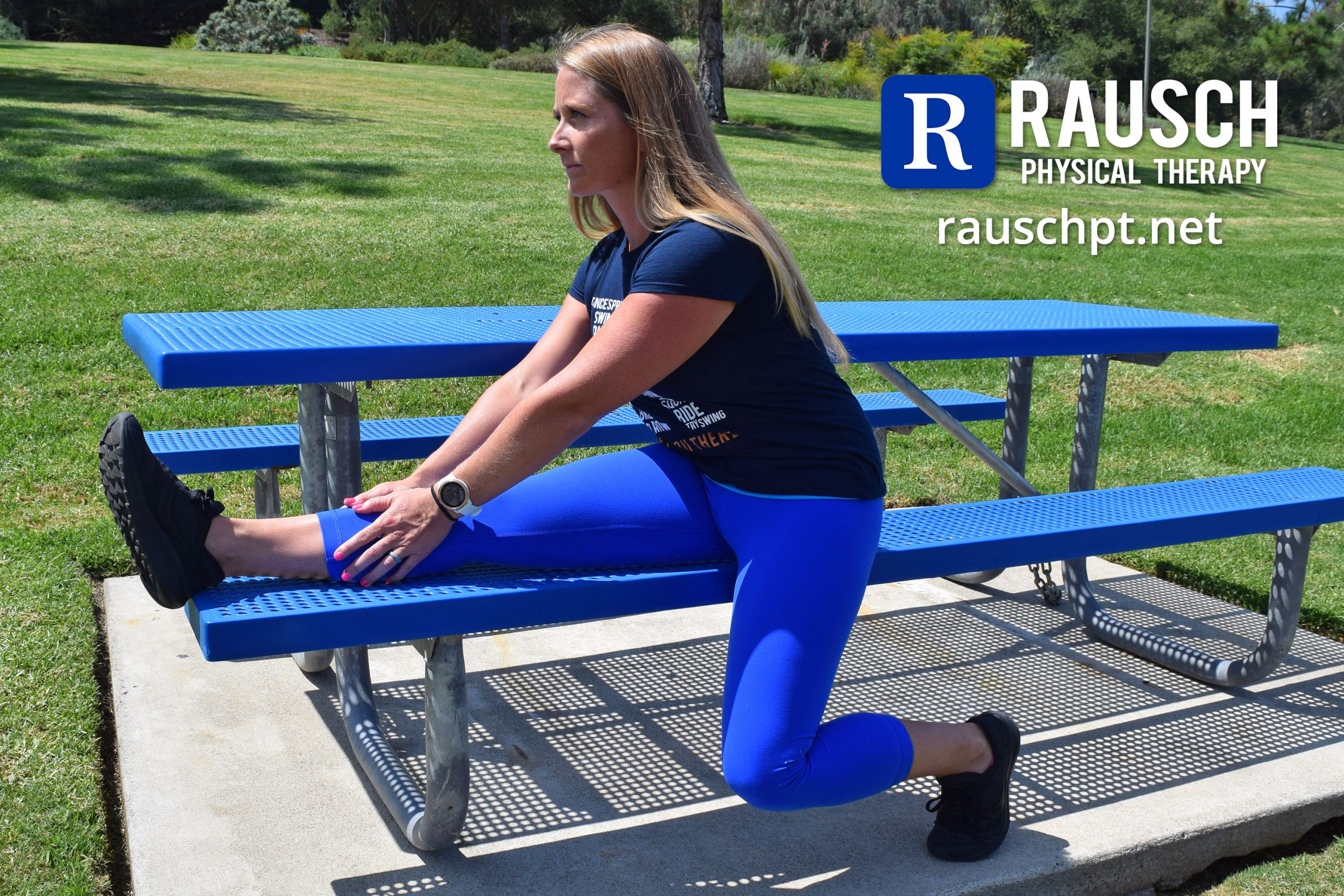
Since I am usually exercising outside, I love stretching on picnic tables. They offer a good surface for stretching with a variety of heights useful for multiple stretches, plus they are convenient since they are virtually everywhere!

Ashley’s Picnic Bench Stretch Series

Here are my five go-to stretches when I’m running outdoors:

#1 – Quad/Hip Flexor Stretch

Glutes are the driving power for running and propelling the body forward. Lack of hip extension results in decreased running efficiency. Tight hip flexors will limit the ability for the hip to extend and use the glutes. A good hip flexor/quad stretch will allow you to engage your glutes more efficiently.

Cue: Tilt the pelvis like you’re tucking your tail under. Gently squeeze your glute to help relax the psoas and gain a better stretch.

Common mistake: Leaning forward. This results in back extension, not hip extension, which is a common way runners injure their backs.

#2 – Hamstring Stretch

Hamstring tightness is often a contributing factor to back pain or hamstring strains. Hamstring tightness can pull the pelvis into a posterior rotation, which deactivates your abs while running and can lead to back pain over time. Adequate hamstring flexibility will also reduce the amount of tension placed on the sciatic nerve and reduce the risk of hamstring strains while running.

Cue: This can also be done as a long duration stretch for 30 seconds to 1-3 minutes.

Common mistake: Over rounding the back when leaning forward.

#3 – Calf Stretch/Prancing

This dynamic stretch is important for both ankle mobility and the elasticity of the calf complex. Calf flexibility is important in preventing calf strains while running. Stiff ankles result in poor shock attenuation can result in injury from the foot up to the back. Poor dorsiflexion mobility will shorten the calf and Achilles complex prematurely and can result in calf strain, Achilles Tendon or plantar fascia injury.

Cue: Start by standing on a curb or bench, hang the heels off and slowly lower the heel below neutral while bending the opposite knee to raise heel. Alternate dropping the heels to ‘prance’ to improve ankle mobility and calf flexibility.

Common mistake: Excessive pronation or flattening of the foot arch.

#4 – Standing Pigeon Stretch

The standing pigeon stretch opens the hip capsule and hip rotators. This will help promote glute activation and hip drive running.

Cue: Begin with one leg crossed over opposite leg. The thigh should be perpendicular to the body while the knee is bent at 90 degrees. Holding onto the table, lean back into a partial squat position while maintaining a flat back. This stretch can also be performed lying supine on picnic table by cross leg over opposite knee, hold thigh behind the non-stretching knee and pull towards chest.

This stretch can also be performed lying supine on picnic table by cross leg over opposite knee, hold thigh behind the non-stretching knee and pull towards chest.

Common mistake: Pain in knee. If there is discomfort in the knee, modify by performing stretch on your back.

#5 – Adductor Side Lunge

This stretch targets the adductors, which are important for medial knee stability. Adductors can be overlooked when stretching but are important to stabilize the knee to prevent injury.

Cue: Using the table, place your foot of the stretching leg on the bench. Lunge away by bending the knee to about 90 degrees, keep your knee stacked over your ankle.

This can also be done as a dynamic stretch without the picnic bench by alternating lateral lunges. Alternate to stretch each side 5 times, hold 2-3 seconds before alternating.

Common mistake: Going too deep. Knee not stacked over ankle.


PT-Headshots-AshleyAshley Heller, MPT is a licensed physical therapist at Rausch Physical Therapy & Sports Performance. She received her Masters of Physical Therapy degree at California State University, Long Beach and is passionate about working with patients with shoulder, knee and ankle injuries. With background in orthopedic-related injuries and post-operative rehabilitation, Ashley believes that the combination of manual therapy and personalized therapeutic exercise program is vital to recovery. Known as the Water Sports PT, Ashley says her goal is to help her patients better understand their injuries and the plan for their road to recovery.

Click to learn more about Ashley and our other physical therapists »


Five Myths You Should Disregard When Buying Running Shoes


Getting ready to shop for a new pair of running shoes? DPT Max Biessmann debunks five common myths you encounter when talking shoes and explains what you should pay attention to when shopping for running shoes.

BY MAX BIESSMANN, DPT, RAUSCH PHYSICAL THERAPY
USAT LEVEL I COACH, ASCA LEVEL I COACH, USA SWIMMING COACH


How often have you been to a 5k race or local weekly run and heard different runners comparing and talking about their shoes? There are many things avid runners can and will say about shoes, such as why they run in a certain pair and why that pair is better than any other, but with so many types of running shoes out there to choose from (and just as many opinions) how do you separate fact from fiction?

As a professional triathlete and doctor of physical therapy, I’m going to discuss some common myths I hear about running shoes to help you make a better decision when buying or trying out your next pair.

MYTH #1: Brand “X” is Better than Brand “Y”

I often hear people say they will only run in [insert name of major running shoe brand here] and that [insert name of competitor running shoe brand here] is not as good because of [insert sales pitch here.] Well, this is not entirely true.

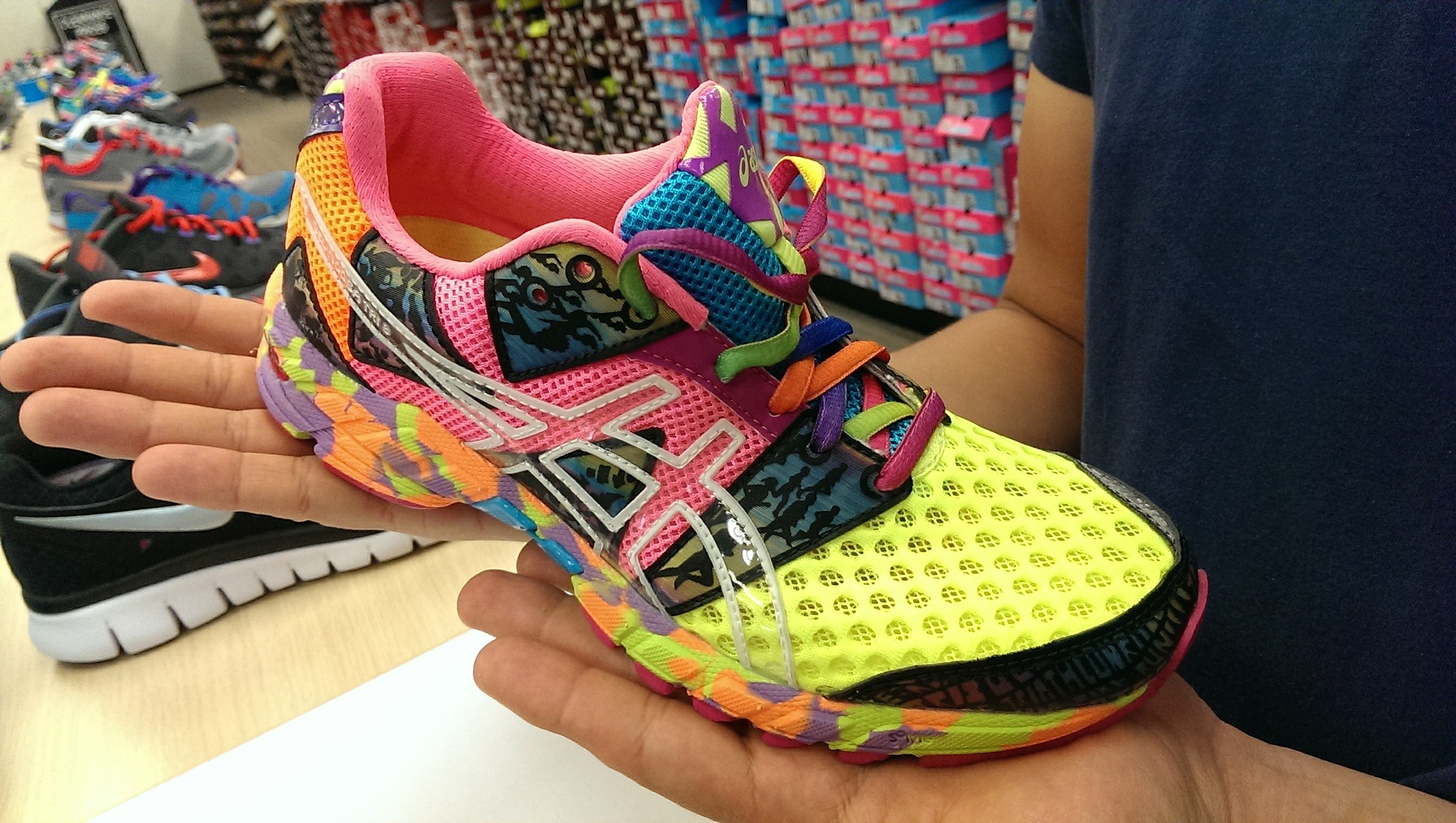
Every major brand offers a wide variety of types of shoe to address the multitude of needs of all runners, from beginner to advanced marathoner. With this in mind, it’s not necessarily a specific brand of shoe that will work best for you, but a specific type of shoe. Do you need a lot of motion control? More cushioning? Do you want more road feel? There are types of shoes that can help each of these aspects.

That being said, there are three main features that can really change the shoe and therefore should take precedence in your decision making process: the amount of pronation control, the stack height or cushioning, and the heel toe drop/ramp. Pronation control refers to the amount of support along the inside aspect of your foot/arch and is designed to prevent your foot from collapsing inward into the dreaded over-pronation range. Stack height is the amount of material in between the sole of the shoe and your foot and is often thought of as padding or cushion. Heel toe drop or ramp is the difference in stack height from the heel of the shoe to the toe of the shoe.

If you’re lost as to what type of shoe is best for you, keep these three features in mind and ask an expert. Many running shoe stores will allow you to run in shoes at the store in order to recommend a type of shoe to help get you started in the right direction.

MYTH #2: There’s an Ideal Heel Ramp/Drop for Running Shoes

As mentioned above, the drop or ramp of a shoe is the difference between the stack height of the heel and the toe. The current standard is 10mm, or a heel that is 10mm higher than the toe of the shoe. However, some companies have started advertising a “zero drop shoe” (same height at heel and toe) because higher heel ramps have been blamed for an increase in heel striking and over-striding in runners, leading to an increased injury rate. However, there is currently no sound scientific research to prove that theory. In fact, it can also be argued that since the sole of a shoe compresses under a load, then a zero drop could become a negative drop (basically the heel becomes lower than the toe.)

The truth is that there is no specific standard drop that works best for everyone; the only way to determine the best drop for YOU is to have your gait analyzed by a trained professional. So check the drop of the shoe and find one that works for you; many companies offer ranges of drop from 0mm to 10mm. If you have good success in a specific drop of shoe, be careful not to make a large, sudden change when it’s time to replace that pair.

MYTH #3: There’s a Pair of Running Shoes That Will Make You Faster Although everyone is looking for that one pair of shoes that will magically make them faster, the reality is that the shoes on your feet won’t greatly slow you down or speed you up because they are not performance enhancing in and of themselves. Shoes are a tool that help you complete the necessary training without injury. For example a recent study discovered that adding 100 g (3.5 oz) to shoe weight affected well-trained runners by 1% over a 3k time trial. At 4 min/k (6:25 min/mile) this equates to approximately 7 seconds per 3k. So unless you are looking for those few seconds to win an Olympic gold medal, shoes are not going to make a huge difference overall, and you’re best off in the shoes that are the most comfortable and allow you to train the best without injury or discomfort.

MYTH #4: Shoes With More Padding Prevent Injury

The current trend in running shoes is shifting away from the minimalist movement of a few years ago toward increased padding or stack height. Many people are embracing the increased padding trend, claiming that it will help reduce the load on the joints and, thus, injury rates.

The concept behind this is sound, but good running form and mechanics revolve around being able to absorb and reuse the load to propel the runner forward. Good running form will put about 2.5x your bodyweight of force through your legs; as this force is applied, your legs and entire body must make very quick alterations in muscle activation patterns in order to maintain proper alignment and distribute the loads correctly across the various joints. However, when you run in maximal shoes, or shoes with a lot of padding/stack height, the padding will reduce some of the sensory input from your foot that is required for your brain to maintain the proper alignment. This doesn’t mean that shoes with increased padding are necessarily bad, but they do not prevent injury as some would claim.

MYTH #5: Shoes Change the Way You Run

Shoes can have minor effects on the mechanics within your foot and up through your leg, but the most important part of running form is the way YOU move and your own mobility, strength and motor control. Certain types of shoes or designs can be beneficial in helping you achieve the proper mechanics, but they will not fix anything.

Final Tips

In the end, the selection of a running shoe is a very personal decision and depends on many factors; I hate to be cliche, but there’s really no “one-size-fits-all” answer to running shoes. Here are my final tips and things to remember when purchasing your running shoes:

  • Just because your friend swears by a certain brand or model does not mean it will be the best for you.
  • When looking at running shoes, always take into account your running history, your body type, and your average running surface.
  • It’s important to test any shoe you buy—most running shoe stores will have a treadmill or will let you try the shoes out in front of the store.
  • If you ever see a demo night for a specific brand of shoes, try them out! One of the best things you can do for your running is to play the field with running shoes and try out different designs and models.
  • It is usually best to have several pairs of shoes in your stable to use for different types of runs. Changes in shoe dynamics will change the forces relayed into your foot and body during runs and can reduce overuse injuries.


StaffHeadshot-MaxMax Biessmann, DPT is a licensed physical therapist at Rausch Physical Therapy & Sports Performance. He received his Doctorate of Physical Therapy degree at the University of St. Augustine, San Marcos in 2016 and started his career at Rausch PT. Max is passionate about helping people achieve their goals through physical therapy and innovative rehab technologies. As the Endurance Sports PT, Max says he’s lucky to be able to combine his professional coaching experience and PT knowledge to help his patients achieve their personal bests in sports and daily life.

Learn more about Max and our other physical therapists »