Blog

Exercises to Help Prevent ACL Tears in Soccer Players By Dr. Renee Rinard PT, DPT, ITPT

If you’re a soccer player, you’ve probably heard the term “ACL” or most likely know someone that has torn their ACL in their soccer career. Its most commonly torn in sports involving sudden directional changes, sudden stops, and jumps; basically, the activities that are constantly performed throughout soccer practice and soccer games.

So what is an (ACL)? And what does it do? “ACL” stands for Anterior Cruciate Ligament and it is a ligament that connects your femur (thigh bone) to your tibia (shin bone) and averages about only 32 mm but is a major player in the stabilization of the knee joint. When it is torn, most complain of feeling very unstable or have episodes of “buckling” while walking or going downstairs. Surgery is usually required with a minimum of 4-6 months rehab in physical therapy; 9 months is usually recommended to return to sport with the least likely risk of re-injury at that point. If return to sport occurs earlier than 9 months, the risk of re-injury goes up.

Most ACL injuries occur in NON-CONTACT incidents, which means that the tears normally occur when the player was unable to properly control the leg while landing from a jump, a quick change of direction, sudden stop, etc. With proper strengthening, stabilization, balance, and control exercises, we have a higher chance at preventing ACL tears in soccer players.

FUN FACT:

Female high school soccer players are at the highest likelihood of tearing their ACL when compared to all other high school sports.

Below are 7 exercises aimed at the needs of soccer players to help prevent non-contact ACL tears.

  • Clamshells

    • Lay on your side with a resistance band around your knees. Bend your knees up so you have approx 45 deg angle at the hip and a knee. Keep your hips stacked on your side and your feet together. Lift your top knee just high enough so your hips stay stacked. Perform on both sides.
      • WHERE YOU SHOULD FEEL IT: side of your top hip
      • TIP: to ensure your hips are stacked correctly, position your top knee slightly in front of your bottom knee so it hangs slightly over. Can progress to clamshell in a side plank position
  • Lateral walks

    • In standing position, place a resistance band around your knees. Start in a slight squat position with tension on the band. Keep toes facing forward and knees in line with your feet/ankles (do not have knees cave in). Take a small step to the side and continue for approx 10-15 steps. Maintain a squat position throughout the activity. For increased challenge, put the band around your arches; then around both knees and arches. Perform both directions.
      • WHERE YOU SHOULD FEEL IT: sides of your hips
      • TIP: keep tension on the band throughout lateral walks; do not bring feet completely together between steps. If you are having a hard time maintaining a low enough squat because you feel like you will fall backward, hold a dumbbell or kettlebell in front of you to act as a counterweight in order to hold the position.
  • Hamstring slide outs in the bridge position

    • Lay on your back with knees bent, lift hips up off the ground into a bridge position. While maintaining the bridge position, slide feet away from the body in slow and controlled motion. During this motion, hips are still off of the ground but are lowering throughout. Slide feet out as far as you can while maintaining control and proper form. If strong enough, pull heels back towards the starting position while maintaining bridge to continue with repetitions, otherwise, lower hips down to the ground and reset at the bridge position.
      • WHERE YOU SHOULD FEEL IT: hamstrings (back of thighs), glutes
      • TIP: for sliding out, you can wear socks on a slick floor, paper towels/towels on a slick floor, sliders under your feet, or a swiss ball (tougher than feet on the floor). If your low back starts to hurt or strain, concentrate on squeezing your glutes more to take the pressure out of your low back. Once a double leg is mastered, can progress to one leg.
  • Copenhagen adductor

    • Using a chair or bench, you will be in a side plank position on the elbow with your top leg positioned on the chair/bench. Make sure your knee is supported by the chair/bench and not hanging off of it. When in the starting position, lift the bottom leg up and down toward the chair/bench.
      • WHERE YOU SHOULD FEEL IT: inside of the bottom leg, outside of the bottom hip, supporting shoulder
      • TIP: make sure the bottom hip does not sink toward the ground; maintain a straight line from torso to legs in order to get strengthening benefits of glute medius (side of the hip). Make it fun by having a teammate hold your top leg!
  • Walking lunges

    • Starting in standing position, bring one leg in front of you by taking a large step. Lower down by bending the knees and keeping the torso upright. Push up with your front heel to elevate and bring back leg to meet your front leg. Perform with the other leg. Make sure your toes are facing forward, the knee is over your foot, and hips are in line with the knee. FRONT KNEE SHOULD NOT BE CAVING INWARD NOR SHOULD YOUR HIP FALL OUT TO THE SIDE throughout the movement)
      • WHERE YOU SHOULD FEEL IT: side of hip, quadriceps, glutes
      • TIP: if walking lunges are too difficult or you are unable to keep proper form (knees are caving in) throughout the movement, can start with static lunges: Start in the lunge position and perform up/down movement continuously on one leg in the same position, then switch to the other side. Walking lunges are a more dynamic activity and tougher to perform while maintaining proper hip/knee alignment. Walking lunges should be a goal, but if they cannot be performed properly, static lunges are a good starting point. You do not need to touch the ground with your back knee.
  • Pistol Squat to Chair

    • Standing on one leg, lower down as if going to sit down in the chair. Slow and controlled. Ensure that the knee does not cave in during the movement (just as with the lunges). Place both feet on the ground to come to a standing position. Repeat.
      • WHERE YOU SHOULD FEEL IT: glutes, quadriceps, hamstrings
      • TIP: to progress this exercise, when you reach the chair at the bottom of the movement, use that one leg to return to standing position rather than both legs. Make sure to push up through the heel. Continue to make sure the knee does not cave in and the hip does not fall out to the side. To progress past this, remove the chair and perform continuously.
  • Dorsiflexion Ankle Mobs

    • **This is not a strengthening exercise, but a mobility activity to ensure proper ankle mobility. This will help to decrease improper positioning and compensation of the knee
    • Kneel down on the floor with your front foot approximately 6 inches from a wall. Lean forward, pushing knee towards the wall over toes. When you reach your max distance, hold in this position for at least 5-10 seconds. Repeat.
      • WHERE YOU SHOULD FEEL IT: you may feel a stretch in your calf/Achilles when performing or some pressure in the front of your ankle.
      • TIP: if you have a sturdy band, can place along the front of the ankle joint to assist in mobilization.

Dr. Renee Rinard PT, DPT, ITPT

Let’s talk! We are here to help. Give us a call for a complimentary consultation. We would love to meet you.

Did you know there’s no prescription needed from a doctor to see us – but we will communicate your progress and treatment to your doctor if you’d like us too!
(949) 276-5401



RauschPT


Dear Parents: Stop Overusing Your Kids

Originally published August 17, 2015

Dear Parents of Young Athletes:

As a physical therapist, I have the privilege to work with many of your young all-stars. Some of your kids are here to recover from an injury as quickly as possible so they can get back to competing; others come in for injury prevention so they don’t go down again; and still more are simply going above-and-beyond to understand how their body works so they can push their limits. A few of these young athletes are simply, hyper-focused individuals, self-driven to be the best in their sport, and I’m always impressed by their desire to be here and get better. Unfortunately more often than not, your kids are here because of you, the parent.

Parents are pushing their young athletes to perform and—this is going to be hard for some of you to hear—it’s usually too hard, too much and too fast.

From talking to your kids while they’re on my table, I’ve learned that it’s not uncommon for young athletes to have practice twice a day, sometimes for up to four to six hours a day, just for one sport! Whether it’s swimming, running track, or playing baseball, what this means is that your kids are performing one repetitive, sport-specific movement pattern for hours at a time, day after day, for many, many months straight.

Our bodies were not meant to perform one type of movement pattern for the amount of time that most of these athletes are putting in. Kids used to play a variety of sports throughout the year, which provided the body with more diversity and helped avoid overusing one set of muscle groups. However, our society’s current fascination with the specialization of one particular sport has dramatically increased the tendency of our young athletes to overdevelop particular muscle groups without any counter balance. Over time, the overuse of these muscle groups results in an overwhelming demand that their young bodies simply cannot support, which then leads to the injuries plaguing our children these days.

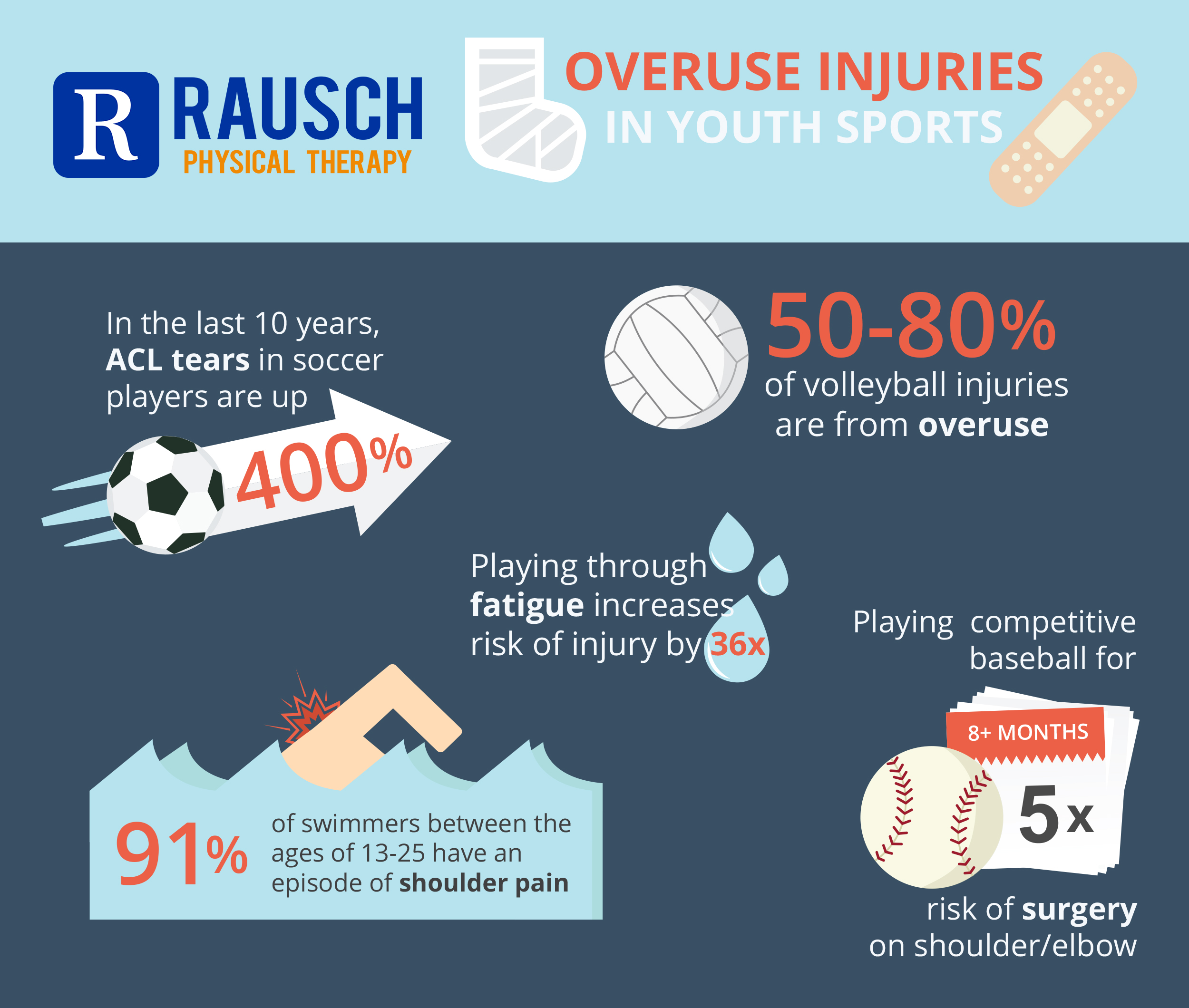
A prime example of this issue is a young soccer player. Between high school and club games, practices and tournaments, she’s essentially playing soccer year-round. She continues to push her body over and over, month after grueling month, for just this one sport. The result? Her quadriceps become too dominate; her hamstrings, glutes and outside stabilizers are basically non-existent because of the lack of strength training in her other muscle groups. This can potentially lead to an ACL tear, which studies show are up 400% over the last decade.

overuseyouthinjurystats

So whether you like to hear it or not, the fact of the matter is kids are suffering more overuse injuries these days, which ironically leads to a decrease in their overall playing time. You think you have your kid on the path to the Olympics, but instead they’re headed to my PT table with an increased risk of surgeries and chronic joint pain later on in life.

Now don’t get me wrong, I think it’s great that these young athletes are so determined to become the next Mike Trout, Michael Phelps, Misty May-Treanor and so on, but the emphasis on overtraining is a serious issue that needs to be addressed. It all starts with you, parents! Can you be the difference maker in your young athletes’ lives?

Please take caution in playing your young athlete for more than eight months consecutively in a given year. A lot of these injuries can be prevented through multiple sport play, active rest and coming in to see one of our sport-specific PTs here at Rausch Physical Therapy & Sports Performance as soon as your child starts showing warning signs of overuse injury (Remember, if they’re in pain, they should have been in here weeks ago.)

With proper injury prevention knowledge and tools, together we can help reduce this alarming overuse injury trend and keep our kids happy, healthy and in the game much longer.

Sincerely,

Jonathan Meltzer, PT, DPT

[framedbox]

Statistics and Additional Reading:


Jonathan Meltzer graduated from the University of Redlands with a bachelor of arts in biology and a minor in physical education. Following graduation, Jonathan discovered his passion for physical therapy while working as a Physical Therapy Aide. After graduating top of his class from Loma Linda University in 2012 with a Doctorate in Physical Therapy, Jonathan began his career at Rausch Physical Therapy and Sports Performance. Jonathan’s goals are to identify limitations and treat his patients with the most recent and innovative techniques in order to maximize functional independence and obtain his patients’ individual goals.
Let’s talk! We are here to help. Give us a call for an initial evaluation and assessment. We would love to meet you.

Did you know there’s no prescription needed from a doctor to see us – but we will communicate your progress and treatment to your doctor if you’d like us too!

(949) 276-5401

RauschPT

Disclaimer — All the information that you find on our blogs and social media pages are for informational purposes only and are not intended to be used as your personal professional diagnosis, or treatment. Come and see us for your excellent, personalized care! https://staging.rauschpt.net/

Why Your Daughter is More at Risk for an ACL Tear Than Your Son


One of the more common—and arguably one of the most devastating—injuries a young athlete can sustain is an ACL tear. Diana Wang, PT, DPT, ATC explains what causes ACL injuries and why she believes it’s so crucial for young women to be proactive to prevent this scary setback.


BY DIANA WANG, PT, DPT, ATC, RAUSCH PHYSICAL THERAPY

One of the most common (and arguably one of the most devastating) injuries a young athlete could sustain is an ACL tear. Your ACL, or anterior cruciate ligament, is a part of a team of ligaments in the knee that helps maintain stability and withstand the force/stress from daily movement and physical activity. The main job of the ACL is to limit forward motion of the tibia (the lower leg) on the femur (the upper leg.) The ACL also limits tibial rotation when paired with an angular force at the knee.

What Causes the ACL to Tear?

The ACL limits certain motions, but just like any other soft-tissue structure in the body, there is a limit to its limitations.

While parents often fear their young athlete will get injured from being aggressively slammed in to, the fact is that 70-78% of ACL tears are non-contact, meaning there was no involvement of external forces. The most common mechanisms of ACL tears include:

  • The “plant-and-twist” motion
  • Sudden deceleration
  • Hyperextension of the knee

With that said, athletes in sports that involve repetitive jumping, landing or cutting—such as basketball, soccer and volleyball—are at a higher risk for ACL injuries. And what puts young athletes at even more risk? Being female.

Why Female Athletes are More Vulnerable to ACL Tears than Male Athletes

According to the National Institutes of Health, female athletes are two to eight times more likely to suffer an ACL injury than their male counterparts. Here are three reasons why:

#1: Anatomical differences


Females are born with wider hips than males; because of this, the alignment between the hips and the knee (known as the “Q-angle”) increases and makes females more susceptible to a “knocked knees” posture. This abnormal posture forces more torsion in the internal rotation and adduction angles in an attempt to create more knee stability. This then increases stress on the ACL, thus increasing risk of injury.

#2: Muscle imbalances

In general, most people have a poor quadriceps-to-hamstring ratio. However, females tend to be more quadriceps dominant during functional activity compared to males, especially during deceleration or sudden changes in direction. This quadriceps dominance produces repetitive anterior shear forces of the tibia on the femur, which then increases stress on the ACL to do its job and limit these forces. As I mentioned earlier, there is a limit to its limitations, so if the forces overpower the strength of the ACL, something’s gotta give.

#3: Hormonal changes

During menstrual cycles or hormonal changes (Hello, puberty!), soft-tissue structures tend to loosen up, which decreases overall joint stability and therefore increases risk of injury during that time. Unfortunately this factor is the most uncontrollable, but the prescription of a specific and well-developed exercise program will prepare any young athlete to withstand the stresses of physical activity, regardless of what their body is going through.


How to Decrease the Risk of ACL Injury

Preventative rehabilitation is key to reducing risk of ACL injuries! While you can’t change anatomy, you can train your body to combat instability and the stressors that comes with physical activity. The first step for prevention is to visit a physical therapy clinic and undergo a functional movement screen with a licensed physical therapist. From there, your physical therapist will create an individualized and specialized exercise program focused on mobility and stability tailored to your needs.

Disclaimer: No movement screen will guarantee prevention of injuries. However, they are extremely useful for physical therapists to identify movement faults that may increase risk of injury.


Diana Wang graduated from the University of the Pacific with a bachelor’s degree in Athletic Training. Following graduation, she knew she wanted to pursue her love for sports rehab further and received her Doctor of Physical Therapy degree in 2017 and began her career at Rausch Physical Therapy & Sports Performance. With her extensive sports background, Diana’s goal is to provide the best, most innovative care to get athletes back in the game faster and stronger than ever.

Learn more about Diana and our other physical therapists »

Finding the Best Soccer Cleats for Your Feet


Are your soccer cleats putting you at risk for injury? PT Lyndsay explains how to find the perfect fit for your feet and shares tips on how to make sure your feet stay healthy and happy all season long.

LF-BLOG
BY LYNDSAY DEFILIPPO, DPT, RAUSCH PHYSICAL THERAPY
If you read my previous article, Tackling Common Soccer Injuries, you already know that the most common injuries sustained on the soccer field involve the ankle and foot complex. One of the risk factors I mention gets very little attention from a health and wellness perspective, but it may just be one of the simplest ways to avoid easily-preventable injuries—your footwear!

With so many brands out there (and superstar athletes to back the sales,) finding your cleat of choice can sometimes be a stressful and expensive task; it’s also one that puts you at risk for injury if the fashion is right but the fit is not. Now, having a tight fit (often a size too small) has always been the go-to for most athletes, as they feel it allows for a heightened control of the ball and better feedback; with that being said, most soccer players are wearing the wrong size shoe.

Finding the Perfect Footwear Fit for You

What Are Your Feet Telling You?

As a physical therapist, I work with and see a lot of feet. Not only do I treat the specific injury my patient presents with, but I also observe all other aspects of their foot/ankle complex to get a complete view of what needs to be done to counteract the damage occurring at the affected body part (and potentially up the chain.) To list a few, I’m looking for blisters, calluses, hammertoes, bunions, ingrown toenails, and wear patterns. Why do I focus on these aspects of the foot? The skin is the largest organ in the body, and it can often give us information regarding one’s health, such as the areas of abuse the foot suffers during sport.

Stiff vs. Flexible Sole

One thing that separates a soccer cleat from your average running shoe is its hard sole. In many cases (not all, as some cleats offer more flexible soles) this key factor can either make or break one’s performance, or send them running to the doc with foot problems.

Some people may enjoy the stiffer sole to allow for greater push-off force and responsiveness to quick movements, while others may like a more natural, softer sole so they can feel the touch of the ball on their feet better. However, the real reason that most soccer cleats have a harder sole may surprise you. A harder sole helps distribute weight and pressure throughout the foot so that the areas directly above the “spikes” don’t receive too many forces when hitting the ground; it offers a greater surface area to distribute the weight equally versus all of the weight through one small area. Think of one person standing on 100 evenly distributed nails and another on only six… who do you think will be rushing to the ER to get a nail removed from their foot first?

Whether you purchase a harder or more flexible sole depends on your own personal preference, however I would caution against investing in a stiff cleat with little-to-no flexibility, as normal foot mechanics have to have some motion to perform their job correctly.

Get the Right Size for Right Now

Another important factor to observe is the width and length of the shoe. First things first, you should wear a cleat that is your normal size (avoid sizing down.) I also recommend having your foot measured by a professional at a soccer specialty or running store; this person can help you figure out whether your foot is wide, medium or narrow so you can be as comfortable as possible in your cleats.

Parents, listen up! While buying a shoe that is too small is not good (it can literally change the structure of your foot over time,) more importantly I will ask that you do not (and I can’t stress this enough) DO NOT buy your kid cleats that s/he can “grow into.” A shoe that is too big, too long, or too wide will be problematic and may lead to injuries. A proper perfect fit is truly the only way to go.

Pay Attention to Expiration Date

While most running shoes have an expiration date tracked in miles, soccer cleats often do not. This becomes problematic because athletes continue to play on cleats that are worn out, which inevitably leads to more injuries. The cleats may have lost their traction, or holes within the cleats open up the body to outside elements; worn in cleats also offer little support and make one more susceptible to ankle sprains, foot sprains and other lower extremity injuries.

Because of their ever-growing price tag, most athletes tend to utilize their cleats way past their expiration strictly for financial matters, instead of putting their body first. So, be mindful of when your cleats begin to feel too loose or start to break down to indicate you’ve used them past their prime.

Six Tips for Happy Feet

Here are my tips and tricks for finding a good fit and making sure your feet stay healthy and happy:

#1 – Find your perfect fit

Have your foot measured by a professional prior to buying your next set of cleats. This is especially important for young athletes whose feet are still growing. Make sure the boot doesn’t feel too big or too small, also noting if your toes feel cramped at the toe box or if there is extra pressure pushing on your big and little toe.

#2 – Hold footwear tryouts

Try a variety of styles and brands to find what fits your foot best (not what your favorite soccer star wears.) When you find a good fit, practice a few soccer-specific drills while in store (e.g. quick taps, side shuffle, toe and heel walks, jog in place.) Heck, even take a soccer ball with you and try a few passes and juggle drills. If you wear orthotics in your cleats, take those with you as well.

#3 – Break in those boots

Every soccer player knows the discomfort of breaking in new cleats. Depending on the material of the cleat (kangaroo leather, vinyl, regular leather, etc.) there are various ways to assist with getting a good fit. Some prefer standing in warm water with cleats on to allow the leather to soften and mold to your foot, while others prefer the old ziploc ice bag in the toebox trick. Whichever method you prefer, make sure that the material the cleats are made from can withstand those methods, as damaging a new set of boots is a costly mistake.

#4 – Consider pitch surface

Pretty simple stuff here: turf shoes are made for turf, indoor shoes are made for hard/court surfaces, cleats are made for outdoor grass/dirt fields.

#5 – Keep your cleats clean

This is not necessarily aimed at the appearance of the cleat as it is more a hygiene concern. Your feet sweat—A LOT—so the potential for foot fungus to develop from your cleats is high. Make sure to air out your boots after use, stuff them with newspaper, or even invest in a cheap shoe dryer (An antifungal spray here and there is also helpful.) And FYI, sweat normally doesn’t make for smelly shoes… it’s the moisture mixing with bacteria or fungus on our bodies or from outside factors being trapped in a warm, dark and wet environment (i.e. your shoes!)

#6 – Create your own foot care regimen:
    • Keep your toenails trimmed.
    • Do a foot check after each practice/game for blisters, callouses, etc.
    • If your feet hurt, try an Epsom salt bath or ice bath.
    • Keep your feet dry to avoid skin breakdown.
    • If you think you have an injury, seek attention immediately. Do not play through pain!


StaffHeadshot-LyndsLyndsay DeFilippo PT, DPT, CKTP received her Doctorate of Physical Therapy from New York University in 2010. She’s a Graston Practitioner and a Certified Kinesiotaping Practitioner. Lyndsay looks at each injury as a constantly changing puzzle, which is only solved when her patient returns to what s/he loves doing. She enjoys helping with the full recovery process, which includes providing the education, tools and fundamentals to prevent re-injury and the potential for new injuries.


Click to learn more about Lyndsay and our other physical therapists »

Why Early Sport Specialization is Unhealthy and Ineffective


Is early sport specialization actually hurting your child’s chances at a college scholarship?

Early sport specialization continues to be a troubling trend in youth sports, despite research and studies showing it is actually more detrimental to a young athlete’s elite athletic goals than it is helpful. Ashley Heller, PT, MPT unpacks the numerous problems associated with early sport specialization and provides solutions for how to set your child up for success in high school and college athletics.

Blog-Ash
BY ASHLEY, PT, MPT, RAUSCH PHYSICAL THERAPY

Originally published: 4/25/17

We all know top universities want students who have the best grades, best athletic ability, and who are well-rounded with extracurricular activities. Even if you do get an acceptance letter, tuition hikes have students and parents concerned about how to pay for higher education. To ease the burden of student loans, a popular strategy is to get an athletic scholarship.

The pressure on young student-athletes to be the absolute best in their sport to increase their chances of getting into and paying for college is astounding, to the level that it has actually changed the way our society approaches youth athletics. Instead of having our kids play multiple sports in seasons and involving them in a variety of extracurricular activities, parents are encouraging their children to focus on only one sport year-round–all in hope they’ll become good enough to earn athletic scholarships.

However, this alarming trend of “early sport specialization” can actually have more drawbacks than benefits, and it’s happening at a younger and younger age as college competition continues to rise.

Cons of early sport specialization

Negative effects on grades, socialization–and your bank account

When a child “specializes” in one sport, their life (and their parents’ lives) revolves around it. Between club practice, high school practice, individual coaching and training sessions, etc., kids have little time for other things. This can have a detrimental effect on their academic performance, as well as limit their involvement in social or extracurricular activities. This often leads to burnout before they even reach high school.

Not to mention the cost of early sport specialization! All those private lessons, club teams, tournaments, travel costs, and specialized coaching adds up quick. Realistically, parents may spend more money on early sport specialization than what can even be awarded in scholarships.

The cold truth is that studies show that only 0.2% to 0.5% of U.S. high school athletes make it to the professional level. Ultimately, pressuring kids to specialize and overtrain at an early age will not make up for innate athletic talent.

Increased risk of injury

In addition to academic, social and financial issues, early sport specialization is also associated with increased risk of injury. Flexibility, mobility and coordination are all affected during and after growth spurts. Trying to specialize a child while they are still growing can lead to strength imbalances and movement pattern deficits, which can result in breaks, tears and sprains.

Year-round practices and games lead to overloading joints and the creation of repetitive, faulty movement patterns, which can result in overuse injuries. Studies indicate that risk of overuse injuries increases significantly when the number of hours spent training weekly exceeds the child’s age. Unfortunately, its the common and avoidable overuse injuries that plague youth sports–“little league elbow” in pitchers, shoulder instability in swimmers, and Osgood-Schlatter’s or Sever’s Disease in soccer players–that often stop collegiate or professional athletic dreams in their tracks.

Pros of sport and activity diversity

Early multisport participation has many benefits for youth athletes.

  • It creates a solid motor skill foundation–coordination, balance, proprioception, motor planning and strength–which translates to athletic success and overall good health later in life
  • It helps prevent burnout if the athlete plans to compete at a higher level
  • It will promote motor skill development and improve their overall athletic skill when they reach the appropriate age (typically late-adolescence, around 16 years old) to specialize in one sport

Sports diversification is even more important now in our tech-driven society. Kids are spending more time in front of screens and less time playing outside. Outdoor “free play” is critical for young motor skill development, which is the foundation for building athletic skill. So, if you want your kids to be great at sports, get them outside early and often! They’ll develop a variety of movement patterns that will help reduce the risk of overuse injuries and improve their overall athletic ability.

The importance of cross training for one-sport athletes

If your child is at the appropriate age and specializing in a specific sport, please consider adding cross training to their training regimen. Cross training helps:

  • Prevent overuse injuries by providing rest to heavily trained muscle groups, which is extremely important for muscle rejuvenation and tissue health, and encouraging different movement patterns
  • Complement strength training to reduce strength imbalances and improves overall core stability and power
  • Minimize fatigue, enhance flexibility, and build endurance


Final Thoughts

If your goal is to be a collegiate or even professional athlete, this article is not meant to discourage you! I want to give you insight into what it takes to achieve this level of athletic ability while avoiding injury.

Here are some final thoughts to take away:

  • The appropriate age for sports specialization is around 15 to 16 years old for most sports
  • Not all high school athletes will be college or professional athletes, so manage your expectations
  • Sports are supposed to be fun! If your child is getting tired of their sport, let them try something new
  • Youth athletes should be encouraged to participate in a variety of sports to develop a good foundation of motor skills
  • Cross-train to become a well-rounded athlete and to avoid overuse/overtraining injuries

And if this article still hasn’t convinced you, the NCAA website includes in its NCAA Sport Science Institute resources and materials section Consensus Statement by the American Orthopaedic Society for Sports Medicine which states:

Background: “Early sport specialization is not a requirement for success at the highest levels of competition and is believed to be unhealthy physically and mentally for young athletes. It also discourages unstructured free play, which has many benefits.”

Results: “The primary outcome of this think tank was that there is no evidence that young children will benefit from early sport specialization in the majority of sports. They are subject to overuse injury and burnout from concentrated activity. Early multisport participation will not deter young athletes from long-term competitive athletic success.”

Conclusion: “Youth advocates, parents, clinicians, and coaches need to work together with the sport governing bodies to ensure healthy environments for play and competition that do not create long-term health issues yet support athletic competition at the highest level desired.”

So, let’s shift our approach to youth sports and be smarter when it comes to our children’s health and well-being. By encouraging your child to play multiple sports, managing your and their expectations, and incorporating cross training, you can set them up for success to achieve their athletic and academic goals and thrive both on and off the playing field.

[framedbox]

References & Additional Reading:

[/framedbox]


StaffHeadshot-Ashley2Ashley Heller, PT, MPT is a licensed physical therapist at Rausch Physical Therapy & Sports Performance. She received her Masters of Physical Therapy degree at California State University, Long Beach and is passionate about working with patients with shoulder, knee and ankle injuries. With background in orthopedic-related injuries and post-operative rehabilitation, Ashley believes that the combination of manual therapy and personalized therapeutic exercise program is vital to recovery. Known as the Water Sports PT, Ashley says her goal is to help her patients better understand their injuries and the plan for their road to recovery.

Click to learn more about Ashley and our other physical therapists »


Tackling Common Soccer Injuries


With the ever-growing popularity of soccer comes an increase in soccer-related injuries in players of all levels. PT Lyndsay explains who’s at risk for the most common injuries and why, and (more importantly) how to avoid sidelining and/or chronic injuries.

LF-BLOG
BY LYNDSAY DEFILIPPO, DPT, RAUSCH PHYSICAL THERAPY
While football, basketball, and baseball may be the most popular sports in the U.S., soccer reigns supreme in most other countries. Millions of people around the world love to watch and play soccer, with an estimated 200,000 professional athletes and 240 million players at lower-level amateur status.

With more people participating in this physically-demanding sport, coupled with a dangerous societal obsession with year-round competition (meaning little-to-no breaks for players,) we are seeing more and more soccer-related injuries. While head and neck injuries are not unheard of, the vast majority of soccer injuries occur within the lower extremity; of those injuries, the foot/ankle complex is the most affected, followed by the knees, thighs, and hips.

With this heightened rate of injury comes an increase in the time players are spending on the sidelines, unable to play the sport they love. Research shows that on average, soccer players will sit out seven to 30 days when they suffer mild to moderate injuries. However, when you compare that to the average time it takes for soft-tissue and bones to properly heal, you can clearly see that the timelines don’t match up.

Athletes are returning to sport too soon and playing on tissues that are still injured, placing  them at increased risk for re-injury, as well as heightened risk for new injuries. You may ask, “Well why are the professionals back on the pitch faster than me?” Keep in mind, it is their job to play soccer, they are in PT and rehab sometimes 8 hours a day, and the team is losing money each minute they are on the bench. Many times a professional athlete will also return sooner than they should, again increasing their risk for further injuries or sustaining new injuries from compensations within the body.

Who’s At Risk, and Why?

While research is still on the fence as to what definitively causes the most injuries in soccer players, here are some of the more notable findings I’ve come across:

  1. Most soccer injuries occur in competition versus practice scenarios, when physical demands, contact, intensity, etc. are all heightened.
  2. A study by Hawkins and Fuller reported 59% of injuries were caused by non-body contact, while 41% are caused by body contact.
  3. Other studies show that tackling is the biggest cause of injury.
  4. Other factors to consider are body mechanics and alignment, gender, and time spent playing the sport, as well as outside variables, such as pitch surface, athlete footwear, etc.

Basically, there are plenty of sport specific factors that put players at risk of sustaining lower extremity injuries; again, the most common area for concern in soccer players. In fact, one study has shown ankle sprains account for 80% of injuries in soccer, compared to 40% across all other sports. Even if you’re lucky enough to have never “rolled your ankle” while playing soccer, you may be one of those players who has sustained other common lower-body injuries, such as a contusions, strains, sprains, muscle tears—and in more severe cases—ACL tears, meniscal pathologies, and MCL sprains.

Seven Ways to Combat Common Soccer Injuries

So, if soccer players at all levels are constantly at high risk for sidelining injuries due to the nature of their sport, what can they do to prevent them?

First and foremost, athletes (as well as parents and coaches) need to put their body’s needs first, and if/when injury occurs, they need to respect the amount of time it needs for proper healing and recovery. This shift in mindset alone will help players avoid not only re-injury, but also future injuries and chronic pain down the road.

Simply put, playing through the pain is no longer an acceptable excuse (unless you don’t care about chronic injury, early arthritis and a host of other health issues later in life.) While athletes in demanding sports will always be at risk for injury, here are a few steps you can take to get started on your path to preventing overuse injuries and chronic pain:

  1. Always, always warm up. Do a proper, structured dynamic warm up program, such as the FIFA 11+ Program, before every practice and game. A dynamic warm up includes exercises that mimic the movements you’ll actually be doing while playing soccer, which properly preps your body to perform.
  2. Focus on exercises that target and build stability in the most vulnerable areas of soccer players, i.e. the ankles, foot, knees, and hips. Some good exercises for this are single leg balance drills, lateral walks with resistance bands, heel raises, and hip series exercises targeting lateral hip stabilizers.
  3. Build a good support system. Find a good coach, physical therapist, certified athletic trainer, and/or other sport professionals to assist you with injury prevention techniques. These people should share your focus on listening to your body, and should never push you to return to sport before your body is properly healed.
  4. Make sure to stretch and foam roll after every practice, training session, or game. Click to download the Rausch Physical Therapy & Sports Performance Foam Roll Routine poster.
  5. Emphasize proper form. Always focus on form when performing sport-specific movements (eg. long kicks, corners, short kicks, penalties, passing, etc.) They may feel second-nature after many years playing, but when you get sloppy you risk re-injury.
  6. Do NOT depend on braces, taping, etc. long term to “fix” an injury. While these bracing methods are good for prevention and short-term protection, ultimately you are treating the symptoms of the problem, not the cause. Visit a physical therapist who can use manual therapy to actually rehab traumatic and chronic injuries, as well as create an exercise program to strengthen your weak areas to keep you off their table and on the field.
  7. Listen to your body! Pain is not the only indicator for injury. Instability, weakness, poor-tissue mobility, etc. can all indicate that an athlete is NOT ready to return to the pitch.


StaffHeadshot-LyndsLyndsay DeFilippo PT, DPT, CKTP received her Doctorate of Physical Therapy from New York University in 2010. She’s a Graston Practitioner and a Certified Kinesiotaping Practitioner. Lyndsay looks at each injury as a constantly changing puzzle, which is only solved when her patient returns to what s/he loves doing. She enjoys helping with the full recovery process, which includes providing the education, tools and fundamentals to prevent re-injury and the potential for new injuries.
Click to learn more about Lyndsay and our other physical therapists »