Blog

Why Early Sport Specialization is Unhealthy and Ineffective


Is early sport specialization actually hurting your child’s chances at a college scholarship?

Early sport specialization continues to be a troubling trend in youth sports, despite research and studies showing it is actually more detrimental to a young athlete’s elite athletic goals than it is helpful. Ashley Heller, PT, MPT unpacks the numerous problems associated with early sport specialization and provides solutions for how to set your child up for success in high school and college athletics.

Blog-Ash
BY ASHLEY, PT, MPT, RAUSCH PHYSICAL THERAPY

Originally published: 4/25/17

We all know top universities want students who have the best grades, best athletic ability, and who are well-rounded with extracurricular activities. Even if you do get an acceptance letter, tuition hikes have students and parents concerned about how to pay for higher education. To ease the burden of student loans, a popular strategy is to get an athletic scholarship.

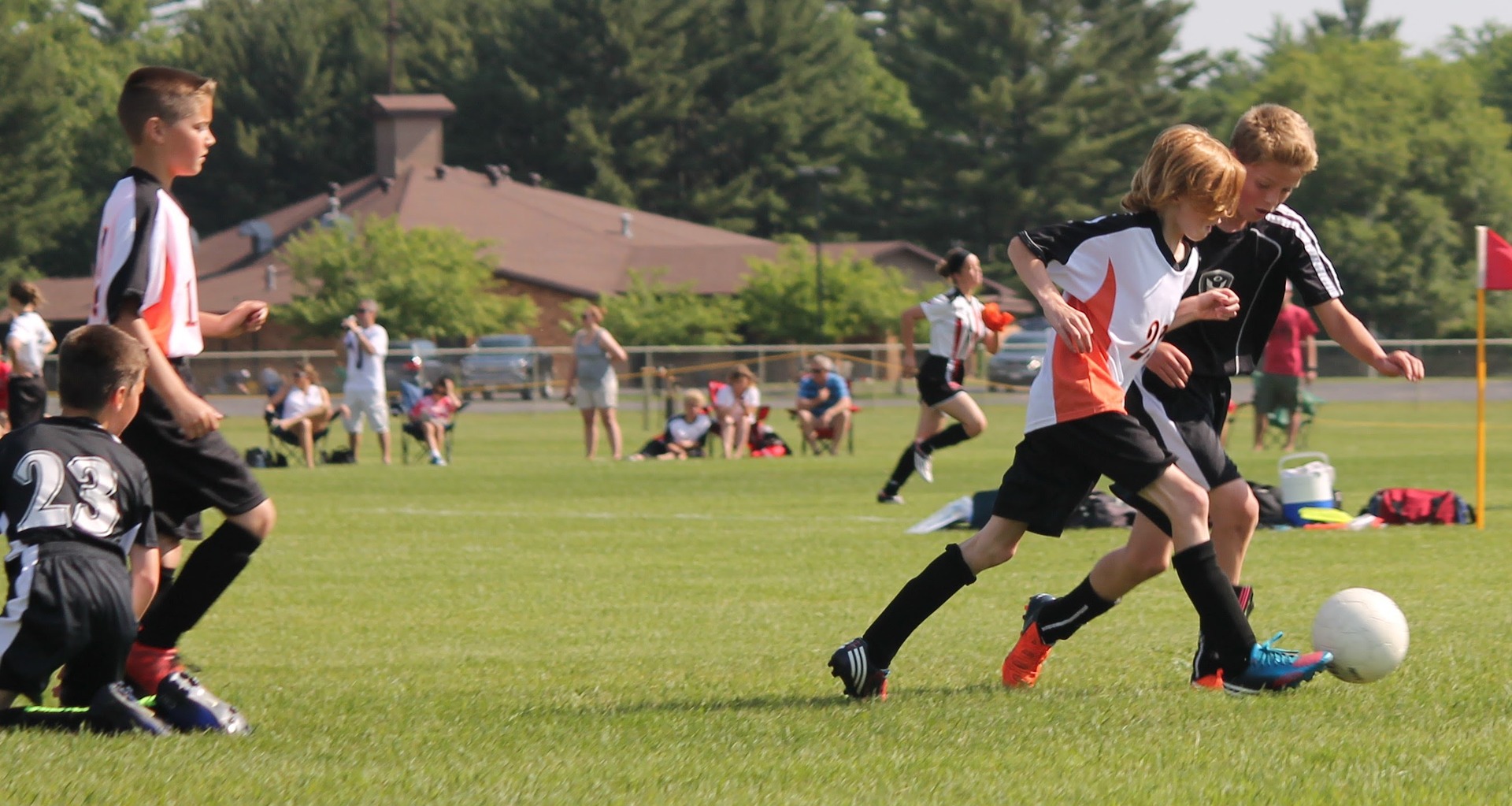
The pressure on young student-athletes to be the absolute best in their sport to increase their chances of getting into and paying for college is astounding, to the level that it has actually changed the way our society approaches youth athletics. Instead of having our kids play multiple sports in seasons and involving them in a variety of extracurricular activities, parents are encouraging their children to focus on only one sport year-round–all in hope they’ll become good enough to earn athletic scholarships.

However, this alarming trend of “early sport specialization” can actually have more drawbacks than benefits, and it’s happening at a younger and younger age as college competition continues to rise.

Cons of early sport specialization

Negative effects on grades, socialization–and your bank account

When a child “specializes” in one sport, their life (and their parents’ lives) revolves around it. Between club practice, high school practice, individual coaching and training sessions, etc., kids have little time for other things. This can have a detrimental effect on their academic performance, as well as limit their involvement in social or extracurricular activities. This often leads to burnout before they even reach high school.

Not to mention the cost of early sport specialization! All those private lessons, club teams, tournaments, travel costs, and specialized coaching adds up quick. Realistically, parents may spend more money on early sport specialization than what can even be awarded in scholarships.

The cold truth is that studies show that only 0.2% to 0.5% of U.S. high school athletes make it to the professional level. Ultimately, pressuring kids to specialize and overtrain at an early age will not make up for innate athletic talent.

Increased risk of injury

In addition to academic, social and financial issues, early sport specialization is also associated with increased risk of injury. Flexibility, mobility and coordination are all affected during and after growth spurts. Trying to specialize a child while they are still growing can lead to strength imbalances and movement pattern deficits, which can result in breaks, tears and sprains.

Year-round practices and games lead to overloading joints and the creation of repetitive, faulty movement patterns, which can result in overuse injuries. Studies indicate that risk of overuse injuries increases significantly when the number of hours spent training weekly exceeds the child’s age. Unfortunately, its the common and avoidable overuse injuries that plague youth sports–“little league elbow” in pitchers, shoulder instability in swimmers, and Osgood-Schlatter’s or Sever’s Disease in soccer players–that often stop collegiate or professional athletic dreams in their tracks.

Pros of sport and activity diversity

Early multisport participation has many benefits for youth athletes.

  • It creates a solid motor skill foundation–coordination, balance, proprioception, motor planning and strength–which translates to athletic success and overall good health later in life
  • It helps prevent burnout if the athlete plans to compete at a higher level
  • It will promote motor skill development and improve their overall athletic skill when they reach the appropriate age (typically late-adolescence, around 16 years old) to specialize in one sport

Sports diversification is even more important now in our tech-driven society. Kids are spending more time in front of screens and less time playing outside. Outdoor “free play” is critical for young motor skill development, which is the foundation for building athletic skill. So, if you want your kids to be great at sports, get them outside early and often! They’ll develop a variety of movement patterns that will help reduce the risk of overuse injuries and improve their overall athletic ability.

The importance of cross training for one-sport athletes

If your child is at the appropriate age and specializing in a specific sport, please consider adding cross training to their training regimen. Cross training helps:

  • Prevent overuse injuries by providing rest to heavily trained muscle groups, which is extremely important for muscle rejuvenation and tissue health, and encouraging different movement patterns
  • Complement strength training to reduce strength imbalances and improves overall core stability and power
  • Minimize fatigue, enhance flexibility, and build endurance


Final Thoughts

If your goal is to be a collegiate or even professional athlete, this article is not meant to discourage you! I want to give you insight into what it takes to achieve this level of athletic ability while avoiding injury.

Here are some final thoughts to take away:

  • The appropriate age for sports specialization is around 15 to 16 years old for most sports
  • Not all high school athletes will be college or professional athletes, so manage your expectations
  • Sports are supposed to be fun! If your child is getting tired of their sport, let them try something new
  • Youth athletes should be encouraged to participate in a variety of sports to develop a good foundation of motor skills
  • Cross-train to become a well-rounded athlete and to avoid overuse/overtraining injuries

And if this article still hasn’t convinced you, the NCAA website includes in its NCAA Sport Science Institute resources and materials section Consensus Statement by the American Orthopaedic Society for Sports Medicine which states:

Background: “Early sport specialization is not a requirement for success at the highest levels of competition and is believed to be unhealthy physically and mentally for young athletes. It also discourages unstructured free play, which has many benefits.”

Results: “The primary outcome of this think tank was that there is no evidence that young children will benefit from early sport specialization in the majority of sports. They are subject to overuse injury and burnout from concentrated activity. Early multisport participation will not deter young athletes from long-term competitive athletic success.”

Conclusion: “Youth advocates, parents, clinicians, and coaches need to work together with the sport governing bodies to ensure healthy environments for play and competition that do not create long-term health issues yet support athletic competition at the highest level desired.”

So, let’s shift our approach to youth sports and be smarter when it comes to our children’s health and well-being. By encouraging your child to play multiple sports, managing your and their expectations, and incorporating cross training, you can set them up for success to achieve their athletic and academic goals and thrive both on and off the playing field.

[framedbox]

References & Additional Reading:

[/framedbox]


StaffHeadshot-Ashley2Ashley Heller, PT, MPT is a licensed physical therapist at Rausch Physical Therapy & Sports Performance. She received her Masters of Physical Therapy degree at California State University, Long Beach and is passionate about working with patients with shoulder, knee and ankle injuries. With background in orthopedic-related injuries and post-operative rehabilitation, Ashley believes that the combination of manual therapy and personalized therapeutic exercise program is vital to recovery. Known as the Water Sports PT, Ashley says her goal is to help her patients better understand their injuries and the plan for their road to recovery.

Click to learn more about Ashley and our other physical therapists »
 

Three Easy Ways to Avoid Neck Pain While Cycling


Don’t let cycling be a pain in the neck. DPT Max Biessmann shares his three quick fixes for helping alleviate and prevent pain, aches and soreness in the upper back and neck while on your bike.

BY MAX BIESSMANN, DPT, RAUSCH PHYSICAL THERAPY
USAT LEVEL I COACH, ASCA LEVEL I COACH, USA SWIMMING COACH


Approximately 66 million Americans enjoy cycling for sport, and why wouldn’t they! It’s a great workout, social, and is perfect for cross training or for people with chronic injuries because of the reduced impact cycling has on the body. Unfortunately, many cyclists find themselves struggling with pain or discomfort, whether it’s the inability to get comfortable on the saddle or one of the most common complaints: neck/upper back pain and discomfort. Many people complain of pain ranging from soreness and aching, to numbness or tingling in their arms and hands, to sharp shooting pains in the neck and arms.

What Causes Neck Pain While Cycling

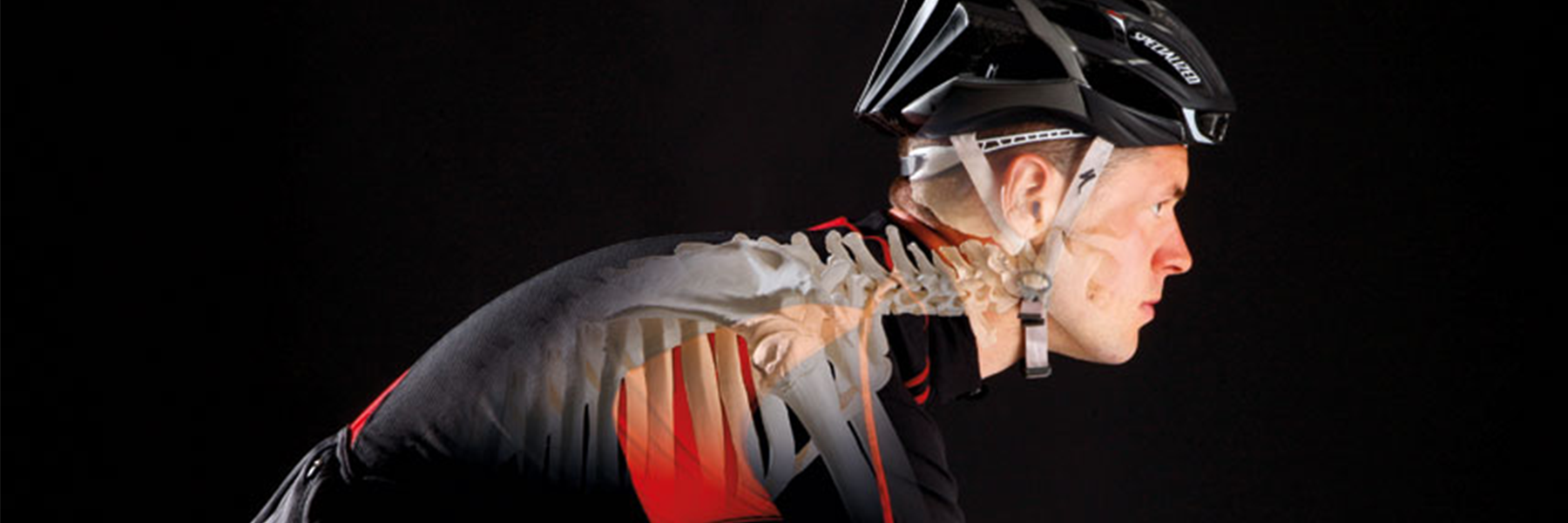
While cycling, your neck is in an extended position, doing its best to hold up your rather heavy head (the average head is 10 to 11 lbs.) Not only must your muscles do all the heavy lifting since the spine is unable to support the weight directly, but this also causes a closing down of the facet joints in your vertebrae. This constant closing can cause nerve irritation and excessive wear and tear on the joints.

As with anything you do, the longer you spend in a specific position, the more your body adapts to maintain that position. So, when you’re spending hours and hours per day hunched forward at your desk, in front of a laptop, looking at your phone, and on your bike, the more your body adapts to this position. This can cause the common posture dysfunction upper crossed syndrome, which is when your neck extenders (the muscles you use to look up) get short and tight, while the deep neck flexors (the muscles that tuck your chin down) get stretched out and relatively weakened.

Three Easy Ways to Avoid Neck Pain While Cycling

This combination of muscular imbalances and decreased nerve root space can lead to any combination of symptoms from chronic aching to shooting pains. Luckily, there are several very simple things you can do to decrease these symptoms if you already have them or prevent them from starting in the first place.

#1: Check how you’re riding your bike
Lawrence performing a Bike Right session at Rausch PT.The first thing to consider is how you’re riding your bike; a very small change here can have a big positive change. Are your arms always locked out at the elbows? Do you have a death grip on the bars? Are your shoulders hunched up and stuck in your ears? All of these can lead to cycling pain. Here are some quick fixes to make sure you’re riding your bike right:

  • Make sure your elbows are slightly bent in order to allow your arms to absorb vibrations and impacts from the road or trail.
  • Your hands should be snugly gripping the bars or hoods, but still staying relaxed in order to allow proper blood flow.
  • Shoulders should be relaxed and loose to help absorb shocks your elbows can’t absorb alone.
  • Make sure to look forward with your eyes as well as your neck in order to try and reduce some of the extension in your neck.
  • Check your helmet; it may be sitting too low on your forehead and obstructing your view causing you to look up more.

Remember, while cycling the only part of your body that should be working really hard is your legs; make sure you’re keeping your neck, shoulders and arms in a relaxed ready to go state. If you don’t feel you’re moving correctly on the bike, schedule a Bike Right session and have a physical therapist assess how you’re moving on your bike; having someone else watch you ride can help isolate the specific movement deviations and bad habits you may have developed over time.

#2: Work your body

To help prevent some of the adaptive muscle shortening and nerve compression from cycling, try these 10 simple exercises and stretches. These are also great exercises to do if you work at a desk a lot!

Stretches/Mobility:
  1. Pec Stretch: Stand in a doorway and put your arms out to either side and slowly lean forward until you feel a stretch through the front of your chest into your armpit. Play with the height of your arms above, at or below your shoulders to get the various fibers of the muscle. Do 2-3x for about 30 sec each.
  2. Upper Trap/Scalene: Sitting in a chair, grab the bottom of the chair and side-bend away from that side. Look up for a scalene stretch and look down for a upper trap stretch. Do 2-3x for about 30 sec each side.
  3. Neck Extensors: While sitting, gently pull the back of your head forward while gently pushing in on your chin till you feel a stretch just at the base of your skull. Don’t crank on this one, take it easy on your jaw, it should be a fairly gentle stretch. Do 2-3x for about 30 sec.
  4. Pec Release: Take a tennis or lacrosse ball and place it between your chest, near the front of your armpit, and the wall. Roll the ball around until you find any tender spots and spend about 10-20 sec massaging that area. Spend about 1 min on each side
  5. Upper Trap Release: Place a tennis or lacrosse ball in pillow case and lean against the ball and a wall anywhere between your shoulder blade and spine up through the base of your neck. Massage out any tender or sore spots for about 10-20 sec per area; spend approximately 1 min on each side
  6. Foam Roll Extensions: In order to take strain off of the joints of your neck make sure your upper back can move well. Lie across a foam roller on your back with your arms supporting your head and your hips on the ground and lean back to extend your upper back. Start about halfway up your back and continue up until just short of your neck. Do about 5 extensions at each spot moving the foam roller up about an inch each time.
  7. Towel Rotations: Wrap a small hand towel or pillowcase around the back of your neck, grab the ends with the opposite hands. Pull down to anchor the towel with one hand and pull the towel across your chin as you rotate your head, when you get to the end of your range add a little bit of overpressure from the towel to help stretch into the movement.
  8. Thread the needle: Begin in quadruped position (on hands and knees), place foam roll on the outside of one arm. Once there, reach with the arm furthest away from foam roll under the body to make contact on top of foam roll and roll through, rotating upper spine.


Strengthening:
  1. Chin Tucks: Begin by lying flat on your back with a soft pillow under your head. First gently press the back of your head into the pillow as you tuck your chin in, as if you’re making a double chin, hold for 10 seconds then relax, repeat 10-20 times. If this is easy practice against a wall while doing a wall sit.
  2. I’s, T’s and Y’s: Lying flat on your stomach, across a swiss ball or end of bed or couch, place your hands at your side (I) out to the side at shoulder height with thumbs up (T’s) or above your head and out to the side (Y’s). The focus of the movement is to move your shoulder blades not so much your arms, squeeze your shoulder blades together and squeeze for 10-15 seconds and relax, repeat 10-20x in each position. The Y’s will be the hardest so start with less reps here and advance as it becomes easier. While lying on your stomach focus on good posture through your entire spine all the way to the top of your head.


#3: Get a Bike Fit

If none of these “quick fixes” seem to help, it may be time to reassess your bike fit. First off, were you ever fit? If so, how long ago? Your body changes, so you should really get a bike fit every year or so.

There are many aspects of the bike fit that can affect how much strain and what kind of strain is being placed on your neck and upper back:

  • The most obvious is your handlebar height; the lower they are the more you have to look forward to see (looking at you, triathletes!)
  • The length of your bike, the distance between saddle to handlebar, can also affect how much you have to reach and how you carry your weight through your arms.
  • The width of your handlebars may be too wide or to narrow, which can make it difficult for your arms to rest or settle in a comfortable position.
  • Triathletes, look at both bullhorn and aerobar pad positions.
  • The angle of your hoods on a road bike might pitch the angle of your wrists and affect how you carry your weight through your arms.
  • The tilt of your saddle can cause you to be unbalanced between handlebars and saddle.


Nikki performing a Bike Fit at Rock N’ Road Cyclery Laguna NiguelBike fitting should be left to a professional fitter, as small changes in one area of the bike can have a huge effect on other parts of your body. A proper bike fit is a valuable service; these pros can make the necessary adjustments to your machine that will help with comfort, injuries and power output. You can google around for local bike shop that does Bike Fits, or if you’re in South Orange County check out Rausch PT’s tried and true favorites:


Conclusion

Don’t let neck pain stop you from enjoying the sport you love. By making a few quick adjustments and getting a professional bike fit, you can continue to ride hard and ride long for many years to come.


StaffHeadshot-MaxMax Biessmann, DPT is a licensed physical therapist at Rausch Physical Therapy & Sports Performance. He received his Doctorate of Physical Therapy degree at the University of St. Augustine, San Marcos in 2016 and started his career at Rausch PT. Max is passionate about helping people achieve their goals through physical therapy and innovative rehab technologies. As the Endurance Sports PT, Max says he’s lucky to be able to combine his professional coaching experience and PT knowledge to help his patients achieve their personal bests in sports and daily life.

Learn more about Max and our other physical therapists »


The Four-Step (Dry) Swim Warm Up


While most triathletes focus on training for the run and bike portion of their race, it’s actually the swim that can make or break your day. A proper warm up is key to success—with or without being able to get into the water before your start.

BY MAX BIESSMANN, DPT, RAUSCH PHYSICAL THERAPY
USAT LEVEL I COACH, ASCA LEVEL I COACH, USA SWIMMING COACH

It’s no secret that triathlon is a very difficult sport to find the time to train. Not only do you have to train a large volume to build the proper endurance, but you also have to find the time to train in three different disciplines.

Running and cycling share the most in common, as both are leg-driven sports and make up the majority of your race, and because of this, many triathletes will focus most of their time and effort into training for these two sports. However, I believe that it’s the swim portion of triathlon that’s the most important; a solid swim starts your day off right and sets you up for success for the rest of your event. As the saying goes, “You can’t win the race in the swim, but you can lose it.”

Beating the Rush

As the first of the three events on race day, the swim has an undoubtedly hectic beginning. Everyone is still fresh, nervous, and pumping with adrenaline, which makes for a fast and chaotic start to your day. Still, if you’re looking to place well or find the feet of the right person, it’s important to be able to handle this initial energy surge and settle into your pace after the first 300 to 500 meters.

A proper warm up is crucial to combatting this high-intensity rush so you can avoid overloading your body with lactic acid or excessively tapping into your anaerobic system, which is especially important since you’re about to do an activity with limited oxygen availability.

Fish Out of Water

Most events allow racers to get into the water before start time to warm up their arms and shoulders, get their wetsuit to “settle” onto the body, and acclimate to the water temp, which is especially helpful for those of us racing in So Cal in the cold  Pacific Ocean. However, there are several very popular races on the IRONMAN circuit, such as Oceanside 70.3 or St George 70.3, that make it challenging or near impossible to get into the water before the start of the race due to race logistics.

While you should do your best to always get in the water before a race, a “dry swim” warm up using theraband tubing is another great way to get your arms and shoulders ready for the load of the swim. If for whatever reason you can’t get in the water before your race start (or even for your weekly swim workout) this “Dry Swim” Warm Up will quickly activate the stabilizing muscles of the shoulder complex to prepare you to swim at your best.

Four Steps, 10 Exercises: The “Dry Swim” Warm Up

In order to complete this warm up you’ll need a relatively long (3 to 4 ft.) piece of surgical tubing or theraband. Light resistance (green or red theraband) is best, as you’re not trying to load up the muscles or increase strength; this is just get the muscles moving and warmed up. The key is to focus on the speed and quality of the movement.

Step 1 – Complete your usual warm up or pre-race routine
  • Start with your usual jog or dynamic stretch warm up to get your lower body and cardiovascular system ready, as these will carry you throughout the entire day.
  • Put on your wetsuit so you can check in the morning clothes bags and be ready to go at any point.
  • Don’t forget your body glide or lubricant for neck, underarms, etc.!


Speed Skaters

Step 2 – Get your shoulders ready to move

Begin with a few arm circles, forwards and backwards, both single and double arms. This is a great time to check and adjust the fit of your suit on the neck and shoulders. Make sure to move your whole shoulder complex, including the scapula. Focus on relaxed arms, generating the movement from the trunk and shoulders and preparing the joints for movement.

Then, go on to speed skaters. This involves bending at the waist and swing your arms side to side with a bit of thoracic spine rotation—another key point in being able to swim well. Speed skaters also help by adding a dynamic stretch to your pec muscles and anterior chest. Speed skaters can also be done standing, known as helicopters.

Do each stretch for about 15-30 seconds.

Step 3 – Waking up the shoulder stabilizers

Time to break out the theraband! A light-resistance piece of theraband or surgical tubing is all you need to wake up the muscles of the rotator cuff and scapular stabilizers and prepare your shoulder joint for the stresses that will be applied during the swim stroke.

Perform 20 to 30 reps or 30 seconds per exercise.

[one_half]

Internal/External rotations with arm at side

Start with your arm at your side with the elbow bent 90 degrees, then depress and squeeze the scapulas together. For external rotations, move your hand away from the body; for internal, move the hand towards the body.

[/one_half]
[one_half_last]

Rows

Standing facing the band with elbows bent about 90 degrees, squeeze the scapulas together and bring the elbows straight back. Make sure to keep the scapulas anchored and depressed the entire time.

[/one_half_last]
[one_half]

Flexion/Scaption Raises

Standing on the band, lift the band up to shoulder height with minimal hiking of the shoulder. Flexion is directly in front of the shoulder, and scaption is at about 45 degrees to the side.

[/one_half]
[one_half_last]

Standing Ys

With the band looped around a pole, start with both arms crossed and at the opposite hip. While squeezing the scapulas together and keeping your back straight, bring your arms up and out to form a Y shape above your head.

[/one_half_last]

Step 4 – Waking up the primary swim movers

The final step is to warm up the primary swim muscle: the latissimus dorsi muscle. This is the most swim-specific part of your warm up, and it’s a great time to work on the early, high-elbow arm position that’s critical for generating a good catch while swimming. As you move through these next four exercises, focus on the timing of the stroke pulls; start the movement slower and increase the speed through the back of the pull—just as you would with a normal stroke—then control the return (don’t just let the arm snap back to the front.)

Spend about one minute on each exercise; repeat until you’re warmed up and ready to go.

[one_half]

Standing Swimmers

Stand facing a pole with scapulas depressed and controlled pull from about shoulder height down to your hips. Your arms should move in a direct line with shoulders and hips.

[/one_half]
[one_half_last]

Front Quadrant Pulls

Bent forward with an active core and arms out in front of the shoulders, begin a stroke with a good high-elbow position and pull back until about the shoulder. Focus on coupling scapular depression and elbow flexion in order to wake up and perfect the timing of the arm engaging with the scapula moving.

[/one_half_last]
[one_half]

Butterfly Pulls

Both arms together do a front quadrant pull, but continue the motion all the way back to the hips. Make sure focus on accelerating the pull from shoulder to hip. Bring arms back out to the front underneath the body in a controlled fashion. Keep the arms controlled while recovering and don’t let them elevate above the shoulder. Do not bounce the whole body; focus on isolating the arms.

[/one_half]
[one_half_last]

Freestyle Pulls

Same as butterfly pulls, but one arm at a time. Work on adding a little thoracic rotation. Do the first few with an under-the-body recovery, then you can advance to a more freestyle-like recovery—just be careful of pulling on the shoulder while it’s coming up behind the hip.

[/one_half_last]

Conclusion

This warm up is a great way to help prepare for the swim—with or without being able to get into the water. Make sure to play around with the timing before swimming during normal training; some races will make you wait around a while in a chute before swim starts. Also make the routine your own, you might benefit from more time doing double arm butterfly pulls to help wake up your lats and primary swimmers, or more time with speed skaters and freestyles in order to help open up your stiff thoracic spine. It is still important to get into the water as soon as possible to try and swim if possible, get water into your wetsuit, and acclimate to the temperature of the water. At the end of the day, make sure you practice this and are comfortable doing it before your normal swim training sessions: never try anything new on race day!

Have fun out at the races. Each triathlon is an adventure, don’t lose sight of the journey by only thinking of the destination.


StaffHeadshot-MaxMax Biessmann, DPT is a licensed physical therapist at Rausch Physical Therapy & Sports Performance. He received his Doctorate of Physical Therapy degree at the University of St. Augustine, San Marcos in 2016 and started his career at Rausch PT. Max is passionate about helping people achieve their goals through physical therapy and innovative rehab technologies. As the Endurance Sports PT, Max says he’s lucky to be able to combine his professional coaching experience and PT knowledge to help his patients achieve their personal bests in sports and daily life.

Learn more about Max and our other physical therapists »


Proper Lower-Body Alignment for Maximum Pedal Power


Are poor cycling mechanics effecting your power output? Dustin shares his thoughts on proper biomechanics on the bike, as well as the single exercise you need to ensure all your hard work is translating to optimum pedal power.

Blog-Dustin
BY DUSTIN HANCOCK, DPT, RAUSCH PHYSICAL THERAPY
Are poor cycling mechanics robbing you of your precious pedal power? You can train long and hard to improve your performance on the bike, but if your body alignment is off, you’re putting yourself at risk for both injury and power loss.

For cyclists, proper biomechanical alignment in these three lower extremities is the key to not only avoiding injury, but also to increasing your power output levels.

Hips

As the powerhouse of the body, the hips are an important aspect of a cyclist’s biomechanics. There are several common issues cyclists face in this area, such as overuse of the quadriceps muscles while pedaling, as well as tightening of the hip flexor from sitting for too many hours in a day.

Tight hip flexors inhibit the most important hip extensor muscle, the gluteus maximus, while a lack of full flexion results in compensations at the spine, which can cause joint stress, compression of the discs, lower back pain, and saddle-related pelvic floor dysfunctions.

The “best” hip position while riding is different for each person, which is why it’s important to get a professional evaluation to figure out the natural shape of your hips (Q-angle) and ideal riding style. However, the general rule is to imagine a plumb line from the hip through the middle of the knee and finishing between your second and third toes. Since everyone is different in shape and size, the best position is usually the most natural feeling to you; so, hop on a trainer, close your eyes, and feel to the path of least resistance.

Knees

Think of your legs as pistons; as they attack a hill, they need to keep the power straight and consistent to operate effectively. As a physical therapist, I always perform a frontal plane exam on cycling patients to check that their knees are tracking correctly, as poor alignment causes power loss and puts you at risk for injury.

My frontal plane exam simply consists of having my patients stand in front of me and perform a Single Leg Squat. The squat simulates the cyclist’s foot position, and it shows me what my patient feels is comfortable. In my evaluation, I look to see if the feet are turned out, which results in a collapsed arch and can cause a deviation or torsion strain at the knee. I also check if the hips move backwards first when the patient squats, indicating it’s a gluteal-dominate movement, so the trunk of the body can stay controlled, which ensures core/hip stability. The knee should not go past the toes, and I also advocate for the shins staying as vertical as possible to take stress off the ACL—the most important ligament in the knee.

You can perform a frontal plane exam yourself at home by performing a Single Leg Squat in front of a mirror. As you squat, check that you’re keeping the knee tracking wherever the second and third toes are pointed; this ensures all your power is being transferred to the bike.

Ankles

Your ankle joint positioning is important to efficiently transfer the power into the pedal without any leaks in the system. There are generally three postures of cyclists—toe-down (stabbers), neutral/horizontal, and heel dropped—each of which has some pros and cons. The toe-down posture is designed for flexibility or compliance to the surface beneath, while the neutral/horizontal and heel-dropped ankle postures are understood to derive more power.

Heel Drop: Good

The human body is structurally designed to allow us to use muscles as pulleys and produce power to accelerate our body. When the ankle is in the heel-dropped posture, the ankle is positioned so that you have the least power transfer loss; this is known as a “closed pack” position” in medical terms, meaning the shape of the bones lock into place and all ligaments are in tension. This stiff ankle joint position allows every watt to transfer into the pedal.

Toe Down: Not So Good

If your toe is pointed down in the stabbing posture, typically you’ll lose power on the downstroke, as the ankle will suck up some watts in this “softer” ankle joint position. The analogy that helps the understanding of this concept is to think, “What is more efficient when climbing a steep hill, a bike with full suspension opened up in the rear, or a hard tail or lock out in the rear?” The full suspension example above is like having the stabbing ankle posture (too soft and springy) and as you power stroke up the hill you are leaking power.

Again, each individual is different, so I say the most comfortable, relaxed ankle posture is what’s best for you. However, biomechanically speaking, you may have an advantage dropping the heels during the power stroke to ensure all the power and hard work goes where you want it to.

Prescription for a Quick Fix

There is one particular exercise cyclists can do off the bike to ensure their lower-body biomechanics stay in check: the Single-Leg Squat on an unstable surface (such as a BOSU® Ball*.)

Correct Single-Leg Squat Mechanics:

  • Hips move back first
  • Toes stay relaxed while ankle stays relatively flat to the ground
  • The motion down is controlled and super slow (at least six seconds) with good alignment
  • Finish strong by going back up fast, squeezing the buttock at the top

Start with 10 to 15 reps focused on form, then work up to three sets of 10 to 15 reps, two to three times a week.

*If you don’t have a BOSU®, use a pillow as the unstable surface.

Applying the PAP Theory for MTB

To make this “quick fix” exercise more sport-specific, mountain bikers can apply the Post-Activation Potential (PAP) theory to help unleash greater potential power gains for exploding up those steeps hills.

PAP is a high-level training concept that combines heavy-resistance strength training with explosive plyometric, sport-specific movements. The concept of “explosion timing” and the focus on quality alignment under heavy loads is at the foundation of each movement.

[vsw id=”QmIhTkEQFsA” source=”youtube” width=”425″ height=”344″ autoplay=”yes”]

Single Leg Squat Using PAP:

  1. Stand on one leg. Squat in a controlled and slow downward motion (five to six seconds down) with a focus on good alignment.
  2. Start the upward motion slowly for one to two seconds, then explode to finish.

Applying the PAP theory to a Single Leg Squat—with a two-second delayed, explosive movement—will not only improve your cycling biomechanics, but also your climbs.


DustinDustin Hancock, DPT graduated from San Diego State University with a bachelor’s degree in kinesiology/nutrition. He went on to receive his doctorate in physical therapy in 2011 from University of St. Augustine, and began his career at Rausch Physical Therapy and Sports Performance in 2012. As a snowboarder and mountain bike enthusiast, Dustin specializes in treating extreme sport athletes. As a physical therapist, Dustin says he looks forward to being a companion every step of the way on his patient’s path to recovery.

Click to learn more about Dustin and our other physical therapists »

Why Do Physical Therapists Hate CrossFit?

BY LYNDSAY DEFILIPPO, DPT, RAUSCH PHYSICAL THERAPY

Okay, let me begin by stating that all PTs do NOT hate CrossFit! In fact, there are many physical therapists who participate in and praise the workout. While CrossFit has been around for awhile, founded in 2000, it’s become increasingly popular in the last few years; there are televised CrossFit Games, uber-popular social media accounts for CrossFit Athletes/overnight celebrities, and—at the heart of it all—the local boxes popping up on every corner, delivering daily workouts that tend to be as addictive as they are intense.

My first experience with CrossFit was as an observer while I was still living back on the East Coast. I was invited by one of my patients, a CrossFit coach, whom I was also treating for a shoulder injury.  A coworker and I woke up way earlier than normal one morning to check out this phenomenon first hand. Walking into the box that morning, I was greeted with blaring music, a vast open space with very minimal equipment, and a bunch of pumped-up people who were clearly more awake at 6 a.m. than me.

Why CrossFit Athletes are Getting Injured

As a Doctor of Physical Therapy, I cringed every time I saw someone performing an improper squat, and grimaced as I quickly assessed the amount of weight being lifted with those poor mechanics. My immediate thought? “I’m going to see a lot of these folks in my practice sooner rather than later!” However, during the workout, I was also surprised to see components of stretching and cardio interspersed between the heavy lifting, and slowly I began to see how people could become so addicted to CrossFit.

Nevertheless, I was still concerned about the lack of form and focus on mechanics that I’d seen in some of the participants. So, in the following days I did more research; I quickly realized that CrossFit actually goes deeper than the stereotypical  “bros who lift” or “those who drink the CrossFit Kool-Aid.”

I learned that while each CrossFit box (what most of us refer to as gym) is a privately owned-and-operated entity, each being connected through a uniform Workout of the Day (WOD.) Coaches and trainers are there to direct, motivate and push members through each WOD, offering guidance to maintain form and offer ways to scale or modify certain lifts. I was also pleasantly surprised to discover that CrossFit offers a multitude of training and certification programs, which address movement patterns, lifting techniques, defense training, methodology, etc.

So with all of these proper form-and-function bases seemingly covered, and with so much emphasis on the overall health of the athletes themselves, why are we seeing increased injuries in CrossFit enthusiasts?

Quality Control

My theory? Since each CrossFit box is its own franchise, I think it’s safe to say that not all CrossFit boxes are created equal. Like any gym, the experience and safety within a session is only as good as the coaches or trainers who are leading the workouts. So while I think the CrossFit model itself is exceptional, I fear that not all leaders are following the guidelines, and this is why we are seeing a majority of CrossFitters making their way into PT offices.

The CrossFit Workout Itself

The nature of CrossFit—repeated lifting with increased weight, intensity-based within a short time frame—lends itself to a plethora of injuries.

When it comes to Olympic-style lifting, maintaining form through each movement is crucial, as is having proper mobility and movement patterns established prior to adding the speed factor. In CrossFit, people fatigue during timed workouts, which inevitably causes a break in form and puts them at risk for injury.

Overuse injuries are another concern with CrossFit. Overuse of the body in one plane can lead to an increase in soft-tissue injuries, such as tendonitis and muscle tears. To combat this issue, try adding other HIIT/circuit programs that have an emphasis on rotational planes, lateral planes, and muscle confusion to your weekly workout routine; they’re not only kick-ass workouts, but they’ll also help you avoid overstress in one muscle group. This is similar to the theory of why three-season athletes see fewer injuries than those who specialize in one sport year round.

Most Common CrossFit Injuries

As a physical therapist with quite a few CrossFit patients, I’d say that 25% of the injuries I see are knee, hip or back-related, while the rest are shoulder injuries (which makes total sense considering CrossFit requires a lot of upper-extremity movement.)  Most lower extremity injuries come from improper hip hinge, decreased ankle mobility, poor gluteal firing, and poor lower extremity mechanics. For my shoulder patients, I find a majority of them are hurt because they don’t have full range of motion in their shoulder or sufficient thoracic spine mobility, which can cause serious compensations and, inevitably, injuries.

A good friend of mine and fellow physical therapist C. Shante Cofield, PT, DPT, OCS, CSCS has broken into the CrossFit field, offering amazing tips on her Instagram page, breaking down the movement patterns most CrossFitters struggle with and teaching them how to correct to avoid injuries. Shante and I often chat to geek out about movement patterns, so I asked for her thoughts on the relationship between the shoulders and hips when performing Olympic-style lifts:

Shoulder injuries are often a result of doing too much too soon, as well as poor stabilization. CrossFit incorporates Olympic lifts and certain gymnastics movements, both of which utilize the hips for momentum and force production. Since the hips are much bigger than the shoulders, it’s imperative that you train your shoulder to be strong enough to accept that force. Additionally, traditional CrossFit-training tends to focus on strengthening the larger, prime movers of the shoulder, which ultimately overpower the (less-often trained*) stabilizing muscles. All of this leads to injury.]

* Your PT can help you to understand these “less-trained” muscle groups, and avoid future injuries.


Five Ways to Avoid CrossFit Injuries


  1. Have your form, mobility, and strength assessed by a professional before starting CrossFit. If there are deficits in any of those, fix them before starting.
  2. Don’t let adrenaline overpower your body’s pain-response. Our bodies feel pain as a result of injury—don’t brush it off.
  3. Use a PVC pipe to focus on form. Once you begin CrossFit, spend more time with a PVC pipe to really address form prior to adding weight, repetitions, speed or intensity.
  4. Don’t forget to work the understated muscles, like the rotator cuff, scapular stabilizers, transverse abdominus, etc. They may not be the “pretty muscles,” but they will ensure overall body stability.
  5. Learn and improve your body awareness. This is actually something people struggle with in almost every situation on a daily basis. Learn how to utilize dissociative movement patterns to your advantage.


Conclusion

Again, all physical therapists do NOT hate CrossFit; most of us just want to make sure that there’s a greater emphasis on form and movement, instead of reaching a PR or adding weight before you’re ready.

Seeing a physical therapist is not only a great way to assess form and function weaknesses once you’re injured, it’s also a good way to spot poor mechanics before starting a program with such high physical demands, such as CrossFit. So whether you’re a seasoned pro or you’re thinking about stepping into the box for the first time, do your research, take the time to learn the proper fundamentals, and go see a licensed physical therapist; I guarantee you’ll see better workouts, better results, and fewer injuries.


Lyndsay DeFilippo PT, DPT, CKTP received her Doctorate of Physical Therapy from New York University in 2010. She’s a Graston Practitioner and a Certified Kinesiotaping Practitioner. Lyndsay looks at each injury as a constantly changing puzzle, which is only solved when her patient returns to what s/he loves doing. She enjoys helping with the full recovery process, which includes providing the education, tools and fundamentals to prevent re-injury and the potential for new injuries.

Click to learn more about Lyndsay and our other physical therapists »

Five Exercises to Increase Surfers’ Paddling Strength and Endurance

Blog-Ash
BY ASHLEY, MPT, RAUSCH PHYSICAL THERAPY

How well did your shoulders hold up to the El Niño this winter? Building strength through your shoulders and upper back to improve paddling endurance is your key to paddling out in bigger surf, catching bigger waves, and being able to stay out for longer surf sessions.

Strengthening the rotator cuff, scapular stabilizers and upper back are all key components to improve paddling strength. The rotator cuff muscles are extremely important for stabilizing the shoulder joint, which is the most mobile joint in the body. Specifically, strengthening the external rotators of the rotator cuff act to counterbalance the more dominant internal rotators (pecs & lats), minimize muscle imbalances when paddling, and promote good shoulder mechanics. Enhancing strength and endurance of the scapular stabilizers will also help you maintain good shoulder mechanics to prevent injury during extended periods of paddling.

Exercises for paddling endurance should focus on high reps and low weight, while exercises for paddling power should focus on increased weight with lower reps to maximize overall strength. As you build strength, it’s important to maintain shoulder mobility and flexibility by stretching and foam rolling before and after every session to minimize any joint stiffness throughout the shoulder and upper back, as well as to minimize muscle fatigue and soreness. Check out my previous surfing blog for the Best Foam Rolling Exercises for Surfers’ Shoulders.

Five Exercises to Target Muscles for Paddling

While the best way to gain paddling strength is actually getting out in the water, these five exercises can help compliment the work you do in the water, on dry land:

Exercise 1: Scaps Clocks

Scap Clocks

Promotes endurance of the upper back and shoulder

  • Start with the right arm. Pull tension in the band to 1 → 3 → 5 o’clock. Repeat with left arm, pull band to 11 → 9 → 7 o’clock. Make sure to keep your shoulders down and back; standing against the wall is a good cue for upright posture.
  • Perform 10-15 reps on each side.


Exercise 2: Alternating Rows with cables or bands

Alternating Rows

Promotes stabilization and endurance of the shoulder blade while paddling

  • Keeping your elbow at your side, pull the band back while squeezing the shoulder blades together.
  • Perform 2 sets of 20, increase resistance if you’re not fatigued by the end of the set


Exercise 3: Alternating Lat Pull-Downs with cables or bands

Alternating Lat Pull-Downs

Builds paddling endurance through lats for a strong pull through the water

  • Stand in a partial squat to activate your core. Pull the band down towards your hip, keeping your elbow straight. Let the tension out of the band slowly to return to starting position. Alternate arms.
  • Perform 2-3 sets of 20 on each side alternating strokes


Exercise 4: Prone external rotation/internal rotation on swiss ball

Prone External/Internal Rotation

Promotes rotator cuff strengthening while paddling

  • Lay prone on the swiss ball, keeping your back straight and chin tucked. Start with the shoulder abducted and externally rotated in the ‘90/90 position’ (as shown in photo.) Internally rotate your shoulder to simulate paddling while keeping your shoulder and elbow aligned.
  • Perform 2-3 sets of 10, add light weight (1-3 lbs. dumbells) as strength improves


Exercise 5: Simulated paddling on swiss ball with band

Simulated Paddling

  • Keep chin tucked and shoulders back and keeping your elbow straight while pulling. Slowly let tension out of band to return to overhead position, alternate arms.
  • Perform 2-3 sets of 20 on each side alternating strokes

Training to build muscle strength to help you paddle longer and faster will improve your overall surfing endurance. The best way to practice paddling is getting out in the water; these specific paddling exercises are to help compliment the work you do in the waves. See you in the water!


StaffHeadshot-Ashley2Ashley Heller, MPT is the newest member of the Rausch PT team. She received her Masters of Physical Therapy degree at California State University, Long Beach and is passionate about working with patients with shoulder, knee and ankle injuries. With background in orthopedic-related injuries and post-operative rehabilitation, Ashley believes that the combination of manual therapy and personalized therapeutic exercise program is vital to recovery. As a physical therapist, it’s Ashley’s goal to help her patients better understand their injuries and the plan for their road to recovery.

Click to learn more about Ashley and our other physical therapists »

Quick Fix for Dead Spots in Your Pedal Stroke

Blog-Dustin
BY DUSTIN HANCOCK, DPT, RAUSCH PHYSICAL THERAPY
When cycling, there are two things that can improve your velocity: power output and turnover cadence. However, the overall power output can be weakened if at some point during your pedal stroke, you have inconsistencies during that full, circular motion. Inconsistent torque forces, or dead spots, typically occur at the initiation of the upstroke. You can determine if you have dead spots by using a power meter or by doing a test like our Performance Lab’s Bike Right, but a simple indicator if your stroke has dead spots is smashing and hammering of the pedals.

Like most exercise movements, a healthy pedal stroke relies on the stretch shortening cycle (SSC) to be efficient. SSC occurs when a muscle stores elastic energy as a muscle lengthens; this stored-up energy is then used when the muscle immediately shortens. Since SSC is a myofascial and nervous system stretch reflex, if the body has adequate mobility and dynamic stiffness, the SSC will allow for any athlete to access free kinetic energy, i.e. more power for less work! Improving SSC can not only be a huge efficiency booster, it can also help improve joint stability and congruency to save those knees from arthritic changes.

Quick One-Legged Exercise to Improve Dead Spots

Here’s a great neuromuscular recalibration drill that you can do on a trainer to improve those dead spots.

Step 1: Hop on a trainer and warm up with the smooth circular stroke pattern focused on relaxing your legs especially your ankles.

Step 2: When you feel warm and ready, pick up the cadence to 92-95 rounds per minute (RPM) and take one foot off the pedal. Place that foot in the center frame.

Step 3: Maintain the cadence for 30-second intervals, working up to 90-second intervals for three to five rounds.

This exercise ensures the leg pulls up at the bottom of your stroke, allowing the hamstring to apply more power into the equation. It also improves the circular stroke pattern and gets you away from that less effective “smashing pedal” form. Try to apply this exercise to your warm up and see what it can do for your cycling efficiency and overall speed.

Enjoy one more thing to think about on your ride!


DustinDustin Hancock, DPT graduated from San Diego State University with a bachelor’s degree in kinesiology/nutrition. He went on to receive his doctorate in physical therapy in 2011 from University of St. Augustine, and began his career at Rausch Physical Therapy and Sports Performance in 2012. As a snowboarder and mountain bike enthusiast, Dustin specializes in treating extreme sport athletes. As a physical therapist, Dustin says he looks forward to being a companion every step of the way on his patient’s path to recovery.

Click to learn more about Dustin and our other physical therapists »

Best Foam Rolling Exercises for Surfers’ Shoulders

As a licensed physical therapist, my passion is helping others. I love being able to help my patients feel better so that they can get back to doing what they love. There’s nothing better… except maybe my other passion: surfing.

I started surfing competitively at a fairly young age, and I continued through high school and college. Nothing compares to that feeling you get when you make a big turn with a good board under your feet and spray in your face. Surfing continually pushes you physically and mentally; the more physically challenging, the more rewarding it is. But with two decades of competing under my wetsuit, I know how hard it is to continuously battle those waves year after year without suffering an injury or two along the way.

So, here are some pearls of wisdom from a surfing PT to improve your paddling mechanics and minimize your risk of injury.

Common Causes of Surfing-Related Injuries

Shoulder impingement is a common injury in sports that require repetitive overhead shoulder motions, such as surfing, paddling, swimming and baseball. Restoring proper shoulder alignment is essential to reducing the risk of impingement, tendonitis and instability.

Rounded Shoulder Posture

Over time, paddling can create muscle imbalances in surfers, which often results in “Rounded Shoulder Posture.” Rounded shoulders, also known as shoulder protraction, can interfere with proper shoulder mechanics for paddling. Tight internal rotators (pecs, lats and subscapularis) limit the shoulder’s ability to externally rotate when reaching overhead to paddle. This can ultimately lead to bursitis, impingement, tendonitis andif left unaddressed—potentially a rotator cuff tear.

Limited Thoracic Extension

Thoracic extension, or extension throughout the upper spine, is crucial to maximizing shoulder mobility and preventing joint dysfunctions in the shoulder and neck. Limited thoracic extension also contributes to Rounded Shoulder Posture and limits the range of motion us surfers need to elongate our stroke when paddling. By addressing restrictions in thoracic extension, you can improve the biomechanics of your shoulder to optimize strength and stability while paddling.

Five Foam Rolling Techniques to Improve Mobility for Paddling

The foam roller is a simple yet important piece of equipment that can be used in a variety of ways to target and stretch different muscles to help decrease the tissue tension and adhesions/knots you can get from paddling. Try these five foam rolling exercises for shoulders to help maintain flexibility, minimize Rounded Shoulder posture, and workout any knots/trigger points after a hard day of hitting the waves.

1. Foam Roll Pec Stretch and Lacrosse Ball Release

rauschpt.net | foam roll for surfers2. Foam Rolling Thoracic Spine with Extension

rauschpt.net | foam roll for surfers

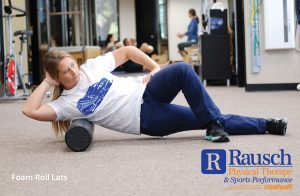
3. Foam Rolling Lats

rauschpt.net | foam roll for surfers

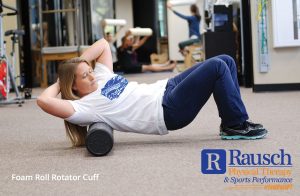
4. Foam Rolling Rotator Cuff (shoulder blade)

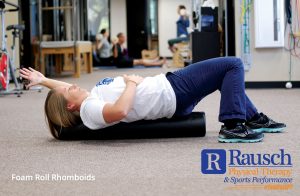
rauschpt.net | foam roll for surfers5. Foam Rolling Rhomboids (between shoulder blades)

rauschpt.net | foam roll for surfersSo, dust off that foam roller (or buy one after your next appointment at Rausch PT) and start using it! If you have any questions about foam rolling, come talk to me during your next PT session. Want to really get a good foam roll workout in? Take advantage of the new foam roll class at ABC Pilates, located in the same suite as Rausch PT.


StaffHeadshot-Ashley2Ashley Heller, MPT is the newest member of the Rausch PT team. She received her Masters of Physical Therapy degree at California State University, Long Beach and is passionate about working with patients with shoulder, knee and ankle injuries. With background in orthopedic-related injuries and post-operative rehabilitation, Ashley believes that the combination of manual therapy and personalized therapeutic exercise program is vital to recovery. As a physical therapist, it’s Ashley’s goal to help her patients better understand their injuries and the plan for their road to recovery.

Click to learn more about Ashley and our other physical therapists »

 

Lessons From Hiking Whitney

Mount Whitney is the highest peak in the lower 48  boasting nearly 15,000 feet in elevation, and second only to Mount McKinley in Alaska. Starting from the Whitney Portal, the hike is 10.7 miles to the summit. I recently had the opportunity to hike Mount Whitney, and it was an amazing experience. If you ever get the chance, do it! The beauty of the mountain is unreal, and the physical and mental challenges are unlike anything I have ever experienced.

Here are four tried and true tips for my fellow adventurers who are interested in hiking Mount Whitney:

    1. Get an early start. It’s recommended that hikers reach the summit by noon, so we started at 3 a.m. Early, I know, but I’d suggest the same start time to other hikers; it gives you time for rest breaks, puts you ahead of the crowds (trail congestion increases as the time gets later), helps you avoid bad weather on the summit, and gets you back down the mountain before nightfall.
    1. Bring water. 4-5 liters should be plenty, but water-needs depend on body size and fitness level.
    1. Find the right equipment. Hiking poles: absolute must. Hiking boots? A bit too much; a good pair of trail shoes did the trick for me. Also, I did this hike in July, so while I wore hiking pants, next time I’d just wear running tights. Layers are the key to comfort—tank top, long-sleeve shirt, jacket. Weather conditions vary depending on the time of year, which will effect your footwear and clothing choices. Ultimately, wear what you’re accustomed to hiking in.
      *I suggest doing a few training hikes in the gear you’re planning on wearing; that’s how I discovered the boots I’d planned on wearing were actually a horrible choice and avoided sore toes and blisters.*
  1. Last and most importantly: altitude sickness is REAL. Unfortunately, I wasn’t able to go as far as I wanted to  because I started experiencing symptoms of altitude sickness—a very real and dangerous thing when hiking at high-altitude.

The Deadly Truth About Altitude Sickness

There are two primary forms of altitude sickness: high-altitude pulmonary edema (HAPE) and high-altitude cerebral edema (HACE). HAPE is fluid accumulation in the lungs, while HACE is fluid accumulation in the brain; both can lead to a coma or death.

HAPE causes the obvious symptom of breathlessness (both with exercise and when at rest.) It can be deadly, especially when the breathlessness progresses to include elevated body temperature and coughing. HAPE has a high mortality rate in the absence of adequate emergency treatment.

HACE causes headache, dizziness, confusion and clumsiness. Drowsiness and loss of consciousness are major indications that HACE has reached a deadly level.

Often, these two conditions occur simultaneously, and again, this is very serious. Once symptoms start, they will progressively worsen and eventually lead to a coma or death. Immediate descent is the first course of action. Supplemental oxygen can be helpful in relieving symptoms and will essentially buy time.

How to Prevent Altitude Sickness

A prescription drug for altitude sickness does exist Acetazolamide (brand name Diamox.) The active ingredient is Dexamethasone, which prevents swelling in the brain and subsequently reduces symptoms. It is recommended that Diamox be taken several days prior to being at altitude as the side effects can be equally as bad and as deadly as the altitude sickness itself.

HACE occurs when your body fails to acclimatize while ascending to a high altitude; to prevent this, ascend slowly to allow the body more time to get used to the altitude. On the other hand, HAPE is difficult to prevent, as we don’t really know what makes some people more susceptible to it than others. Those with sleep apnea should be cautious, as should people who have experienced HAPE before.

Acute altitude sickness and all, it was an amazing trip. I would have saved myself the altitude sickness by training on Hypoxico Altitude Simulation System at the Performance Lab, which is something I will definitely do next time because we are already planning on going back.

[framedbox]Additional Links:


StaffHeadshot-Jessica copyJessica Snyder (PT, DPT, ATC, CSCS) received her Doctor of Physical Therapy degree at the University of St Augustine for Health Sciences – with an emphasis on orthopedics, movement science, and manual therapy. Jessica started her career as a Certified Athletic Trainer working with high school, college and professional athletes. She is also a Certified Strength and Conditioning Specialist (enhancing her ability to build custom strength, stability and performance-centered rehabilitation and return-to-sport programs) and Certified Natural Running Coach. Being a runner herself, Jessica specializes in running-related injuries, including the entire lower extremity. She is also passionate about treating headaches and neck/shoulder pain.