
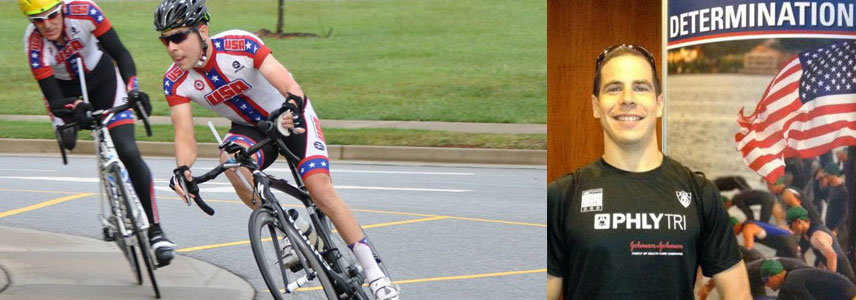
Billy Lister

Keeping the Challenged Athlete spirit alive. This month we are highlighting a very talented and inspiring individual, Billy Lister. He has seen life on both sides of the spectrum, spending half his life as an active athletic child and adolescent to having his world drastically changed and rediscovering his new potential and strength. Having earned a spot on the USA Paracycling team, Billy left his east coast home to make sunny southern california his new training grounds.

What kind of kid were you?

I was an athlete growing up, playing anything that would get me on a field. Sport was a lifestyle, and I was good at it.


At 15 your life took a bit of a turn….?

It was the spring during my freshman year of High School, of which I was newly entered into and was just getting to know my classmates; Springtime on Long Island, NY meant Lacrosse season.

A few weeks into the season, I started getting really bad headaches after practice. These were not garden variety headaches, and often forced me to go straight to bed once I got home. My parents took me in to see my doctor; but after multiple routine tests, nothing out of the ordinary showed up. Until my doctor decided to get an MRI scan of my sinuses, which he thought might be a major infection causing the headaches. Now, when you get a standard sinus MRI scan, it actually partially shows the lower hemisphere of your brain stem; and with nothing short of pure genuine luck on the uppermost corner of the scan is where they found the abnormality in my brain. To create a perspective of analogy, it’d be like falling into a haystack and finding a needle with Babe Ruth’s rookie baseball card attached to it.

What was the abnormality?

AVM is short for Arteriovenous Malformation, which often refers to a blood vessel in your brain that shouldn’t technically be there. It is something congenital (though not genetic), but serves no cerebral function. The danger it poses however, is very real; as at any time without warning it can rupture and can cause a brain hemorrhage. Many people can live a full and healthy life with an AVM and will never know the threat they face, while the fate of other less fortunate is marred in tragedy.

It only took a few days before I was sitting in front of the World’s leading Neurosurgeon at Beth Israel Hospital in New York City being told about my diagnosis. The most beyond imagination aspect of these chain of events was the headaches I was getting were completely unrelated to my diagnosis. It turned out I was just a stressed out High School kid.. go figure

To correct the malformation, I underwent invasive brain surgery at the age of 16. The surgery was a success in treating the AVM; however as a complication I started experiencing some swelling in my brain several months post op. The swelling led to some loss of function on my left side. I immediately underwent intensive physical rehab and was making strong gains, but then in June of 1999 at the age of 17 I suffered a stroke. My stroke was a very atypical event, where it actually was a slow and regressive process. Each day I woke up and couldn’t do something I could the day before; type on a keyboard, tie my shoes, brush my teeth, and eventually the ability to run. After about 4 weeks the episode had finally ceased leaving me in the full left side hemi paresis state I’m in today.

I’d been an athlete my whole life, playing everything I could find the time for. So when sports were slowly taken away from me, it was a tremendous burden to cope with. For many years I was coasting through life, going through the motions as a kid learning how to survive with a disability. And in that is a monumental point; I was only surviving life, I wasn’t living it.

What was the turning point that made you go from “just surviving life, to living it”?

There are certain junctures in life that shape the individual and person you become, and the path that you journey on. My stroke was obviously the first such moment, altering my future and the challenges I would face for the rest of my life. Other moments point you in a direction to where you belong in this world, and can be an awakening to what is possible. That second such instance was in August of 2011 when I attended a Paratriathlon camp for the Challenged Athletes Foundation, and got on a bike for the first time since I was 17 years old.

Since getting involved with CAF, where has life on two wheels taken you?

In the past 3 years since learning to ride a bicycle, I had competed in over 20 triathlons; reaching the podium in several of the National Paratriathlon races, and ultimately winning the points championship in the 2012 USA Paratriathlon series.

After relocating to Southern California, it didn’t take long to realize that my true athletic passion lied in the form of 2 wheels and a saddle. Only a few months after my relocation, in November 2013 I fully dedicated my training to the realm of Paracycling; and in less than 10 months managed to accumulate an abundance of highlights and growth trajectory potential.

In my very first cycling event, I entered into the US Indoor Track Paracycling National Championships at the LA Velodrome at the end of November 2013. Having only ridden a track bike twice in my life the week prior leading up, I came away with the victory in both of the events I entered. By the end of the weekend I had become a two time National Champion in the Men’s C2 Division, 3 Kilometer Individual Pursuit as well the 1 Kilometer Time Trial.

Once my target became racing on the Road, huge results quickly came into line. Based on my 1st place performance at the selection race in conjunction with US Pro Championships, I was named to the Team USA roster for the UCI Paracycling World Cup in Segovia, Spain.

Additionally given my times and ranking held throughout the US Paracycling National Championships weekend, am proud to announce I was also chosen to the World Championships team to represent Team USA on our home soil, a once in a lifetime opportunity. My ascension onto Team USA Paralympic Cycling has been explosive, but my growth potential is seen as an even greater advantage. With the ultimate goal to compete for the United States of America at the 2016 Paralympic games in Rio de Janeiro.

Check YOUR Engine Light!

“I saw the sign, but didn’t open up my eyes”! We hear it all the time. Your body tried to warn you. Your Check Engine light came on. It told you an injury was coming, but you decided to push through pain. It told you to get more rest, or you will get sick. We get it. Pushing ourselves is a true way to make progress toward improving our fitness and life goals. But we can’t achieve our personal best if we choose not to LISTEN TO OUR BODY!

Tune in to hear the alarms our bodies are sounding and know what to listen for. Stop popping ibuprofen just to make it through your next workout. You will run yourself right into an injury. Know how to identify if you have signs of overtraining. Listen to your body to solve sleep problems you may be facing.

Learn how to pay extra close attention to your body and it’s “check engine” light to improve your overall health, increase your vitality and enhance your performance.

Interested in learning more? READ ON!

Challenged Athletes Foundation

The Challenged Athletes Foundation (CAF) a non-profit organization, is a world leader in helping people with physical challenges get involved, and stay involved, in sports. Headquartered in San Diego with regional chapters, CAF provides unparalleled sports opportunities, hope, education and inspiration enabling physically challenged individuals to live active lifestyles.

CAF recognizes the athletic greatness inherent in all people with physical challenges and supports their athletic endeavors by providing unparalleled sports opportunities that lead to success in sports — and in life.”

HOW DOES CAF HELP?

More than eighty cents of every dollar raised provides funding for adaptive sports equipment, training and competition expenses, programs and events that help challenged athletes get off the sidelines and into the game.

WHY DO CHALLENGED ATHLETES NEED FUNDING?

There are 21 million individuals living with a disability in the United States today. Only one in 10 takes part in fitness activities on a daily basis. A major impediment is cost. Equipment and specialized training that allows these individuals to engage in active lifestyles is very expensive – in fact, for many, it’s cost-prohibitive and is not covered by insurance.

Join us for the “Best Day in Triathlon” in San Diego, October 19th for an amazing day and experience you will never forget!

Interested in learning more? Get involved here.


Gait This

There are many ways to do something, but often time there is a better or best way. Just because you can do something a certain way, doesn’t mean you should. Example: You can drive a car at 5000 RPM at all times. The car is fully capable of this and will withstand it…for a while. Your running gait is similar. You can get away with poor mechanics and gait for a while, but in the end it will catch up with you. It will present itself in the form of having to cease running, injuries, or being forced to slow down. None of these are desirable outcomes. The investment of a running gait analysis can really help to identify the key form flaws that will lead to major issues.

Did you know the Performance Lab offers such service? We call it “Run Right.” Get your running mechanics analyzed just in time for the off season of racing. Allow yourself the leisure of pressure free training while you strengthen and correct your run form.

Read more about Gait Analysis.

Questions? email jack@rauschpt.net Jack McPheron, Performance Lab Director


5 Season Success Tips

“Success is the sum of small efforts repeated day in and day out” – Robert Collier.

I couldn’t agree more with Mr. Collier, but what do those small efforts look like on an everyday level? What are the little things that your body needs to stay healthy as you endure a grueling season of ___________ (it all counts).

This list is meant to be encouraging. So don’t go getting all – “I don’t have time for that”, “I’m too busy to take care of myself, I have too much training/practice to do”. The key to this opportunity is SMALL. Remember, its all the little things that you do that keep you healthy and in the game.


  1. Have a great OFF SEASON! – this is your chance to let your body heal up. Get rested and get ready for the next opportunity to succeed. So if you skip this, you are missing out. Give your self 2-4 weeks of fun, play, recovery, something different. When making your training program, start with a defined off-season. Whether your 11 or 59 playing baseball or running a marathon, your body is not meant to do the same thing all year round.
  2. Get STRONGER – that’s right people strong and stable muscles get hurt less, they protect joints, they hit the ball further and they protect you. So get stronger. The pre-season time is best time to make this happen. 3-5 strength workouts per week: weights, crossfit, boot camp, ABC Pilates, Run Fusion, etc. You can strength training (and you should) during season too, but knock it down to 1-2 strength workouts per week.
  3. Build your CORE – your core is where its at. Its the center of you, its the first thing that contracts when you throw a baseball and it should be engaged during your entire marathon. It can be trained daily and core work should be challenging but fun. No I am not talking about sit ups here, they work your abs and make you look good on the beach; but they don’t do much for your core. I’m talking about Planks, Overhead Squats, Spiderman’s, Pilates, Inch-worms, etc… These strengthen and stabilize the center of you so that your arms and legs can be awesome.
  4. RECOVER every day – if you want to feel great for tomorrow’s workout. Your time spent recovering each day is dependant on how long and how hard your days workout was. It can be as easy as icing your throwing elbow, to as long as wearing compression pants for 6 hours after your workout. Remember, how you recover today will determine how well you start practice tomorrow.

Check out these RECOVERY opportunities:

  • Cool Down for 10 minutes after your workout (stretch, drills, technique work)
  • Ice if it hurts or is sore for 10 minutes. Or if you really want to treat yourself, jump in an ice bath for 8 minutes.
  • Compression Pants – these work great to reduce lactic acid build up, flush your legs, and are research proven to make you run/ride faster tomorrow. 3-6 hours of wear after your workout is best.
  • Stretch – spend 2 minutes stretching every muscle you used in todays practice. Slow and easy. And if your coach tells you not to stretch because it will make you slower, find a new coach (yes, I’ve heard this before:)
  • Tissue work – foam roll, massage stick, massage, ART, etc. All of it works as long as you do it! This is the most important step to recovery. Spend time rewarding your tissues for the hard work they put in today. In fact, if you are going to pick one thing to do out of this whole post, PICK THIS ONE!
  1. Technique – spend time honing in your technique. Work on your mechanics, do focused drills in your warm up and cool down during every workout. This is a great way to prevent injury, because the vast majority of overuse injuries come from flawed techniques. Did you know that during a 3 hour bike ride your knees bend and straighten over 16,200 times! If you do it wrong 16,000 times every workout, you’re going to get hurt! Same goes for baseball. If you throw the ball 100 times per game with bad mechanics your elbow and your shoulder will get injured. So do it RIGHT. #RunRIGHT, #BikeRIGHT, #ThrowRIGHT – biomechanical analysis and movement correction to help you get it RIGHT.
  2. Get Treated – often. Your body goes through a lot every practice. Not all of it ends up in an injury, if taken care of. But it will end up in the dreaded time off, season ending, ordeal if you don’t listen to your body and get it worked on. Who works on you is up to you, PT’s, Chiro’s, ART’ers, Massage Therapists, etc are all great at keeping your tissues healthy. So find someone in your area, that helps make a difference. Of course Rausch PT has 7 PT’s, 4 massage therapists, an ART guy, and a whole rad team to keep you in the game. I know not everyone reading this lives in the OC. So go find someone that know’s how to work with athletes and can keep your tissues healthy. The more often you get treated the better you’ll feel, practice, respond, and succeed.

Bottom line, take care of your body this season and it will take care of you.

“Listen to your body when it whispers to you, because when it screams at you its too late”Amber Neben, World Champion Cyclist.

I love this line from Amber, she’s right on. Do the little things that add up to a successful season of whatever you play. Parents, you’ll have to chat with and keep up with your kids as they work hard on their teams. Pain is never normal in any sport for any reason. Utilize the #fastpassPT option at Rausch PT to get in right away. No prescription needed to get examined and fixed by the best PT’s.

One last point – as the end of the year is coming soon. You have the opportunity to use Flexible Spending and Health Savings Accounts – you can use these towards our Performance Lab services. Right Right. Bike Right. Throw Right. VO2 Max. AlterG. ABC Pilates. Custom Orthotics and Hypoxico.

Kevin signature

October 2014

Keep in touch with the events at Rausch PT and Sports Performance. Here’s some dates to save this month! If you have a question about any of the events listed, please contact us! (949) 276-5401 or info@rauschpt.net.

October 2014

caf CAF San Diego Tri Challenge
Dubbed the Best Day in Triathlon, come support the Challenged Athletes Foundation.

October 19th
La Jolla Cove

renegade Renegade Racing
Halloween 10 mile run, 10K, 5K, and kids run. There is something for everyone.

October 26th
Salt Creek in Dana Point

turkeytrot Turkey Trot
Get your run in BEFORE you stuff your face. 10K, 5K and Kids Gobble Wobble (1 mile).

November 27th
Dana Point