
Finding the Best Kinesiology Tape for Your Body

You’ve seen it on professional athletes, you’ve seen it on weekend warriors, and if you’ve been to our clinic you have definitely seen it on our patients. So what exactly is that colorful, stretchy tape, and should YOU be using it, too?

Go into any sporting goods store and you’ll immediately notice that there are many different brands of kinesiology tapes out there (each claiming to be better than the other,) but what exactly separates the different brands? More importantly, how do you know which one will help best with your own recovery? To answer these questions, you first have to understand what k-tape is and how it works.

What is kinesiology tape?

The basic idea behind all kinesiology tapes is that they are elastic, which means that they stretch and move with you. This is in contrast to your average white athletic tape, which is more rigid and hence limits mobility. Most kinesiology tapes have a heat-activated adhesive component, which allows the tape to last a few days on clean skin without peeling off (even after showering!) Some brands offer cotton-based tapes with natural dyes, while others have more of a nylon component with artificial coloring. Some tapes come pre-cut, while others are sold in roll form. If applied properly, they all essentially do the same thing.

How does kinesiology tape work?

The most common ways to tape muscles or joints using kinesiology tape is to ask yourself why you are taping in the first place: are you taping to inhibit (relax/shut down)? Facilitate (activate)? Stabilize, control edema/swelling, or control pain? Each of these techniques requires specific placement and different tension application in order to perform their duty. While you can certainly YouTube “K-Tape,” “Rocktape,” “Kinesiotape,” etc. and find millions of videos on how to fix that pesky ITB issue or stabilize a knee cap that won’t stop moving, it’s best to have a professional teach you the specifics and application technique to receive optimal care and avoid the potential for other injuries.

You’ll probably notice that most brands have a swirl pattern of adhesive on the backside of the tape. Not only are they cool to look at, those swirly lines also serve a purpose. The swirls expand and recoil based on the amount of stretch a practitioner applies to the tape, targeting small receptors within the skin and underlying tissues to assist with healing. The amount of tension applied, the area of skin covered, and the directionality of how the tape is applied are all key factors in getting the best results.

Kinesiology tape DON’Ts

Now, some of the following may seem silly to some and have you saying, “Duh!” Nevertheless, I have to caution you on the following issues you can run into with kinesiology tape, as I wouldn’t bring them up if they haven’t happened to some poor soul in the past.

  1. Make sure you DO NOT have an allergy to adhesives. Most tapes are latex-free, however if band-aids and other similar products irritate your skin, k-tape may not be in the cards for you.
  2. Watch out for body hair. If the area you want to tape is hairy, it may be a good idea to shave or trim the hair before application. The tape will not stick very well if there’s too much hair, as it’s meant for direct skin contact. More importantly, remember this rule of thumb: sticky + increased activation with heat + a few days of activity = OUCH!! when it’s time to peel off.
  3. If the tape is itchy or causes more symptoms, remove it immediately. There’s no point in getting a rash or having increased discomfort.
  4. The tape has water repellent properties, so pat it dry with a towel after a swim, shower, etc. Due to the heat activation properties of the adhesive, I DO NOT recommended using a blow dryer to get the tape dry (Please refer to #2 for THAT outcome!)
  5. Lifesaver tip: the tape is de-activated with oils. So, if you find the tape painful to remove, grab some lotion, baby oil, olive oil, etc. and slowly peel back while applying the oil to the adhesive side of the tape.


So, which kinesiology tape is best for you?

When taped appropriately, most products will give positive results and can stay in place anywhere from 3-5 days or more, depending on location, activity, sweat factor, etc.  Again, in order to achieve optimal results and ensure you’re applying the tape specifically for your body’s needs, have a professional teach you first.  That being said, my recommendation for the best go-to brands would be either Kinesio Tape or RockTape. Both have proven to be super effective and tend to last longer than their other counterparts.


Lyndsay

Lyndsay DeFilippo PT, DPT, CKTP received her Doctorate of Physical Therapy from New York University in 2010. She’s a Graston Practitioner and a Certified Kinesiotaping Practitioner. Lyndsay looks at each injury as a constantly changing puzzle, which is only solved when her patient returns to what s/he loves doing. She enjoys helping with the full recovery process, which includes providing the education, tools and fundamentals to prevent re-injury and the potential for new injuries.

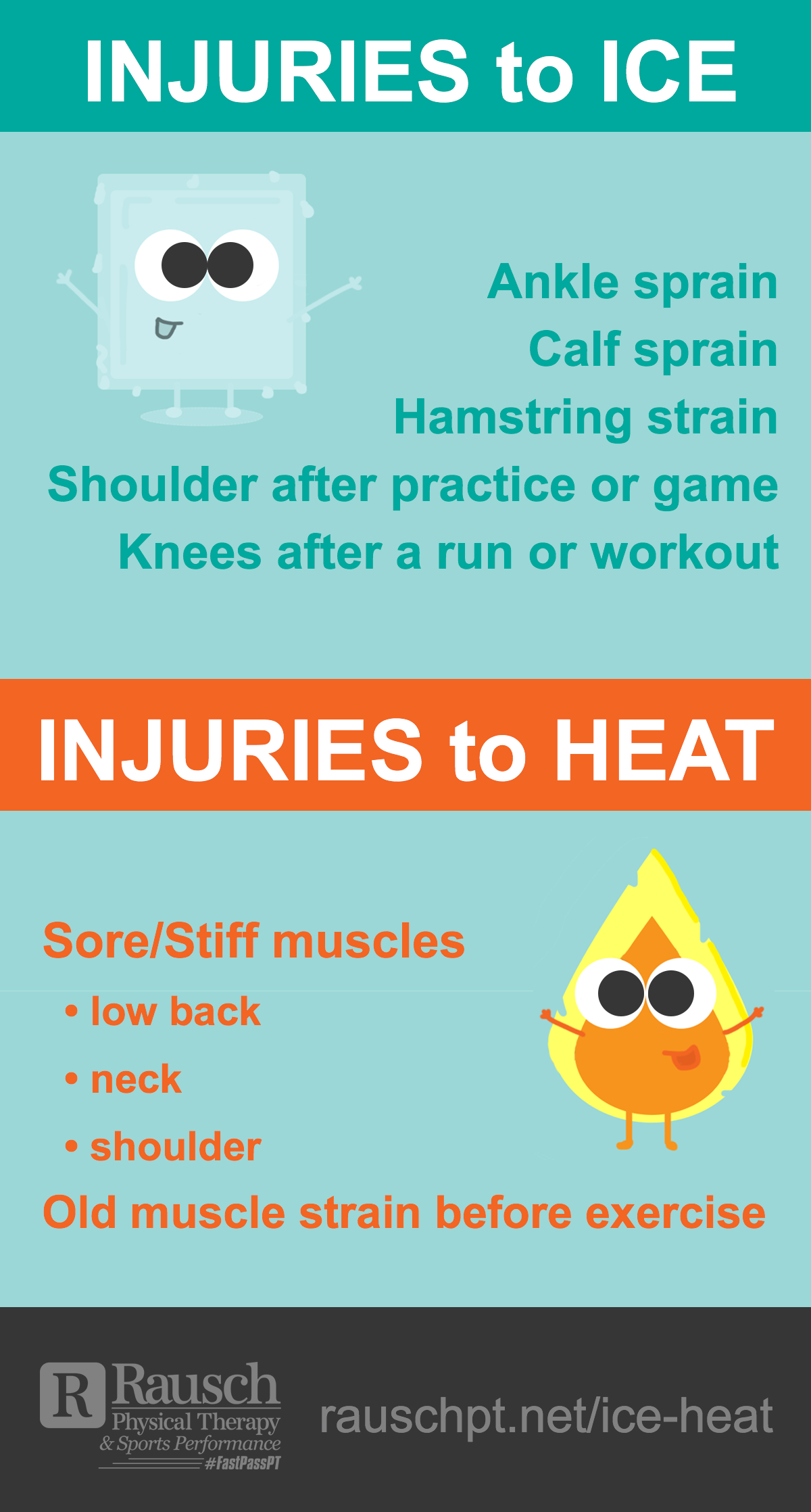
Should I Ice or Heat My Injury?

As a licensed physical therapist, I have been asked about ice versus heat many times. “When should I use ice?” “When should I use heat?” “What about IcyHot?” Then, there are the patients with pulled muscles who ask me, “Should I try to stretch it?” So, ice versus heat: which should you be doing? Well, it depends.

When to Use Ice

As a general rule, I advise using ice for any acute injury (injury occurring within the last 48-72 hours.) Ice will control the inflammation and prevent a muscle or joint from becoming so puffy and stiff that it cannot heal properly. Now, there are some people in the world of sports medicine who will argue against the use of ice because they believe inflammation is part of the natural healing response. This is absolutely true, however,the inflammatory process occurs immediately; so even the fastest application of an ice pack will not beat this natural inflammation.

Rausch PT Ice-Heat-InfographicApplying ice simply prevents the natural inflammation and swelling from becoming excessive and potentially causing secondary tissue death, which happens when there’s so much swelling that blood flow is completely blocked and healthy tissue becomes hypoxic. In clinical practice, uncontrolled swelling turns into pitting edema (a thick, putty-like substance that leaves an indentation when you press on the tissue.) This in turn leads to a stiff and—what I describe as,—“sticky” muscle or joint.

If your injured area is s hot, swollen or painful, ICE IT. Crushed ice is the best at reducing tissue temperature since it undergoes an actual physical change (from a solid to liquid.) But be warned:ice burn is a real thing, and I usually see this with the use of gel packs. To avoid ice burn, use a pillowcase as a barrier between the skin and gel pack. Ice for 10 to 15 minutes at a time. For a brand new injury, ice can be applied hourly.

When to Use Heat

For anything that is stiff, tight or sore, I typically recommend heat. This usually applies to chronic and ongoing injuries – the neck or low back pain after a long day of sitting, or shoulder pain after working on the computer. Heat increases blood flow, relaxes muscle and makes the other fascial tissues more pliable (i.e. the joint capsule.) Physical movement or exercise is actually the best way to increase tissue temperature because your body is warming from the inside. Yes, believe it or not, gentle exercise (walking, stationary cycling, etc.) will actually do more for you than a heat pack.

IcyHot and other topical heat rubs targets the superficial sensory nerve fibers to create the sensation of cold or heat, which can reflexively cause muscle relaxation by inhibiting pain. Does it help with healing? No, but it doesn’t hurt either. Know that there is no magic solution.

Whether you are using ice or heat, , ice and heat application should be part of an all-encompassing rehabilitation program – including soft tissue mobilization, strengthening and re-training of motor control and movement patterns.

Pulled Muscles: Stretch or Don’t Stretch?

First off, you should always do a proper warm-up and cool-down to help prevent pulling a muscle in the first place. However, if you have a pulled hamstring or strained calf, DO NOT stretch it. You should never try and stretch an already over-stretched muscle.. A muscle strain occurs when the muscle fibers are pulled beyond their ability to recoil properly, so they snap back. Yes, I know it’s tight, but if you pull on (stretch) it,  the muscle will only continue to tighten and add to the current strain.

Instead of stretching it, now would be an appropriate time for ice, and in a couple of days you can start heating, foam rolling and stretching. If you have any doubt, you can schedule an evaluation with your Rausch physical therapist who will  assess the severity of your injury and let you know  when you can start stretching it, as well as help you to strengthen the area to prevent straining the muscle a second time.


Jess-web

Jessica Snyder (PT, DPT, ATC, CSCS) received her Doctor of Physical Therapy degree at the University of St Augustine for Health Sciences – with an emphasis on orthopedics, movement science, and manual therapy. Jessica started her career as a Certified Athletic Trainer working with high school, college and professional athletes. She is also a Certified Strength and Conditioning Specialist (enhancing her ability to build custom strength, stability and performance-centered rehabilitation and return-to-sport programs) and Certified Natural Running Coach. Being a runner herself, Jessica specializes in running-related injuries, including the entire lower extremity. She is also passionate about treating headaches and neck/shoulder pain.