

Client Spotlight: Julie Grable


On your first visit to Rausch Physical Therapy & Sports Performance, your PT will ask you what your goals are so s/he can develop a plan to help get you there. For Julie Grables, “there” was Athens, Greece.

Julie was all smiles after finishing her 10th full marathon, but her road to Athens gold wasn't easy.
Julie was all smiles after finishing her 10th full marathon, but her road to Athens gold wasn’t easy.

Julie Grable is no stranger to accomplishing spectacular goals in style. Last year she completed her 50th half marathon on her 50th birthday, so this year Julie knew she wanted to do something special to celebrate her 10th full marathon. With the New York, Chicago, Washington D.C. Marine Corps., and (3x) Los Angeles Marathons already under her bib, Julie’s husband suggested they go somewhere “exotic” for her 10th full marathon.

An Ancient Tale

The Athens Classic Marathon follows the route of the very first “marathon,” ran in 490 B.C. by Pheidippides, a Greek messenger. He ran from the battlefield in Marathon to Athens to announce that the Persians had been defeated in the Battle of Marathon. After running the distance and announcing victory to the government, legend has it he collapsed and died.

“A story that the Greek like to share with youespecially the collapsing and dying part—whenever you mention you’re in town for the Marathon!” Julie said.

Since she’d never ran an international race before, Julie quickly booked her spot for the ancient race in November and began training.

Tear-ible News
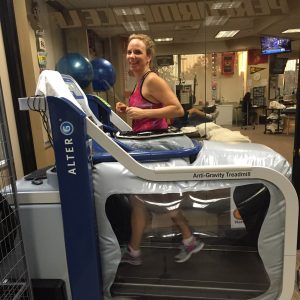
AlterG
Julie was able to use the AlterG to keep training for the Athens Marathon while injured.

However, after several months of painful running, Julie knew she had a problem. With four months left before the big day, she came into Rausch PT hoping to get back on track. Physical therapist Ashley Heller suggested Julie had a high hamstring strain. Two months after that, Julie went to get a MRI and was diagnosed with a high-grade tear.

“I had one other running-related injury years ago, and the suggestion from the physical therapist I saw then was, ‘Don’t run.’   Not an option!” she said.  “I love that Rausch [physical therapists] understand their clients’ goals and support them.”

Initially, Julie’s hope was to be back to pain-free running for the Athens Marathon; it quickly became clear that her sole goal was to manage the injury and get through training without making it worse.

“Without PT, the AlterG (Can you say love/hate relationship?) and the Rausch Team, I don’t think I would have even made it to the starting line,” she said. “In addition to the PT, Ashley helped me work on my running form and gave me lots of good tips to help with training and the race itself.”

Bravo, Jules

During her final appointment before the big race, Ashley taped up Julie’s hamstring for the 15-hour flight to Greece and sent her on her way. Since she had to significantly alter her training program to ensure she wouldn’t aggravate the injury, Julie says she felt very unprepared and undertrained on race day.

“I was even more nervous for this marathon than I was for my first one, probably because I know how far 26 miles is to run!”

Here’s what Julie had to say about race day:
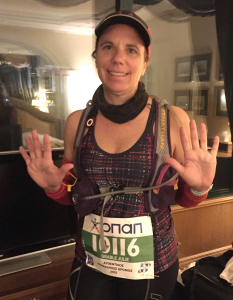
Medal
Julie ready to tackle her 10th full marathon in Athens, Greece.

I was SO nervous, but once I got to the starting line and saw all the festivities and started talking to other runners, my nerves calmed a bit. I knew I had eight hours to finish and my plan was, worse case, to walk the race.

When the race started, I immediately knew it was not going to be as bad as I thought. I listened carefully to Ashley’s voice  in my head telling me, “Slow down, take small prancing strides, walk when needed and you can do it.” I was shocked that I did not feel my hamstring until 11.73 miles (Yes, I know exactly when I felt the first twinge.) […]

It was amazing to run along thousands of runners from all over the world and to be cheered on by the locals yelling, “Bravo! Bravo!” Once I go into the City of Athens (around mile 23) I knew I was going to finish the race with plenty of time to spare. At that point my brain took over and I just dug in for the last three miles. The race finishes in the Panathenaic Stadium, which was host to the ancient Olympic games. There were crowds of people in the stands cheering, and I was scanning for my husband when all of the sudden I heard, “Jules! Jules!” and saw him waving and taking photos. I always cry when I finish my marathons, and this was no exception.

According to Julie, this experience was her most unique training season and race. While she finished 1:40 minutes longer than any of her previous marathons, Julie says she finished faster than she thought she would and “simply did not care.”

“I am thankful for the support of everyone at Rausch PT and know they will get me healthy for my next race. I have not ruled out the Vancouver Marathon in May 2016…”


Health Care Companies Don’t Care About Your Health

You are wasting your money, and you’ve been at it for a while now.

I’m talking about health insurance. Legally everyone has to have it, but really, what has your health insurance done for you lately? Odds are: not much.

The Issue with Insurance

Most people won’t get through their deductible this year, and a large population won’t even see a specialist at all. So, if you paid your $1000 monthly premium (the average family price) and were relatively healthy this year, you’ll have paid your insurance company more than $12,000 with little-to-no benefit in return (And remember, health insurance is not like cell phone minutesthere are no roll-over programs for unused premiums.) This scenario is exactly what your health insurance company hopes will happen.

Every day you are inundated with television commercials, social media ads and mailers sent to your home from big health insurance companies, such as UnitedHealthcare, Kaiser and Blue Cross. They want your premium, and it must be pretty big business since these companies spend hundreds of millions of dollars just to get little ‘ol you as their client. Obviously you’re valuable to them, and they clearly want you as a member, so why do they make it so difficult for you to actually use your benefits once you are a member?

The Cyclist and the Insurance Company

Quick story. Most of you know that Rausch Physical Therapy is the premiere place to rehab injured cyclists in Orange County. Well, we recently had a patient fresh off knee surgery (Let’s call him Joe.) Joe’s a young guy, great cyclist, and he was more than eager to get on the road to recovery so he could get back on the road—an ideal physical therapy patient. There was just one issue: Joe’s insurance. UnitedHealthcare only allotted Joe six PT visits post-surgery. That’s it! Six visits gets him three weeks of therapy; that’s barely enough time to get Joe to bend his knee all the way, let alone get him back on the bike.

Now, here’s the kicker: his insurance company, UnitedHealthcare, has its own professional men’s and women’s cycling teams. That’s right, UnitedHealthcare pays $10 million every year to put its name on a blue cycling kit, but refuses to pay for the PT Joe the Cyclist needs to get back to cycling. Joe’s monthly premiums help UnitedHealthcare pay for its sponsorship costs, and in return UnitedHealthcare limits Joe’s coverage. How is UnitedHealthcare taking care of Joe’s health at all in this situation?

How Insurance Companies “Manage” Your Care

To be fair, UnitedHealthcare is not the only offender in this insurance game. Recently Anthem Blue Cross (BC) sent out letters to its constituents notifying them that it had hired a company called OrthoNet to help manage their physical therapy benefits. Reading between the lines, “help manage” really meant “to help limit your right to direct access to PT and the benefits you pay for each month.” Luckily for BC members, this plot never had the chance to come to fruition because OrthoNet has been sued and brought up on charges in other states for arbitrarily limiting benefits to the members it had been hired to “help manage.”

So, why would BC hire such a bad egg? What was in it for them? Combine the OrthoNet debacle with Joe’s story, and it suggests that it turns out your health insurance company is not really interested in your wellness, but rather in its bottom line. Health insurance should not be this way! The people whose hands you put your life (and money) in should be about supporting and restoring your health, plain and simple.

Okay, Quick Recap…

  • You have to have health insurance.
  • Companies spend millions of dollars made up of your paychecks to try to get new clients instead of to pay for your care.
  • They don’t want/plan to actually pay for your health care, and they will try whatever it takes to not pay the providers that do care for you.


How to Beat the Insurance Game

Now I know this sounds like a lot of negativity, and sometimes it’s overwhelming to think about the frustrating state our health care system is in. However, there are a few things you can do to fight for your health and improve your well-being.

  1. Think ‘prevention’ and avoid unnecessary copays. Exercise every day, do yoga every week, get a massage every month, and eat well at every meal.
  2. Never let your insurance limitations limit your care. Most providers genuinely care about their patients’ well-being, and they will try to come up with a way to work around your insurance issues, such as a cash pay discount.
  3. Get the care you need, then demand payment from your insurance. While your provider will do its best to help, ultimately it’s up to YOU to get payment from your insurance company. As their client you’ll have a lot more pull in that conversation.
  4. Report any insurance issues to the California Department of Managed Health Care. Don’t be shy; these guys are here to help, and it’s the only way your insurance company will ever be held accountable. Click here for the forms you need to file a complaint.

So be proactive. Nurture your wellness daily, and demand access to the care you pay for and deserve. Don’t be intimidated by your insurance company; we’re here to help.

All the best to you and your family this holiday season and upcoming year.

Stay healthy and run faster,

Inbox-35061-messages-1987-unread


StaffBioPage-KevinAs the president and founder of Rausch Physical Therapy & Sports Performance, Kevin Rausch, PT, MPT takes great pride in the care of every single patient he treats. Kevin specializes in sacroiliac joint dysfunctions, running and cycling injuries, and return-to-sport planning for athletes. Since the first day he opened his clinic in 2006, Kevin has strived to provide the best in care, service and technology so as to strengthen his patients’ total body health and get them back to doing what they love.
Find Kevin on Google+


Best Foam Rolling Exercises for Surfers’ Shoulders

As a licensed physical therapist, my passion is helping others. I love being able to help my patients feel better so that they can get back to doing what they love. There’s nothing better… except maybe my other passion: surfing.

I started surfing competitively at a fairly young age, and I continued through high school and college. Nothing compares to that feeling you get when you make a big turn with a good board under your feet and spray in your face. Surfing continually pushes you physically and mentally; the more physically challenging, the more rewarding it is. But with two decades of competing under my wetsuit, I know how hard it is to continuously battle those waves year after year without suffering an injury or two along the way.

So, here are some pearls of wisdom from a surfing PT to improve your paddling mechanics and minimize your risk of injury.

Common Causes of Surfing-Related Injuries

Shoulder impingement is a common injury in sports that require repetitive overhead shoulder motions, such as surfing, paddling, swimming and baseball. Restoring proper shoulder alignment is essential to reducing the risk of impingement, tendonitis and instability.

Rounded Shoulder Posture

Over time, paddling can create muscle imbalances in surfers, which often results in “Rounded Shoulder Posture.” Rounded shoulders, also known as shoulder protraction, can interfere with proper shoulder mechanics for paddling. Tight internal rotators (pecs, lats and subscapularis) limit the shoulder’s ability to externally rotate when reaching overhead to paddle. This can ultimately lead to bursitis, impingement, tendonitis andif left unaddressed—potentially a rotator cuff tear.

Limited Thoracic Extension

Thoracic extension, or extension throughout the upper spine, is crucial to maximizing shoulder mobility and preventing joint dysfunctions in the shoulder and neck. Limited thoracic extension also contributes to Rounded Shoulder Posture and limits the range of motion us surfers need to elongate our stroke when paddling. By addressing restrictions in thoracic extension, you can improve the biomechanics of your shoulder to optimize strength and stability while paddling.

Five Foam Rolling Techniques to Improve Mobility for Paddling

The foam roller is a simple yet important piece of equipment that can be used in a variety of ways to target and stretch different muscles to help decrease the tissue tension and adhesions/knots you can get from paddling. Try these five foam rolling exercises for shoulders to help maintain flexibility, minimize Rounded Shoulder posture, and workout any knots/trigger points after a hard day of hitting the waves.

1. Foam Roll Pec Stretch and Lacrosse Ball Release

rauschpt.net | foam roll for surfers2. Foam Rolling Thoracic Spine with Extension
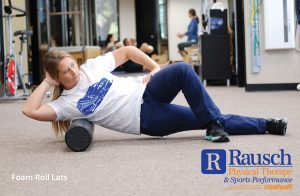
rauschpt.net | foam roll for surfers

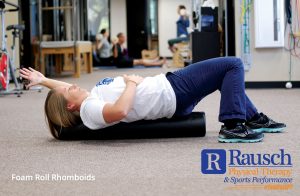
3. Foam Rolling Lats

rauschpt.net | foam roll for surfers

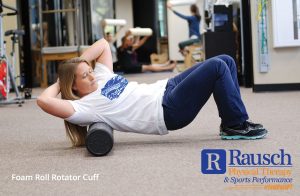
4. Foam Rolling Rotator Cuff (shoulder blade)

rauschpt.net | foam roll for surfers5. Foam Rolling Rhomboids (between shoulder blades)


rauschpt.net | foam roll for surfersSo, dust off that foam roller (or buy one after your next appointment at Rausch PT) and start using it! If you have any questions about foam rolling, come talk to me during your next PT session. Want to really get a good foam roll workout in? Take advantage of the new foam roll class at ABC Pilates, located in the same suite as Rausch PT.


StaffHeadshot-Ashley2Ashley Heller, MPT is the newest member of the Rausch PT team. She received her Masters of Physical Therapy degree at California State University, Long Beach and is passionate about working with patients with shoulder, knee and ankle injuries. With background in orthopedic-related injuries and post-operative rehabilitation, Ashley believes that the combination of manual therapy and personalized therapeutic exercise program is vital to recovery. As a physical therapist, it’s Ashley’s goal to help her patients better understand their injuries and the plan for their road to recovery.

Click to learn more about Ashley and our other physical therapists »


How to Alleviate Tender Trigger Points

We’ve all felt it, that radiating pain that shoots throughout your head and neck when you touch a small spot in your back muscle. You may have heard of trigger points, but what are they exactly, how do they impact your body, and—most importantly—how do you get rid of them?

Trigger points are bands of muscle fibers that are not happy; it’s like a traffic jam of tension that fatigues your body of energy. Trigger points are essentially are a build up of metabolic waste products that blocks blood flow, short circuiting the motor units with excessive neuronal impulses. Or, plain and simple, trigger points are those tender bits you always massage at the end of the day that never really seem to go away.

Active trigger points are tender without physical touch. The latent trigger points only hurt when pressed on them, like when you get a massage. The latter are more common with acute injuries and are a way for the body to protect itself, so be nice to these ones if you try to work them out yourself.

So now that you better understand why trigger points hurt, now how do you get rid of them? For my patients suffering from active or latent trigger points, I suggest the following three solutions:

Fix #1: Straighten Up

Poor posture is the root cause of trigger points for the majority of people. Start thinking about your posture throughout your day; whether you’re sitting at your desk or working out, correct postural alignment will reduce chronic strain. A good illustration of how the muscle acts according to your posture is the Upper Crossed Syndrome diagram. I show this picture to my patients to help them understand which are the stretched out, weaker muscles vs. the bound up, tight muscles.

Proper Posture 101

Try to imagine that there is a cable pulling you upward by the back of your head. Gently tuck your chin and roll your shoulders back and all-the-way down (Ease off a little so no strain is felt.) Next, find your neutral pelvis position: place your hands on your hips and find the middle between arching your back and rounding your back. This middle ground is the neutral pelvis that takes stress out of the muscles, ligaments, discs, and joints of the lower back.

Perfect posture is not easy to hold for long periods of time, so try building a new habit of getting up every 20 to 30 minutes to correct your posture. After about three months of actively correcting your posture, your body will automatically correct itself and with less difficulty.

Fix #2: Cross Train

Cross training is a great way to balance the body; by strengthening the opposite muscles used during your typical sport/activity, you’ll avoid overuse or burn out patterns. If you play a sport that requires a lot of lower body power, such as soccer, take a couple days to focus on working out your upper body.

Cross Training for Cyclists

If you’re a cyclist, a great cross training workout for scapular strengthening is what I call the “Three-way Band Exercise.” Start your workout on a trainer with a resistance band in your hands. Organize your posture and spread the band with thumbs facing backward with a slight shoulder-blade pinch. Don’t let the arms come forward; keep them in that “T” position to build the back muscles in parallel fiber alignment, which helps you keep your shoulders back during postures on the bike. Personally, I don’t start counting to 15 until I start to feel the burn. Don’t forget to get those shoulders down away from your ears when your doing this, just like they should be when you ride.

Fix #3: Have a Ball

I either have a tennis ball or lacrosse ball with me at all times to roll out knots. I typically like to lie on the ball and shop around until I find the tender bits along the inside of the shoulder blade (scapulae.) Then I’ll breath deeply into the tender area. I usually wait for about 50% reduction in pain or stiffness, and then move to another spot. Don’t do one spot for too long or it will get irritated later. Keep a ball in your car and soften up those spots as you drive home from work or a workout.

Trigger points are nasty, annoying things, but with a visit to a massage therapist, consult with a physical therapist, or just a little effort on your own part, you can work through it.


DustinDustin Hancock, DPT graduated from San Diego State University with a bachelor’s degree in kinesiology/nutrition. He went on to receive his doctorate in physical therapy in 2011 from University of St. Augustine, and began his career at Rausch Physical Therapy and Sports Performance in 2012. As a snowboarder and mountain bike enthusiast, Dustin specializes in treating extreme sport athletes. As a physical therapist, Dustin says he looks forward to being a companion every step of the way on his patient’s path to recovery.

Click to learn more about Dustin and our other physical therapists »