
Client Spotlight: John Elliott


At 72 years old with progressive heart and lung conditions, John Elliott may not be able to speak loudly or for a long time, but he has a lot to say. As one of our long-time patients, John is a staple around the clinic, and his determination and attitude continues to inspire our staff to get involved and never give up.

John Elliott first came to Rausch Physical Therapy & Sports Performance nearly six years ago, when a car barreling down the wrong side of the road hit him head-on as he was waiting at a stop sign on his bicycle. John suffered shoulder, leg, ankle, and neck injuries, which meant a good deal of intensive physical therapy. According to John, he’d been to physical therapy at a number of facilities over 30 years, but the approach and atmosphere at Rausch PT took him by surprise, especially its focus on sports recovery and performance.

“Since being treated [at Rausch PT], I can’t imagine ever again being treated by a PT who has not participated in sports and experienced the strains and issues that attend just about every sport. Sports injuries are not ‘if,’ they are ‘when,’ and I feel that a PT who has experienced these issues has a better understanding than someone who just got it from a book or as feedback from their patients.”

Ride On, John

John has been a cyclist his entire life, a fact that his cardiologist now says is the major reason why he’s survived his heart problems. Ironically, 25 years ago his heart and lung issues nearly forced him off the bike for good. John is a retired Nuclear Health Physicist, and when an industrial accident in an adjacent laboratory facility impacted his health enough to force me into a disability retirement, it also drastically impacted his life-long road bike activities when balance became a major issue.

Apparently 50 years of riding 2,000 to 4,000 miles a year was too hard to abandon, so John researched his alternatives and eventually purchased a recumbent racing trike. It was during his daily trike rides when John met two Challenged Athletes, also riding adaptive cycles, who encouraged John to re-enter competitive events through Challenged Athletes Foundation as a relay triathlete.

So, at 65 years old, John entered his first event, and since then (between yearly hospitalizations) John has been able to complete several races each year, from sprint tri events to an Ironman 70.3 event. However, his most treasured event is the San Diego Triathlon Challenge benefiting CAF.

Challenge Accepted

“CAF and the mentoring program are major inspirational forces in my life, and have become an inseparable part of cycling for me,” John said. “Working with athletes facing many different physical challenges always reaffirms my belief that the easy roads only lead downhill; you owe yourself the climb!”

It was John who introduced Rausch PT to the Challenged Athletes Foundation in 2013. The residual pain from his car accident injuries prevent John from running or swimming, and so he always enter triathlons as a relay team member. In 2013, John wanted to have his support team behind him, so he approached a few Rausch PT staff/athletes to join his relay team, and ever since then John has been a driving force behind our clinic’s involvement in CAF and SDTC. This year alone, Team Rausch PT raised more than $10,000 for CAF… thanks to John’s encouragement to never give up.

John nearly didn’t get to race this year after undergoing bypass surgery in June. With only four months until his 44 mile bike race at SDTC, John’s surgeon said it wasn’t going to happen, that it would at least a year to recover from the surgery. In fact, John wasn’t even allowed to walk outside until mid-July, or get on a bike until August for his first 2-mile “baby steps” ride. Nevertheless, John says that his years of physical therapy at Rausch PT, learning how to re-train his body after his 40 heart hospitalizations to-date, really paid off. His physical therapist, Dustin Hancock, coordinated with John’s cardiac rehab team to modify John’s PT treatment to the realities of “being held together with wire and glue,” as John puts it. Dustin also helped coach John on how to work in 1,200+ miles of progressively increasing distance and speed cycling in just two shorts months before SDTC.

“The best part for me is always the actual event–the fun, companionship, and inspiration of all my teammates and all the Challenged Athletes. That, and the satisfaction of having made it back to the starting line one more time!”

Never Give Up

John says the hardest part of his recovery journey is the progressive nature of his heart and lung issues, along with aging. Each trip to the hospital means weeks of conditioning before he’s cleared for cycling again, which means keeping a training schedule can be difficult. Still, John says he’s confident that with the clinic atmosphere, the skill of the PTs and helpfulness of the PT aides, and the fact that the staff at Rausch PT listen to what you are saying about your injury and progress will keep him in the saddle for as long as possible.

“I don’t plan on stopping my riding, so I probably won’t ever stop needing PT at Rausch.”

Your Prescription to Wellness in 2017


In the past, physical therapy has primarily been a field of reactive treatment for an issue, a way to get you back to good health. But is that really the best way to take care of your well-being? Kevin Rausch, President and Owner of Rausch Physical Therapy & Sports Performance, shares his new vision for the future of PT to better serve YOUR health and wellness.

KR-BLOG
BY KEVIN RAUSCH, PT, PRESIDENT OF RAUSCH PHYSICAL THERAPY

During Christmas dinner this year, I overheard my son ask his uncle (my baby brother, the L.A. firefighter,) “How do you put out a fire?” My brother quipped back, “You just put the wet stuff on the red stuff!” Being eight, my son smiled and ran off, satisfied with his uncle’s answer—but I wasn’t.

In my humble opinion, the best way to stop a fire is to never let it start in the first place.

The Past

From IT band syndrome to shoulder surgeries and all sorts of aches, pains and strains in between, our physical therapists have been successfully “putting out fires” that threaten our patients’ well-being for the past 10 years now. Our clinic’s focus on manual therapy combined with the latest-and-greatest rehabilitation technology has been the key to helping thousands of people recover from traumatic and chronic injuries. We’ve helped IRONMAN athletes rehab after muscle tears, fixed marathon runners’ form to combat knee pain, and corrected “armchair athletes” posture to beat the 9-to-5 grind. Whoever you are, our mission has always been to get you better, faster, so you can get back to doing what you love.

But with the passing of Rausch PT’s 10th anniversary this year, I’ve been thinking about our next 10 years and how we can continue to revolutionize the field of physical therapy to better care for our patients’ health and wellness. No doubt, we’re very good at getting you better after an injury, but considering the current state of our healthcare system, I’ve come to believe that this traditional way of dealing with injuries is outdated. We’ve just been putting wet stuff on the red stuff.

Prevention, Not Reaction

To better illustrate my point, let’s compare the different approaches of these two athletes:
[one_half][framedbox]John is getting ready to race his first triathlon, so he puts all his time and energy into his strenuous training schedule. But after a month of tough training, he suffers a fracture. So, he hobbles into urgent care to be seen by a doctor who has never run a mile in his life. He takes one look at John and sends him off to get an X-Ray. After the results get back, he’s off to see an orthopedic surgeon, who also has never raced in her life, to schedule his surgery. Finally, six weeks after John’s injury, he finds himself in physical therapy. SIX WEEKS LATER, and it’s the first time someone’s put their hands on him to work out the tissue injuries, stretch out the tightness, and strengthen the weakness so he can begin to heal. If John works hard in PT (and if his health insurance company doesn’t limit his visits—which is a big “if”) he’ll make a full recovery in a few months. But, unfortunately for John, race day has long come and gone.[/framedbox][/one_half]
[one_half_last][framedbox]Jane is also getting ready to race her first triathlon, but her first step is to go get a run form analysis done by her physical therapist, an expert in biomechanics. He fixes a few issues with her gait, then clears her to start her training program. Jane schedules in physical therapy every other week for muscle maintenance and recovery, and when she starts to feel a slight pain in her foot she immediately makes a PT appointment. Her physical therapist spends a little more hands-on time with Jane and has her train on the AlterG® Anti-Gravity Treadmill® for a week until she’s back to 100 percent. Jane’s race ready on the day of her triathlon and is all smiles across the finish line.[/framedbox][/one_half_last]

Now, wouldn’t you agree that the more effective way of dealing with the “fire” (in this case, an overuse injury) is Jane’s approach: preventing it? I think so, professional athletes think so, and I believe that YOU should, too.

It’s time to stop settling for less because healthcare companies have made you think there’s no other way. Instead, surround yourself with a team that’s always in your corner, that works hard for you, cares about and improves your wellness, builds your fitness, and supports your goals, whatever they may be.

Our Future

I am proud to say that for the past year, our team here at Rausch PT has been hard at work figuring out better ways to face fires before they can flare out of control; something that gives you a chance to act before it’s too late; a way to take care of yourself, better than ever before.

In 2017, you’ll see the launch of our Rx Wellness Membership Program, and like it’s name suggests, it’s been carefully designed with your overall wellness and health in mind. From physical therapy and massage to fitness, nutrition, and so much more, this membership is a holistic option to not only help you get healthy, but stay healthy. It’s your prescription for wellness.

Of course, Rausch PT will always be here for you on your road to recovery after unavoidable injuries and surgery; it’s what we do best. We’re just ready to take our role as care provider one step further to wellness coordinator. After all, YOU is what it’s all about, and if we can keep you healthy, then you can battle everything life throws your way, in 2017 and beyond.

We’ve already built a specialized team for you here at Rausch PT, all you have to do is join us.

To Your Health,


Kevin RauschAs the president and founder of Rausch Physical Therapy & Sports Performance, Kevin Rausch, PT, MPT takes great pride in the care of every single patient he treats. Kevin specializes in sacroiliac joint dysfunctions, running and cycling injuries, and return-to-sport planning for athletes. Since the first day he opened his clinic in 2006, Kevin has strived to provide the best in care, service and technology so as to strengthen his patients’ total body health and get them back to doing what they love.

Find Kevin on Google+

Should I Exercise While I’m Sick?


Feeling under the weather but still itching to hit the gym? Jonathan Meltzer, DPT explains how to know when you should just stay in bed and shares tips for how to modify your workout routine if you’re up for it.

JM-BLOG
BY JONATHAN MELTZER, DPT, RAUSCH PHYSICAL THERAPY

Winter always seems to bring on the flu and many other illnesses, whether it be the change in weather, traveling, or other end-of-year stressors. At the same time, there’s also plenty of holiday dinners and parties to enjoy, which means a ton of decadent food and drinks to gorge on for two months straight. So, come New Year’s Eve (or maybe the morning after a particularly indulgent party) we vow to start an exercise routine to combat the holiday weight gain.

But what happens if/when that nasty cold or flu hits? Should we stay inside and let it pass, or get to the gym and work it off?

How to Know When You Should and Should NOT Exercise When Sick

Exercising when you’re sick usually depends on if you have a cold or a fever, since the two have different symptoms that can affect your body differently during a workout. In general, if you have a cold it’s usually considered okay to exercise. In fact, it may even make you feel better to get out of your stuffy house, work up a sweat, and increase your endorphins with some exercise. Personally I know that when I have a cold, I feel better having done some light exercise because it makes me feel like I’m getting back to normal. Of course, the level of activity will depend on how sick you are feeling and how much you think you can handle that day.

On the other hand, if you have the flu or a fever you should put your workout plans on hold until the fever passes. When you exercise, your internal body temperature increases, which can make you sicker if you have the flu. If your fever is about 101 degrees, it is highly recommended that you do NOT exercise due to the risk of heat stroke.

Here’s what Neil Schachter, MD, medical director of respiratory care at Mount Sinai Medical Center in New York has to say in The Good Doctor’s Guide to Colds and Flu:

A neck check is a way to determine your level of activity during a respiratory illness. If your symptoms are above the neck, including a sore throat, nasal congestion, sneezing, and tearing eyes, then it’s OK to exercise. If your symptoms are below the neck, such as coughing, body aches, fever, and fatigue, then it’s time to hang up the running shoes until these symptoms subside.


Tips for Exercising When You’re Sick

If you’re managing your symptoms with medication and feel up for a workout, I’d recommend you consider these tips for exercising when sick:

  • Follow a workout video at home to avoid spreading germs.
  • If you do hit the gym–wash, wash, wash your hands!
  • Reduce the intensity and duration of your workout (e.g. Go for a walk instead of a run.)
  • Do a light elliptical workout for 20-30 minutes.
  • Try light circuit weight training, with more repetitions and less weight.
  • IMPORTANT! You absolutely must hydrate to compensate for sweat loss and sickness.


What to avoid while sick:


  • Vigorous intense workouts
  • Working out for longer duration than your normal routine
  • Exercising with a fever


The Best Workout Plan to Boost Immunity

Of course, the best solution to this whole dilemma is to avoid getting sick at all. According to Schachter, thirty minutes of regular exercise three to four times a week has been shown to raise immunity, so why not give that exact plan a try? Not only will you feel and look good from keeping a consistent exercise routine, but you’ll also steer clear of those annoying winter illnesses.

This holiday season, give yourself the gift of getting healthy before you get sick, and you’ll stay on track with all your fitness goals in 2017 and for many years to come.


StaffHeadshot-JonJonathan Meltzer graduated from the University of Redlands with a bachelor of arts in biology and a minor in physical education. Following graduation, Jonathan discovered his passion for physical therapy while working as a Physical Therapy Aide. After graduating top of his class from Loma Linda University in 2012 with a Doctorate in Physical Therapy, Jonathan began his career at Rausch Physical Therapy and Sports Performance. Jonathan’s goals are to identify limitations and treat his patients with the most recent and innovative techniques in order to maximize functional independence and obtain his patients’ individual goals.

Click to learn more about Jonathan and our other physical therapists »


Why Do Physical Therapists Hate CrossFit?

BY LYNDSAY DEFILIPPO, DPT, RAUSCH PHYSICAL THERAPY

Okay, let me begin by stating that all PTs do NOT hate CrossFit! In fact, there are many physical therapists who participate in and praise the workout. While CrossFit has been around for awhile, founded in 2000, it’s become increasingly popular in the last few years; there are televised CrossFit Games, uber-popular social media accounts for CrossFit Athletes/overnight celebrities, and—at the heart of it all—the local boxes popping up on every corner, delivering daily workouts that tend to be as addictive as they are intense.

My first experience with CrossFit was as an observer while I was still living back on the East Coast. I was invited by one of my patients, a CrossFit coach, whom I was also treating for a shoulder injury.  A coworker and I woke up way earlier than normal one morning to check out this phenomenon first hand. Walking into the box that morning, I was greeted with blaring music, a vast open space with very minimal equipment, and a bunch of pumped-up people who were clearly more awake at 6 a.m. than me.

Why CrossFit Athletes are Getting Injured

As a Doctor of Physical Therapy, I cringed every time I saw someone performing an improper squat, and grimaced as I quickly assessed the amount of weight being lifted with those poor mechanics. My immediate thought? “I’m going to see a lot of these folks in my practice sooner rather than later!” However, during the workout, I was also surprised to see components of stretching and cardio interspersed between the heavy lifting, and slowly I began to see how people could become so addicted to CrossFit.

Nevertheless, I was still concerned about the lack of form and focus on mechanics that I’d seen in some of the participants. So, in the following days I did more research; I quickly realized that CrossFit actually goes deeper than the stereotypical  “bros who lift” or “those who drink the CrossFit Kool-Aid.”

I learned that while each CrossFit box (what most of us refer to as gym) is a privately owned-and-operated entity, each being connected through a uniform Workout of the Day (WOD.) Coaches and trainers are there to direct, motivate and push members through each WOD, offering guidance to maintain form and offer ways to scale or modify certain lifts. I was also pleasantly surprised to discover that CrossFit offers a multitude of training and certification programs, which address movement patterns, lifting techniques, defense training, methodology, etc.

So with all of these proper form-and-function bases seemingly covered, and with so much emphasis on the overall health of the athletes themselves, why are we seeing increased injuries in CrossFit enthusiasts?

Quality Control

My theory? Since each CrossFit box is its own franchise, I think it’s safe to say that not all CrossFit boxes are created equal. Like any gym, the experience and safety within a session is only as good as the coaches or trainers who are leading the workouts. So while I think the CrossFit model itself is exceptional, I fear that not all leaders are following the guidelines, and this is why we are seeing a majority of CrossFitters making their way into PT offices.

The CrossFit Workout Itself

The nature of CrossFit—repeated lifting with increased weight, intensity-based within a short time frame—lends itself to a plethora of injuries.

When it comes to Olympic-style lifting, maintaining form through each movement is crucial, as is having proper mobility and movement patterns established prior to adding the speed factor. In CrossFit, people fatigue during timed workouts, which inevitably causes a break in form and puts them at risk for injury.

Overuse injuries are another concern with CrossFit. Overuse of the body in one plane can lead to an increase in soft-tissue injuries, such as tendonitis and muscle tears. To combat this issue, try adding other HIIT/circuit programs that have an emphasis on rotational planes, lateral planes, and muscle confusion to your weekly workout routine; they’re not only kick-ass workouts, but they’ll also help you avoid overstress in one muscle group. This is similar to the theory of why three-season athletes see fewer injuries than those who specialize in one sport year round.

Most Common CrossFit Injuries

As a physical therapist with quite a few CrossFit patients, I’d say that 25% of the injuries I see are knee, hip or back-related, while the rest are shoulder injuries (which makes total sense considering CrossFit requires a lot of upper-extremity movement.)  Most lower extremity injuries come from improper hip hinge, decreased ankle mobility, poor gluteal firing, and poor lower extremity mechanics. For my shoulder patients, I find a majority of them are hurt because they don’t have full range of motion in their shoulder or sufficient thoracic spine mobility, which can cause serious compensations and, inevitably, injuries.

A good friend of mine and fellow physical therapist C. Shante Cofield, PT, DPT, OCS, CSCS has broken into the CrossFit field, offering amazing tips on her Instagram page, breaking down the movement patterns most CrossFitters struggle with and teaching them how to correct to avoid injuries. Shante and I often chat to geek out about movement patterns, so I asked for her thoughts on the relationship between the shoulders and hips when performing Olympic-style lifts:

Shoulder injuries are often a result of doing too much too soon, as well as poor stabilization. CrossFit incorporates Olympic lifts and certain gymnastics movements, both of which utilize the hips for momentum and force production. Since the hips are much bigger than the shoulders, it’s imperative that you train your shoulder to be strong enough to accept that force. Additionally, traditional CrossFit-training tends to focus on strengthening the larger, prime movers of the shoulder, which ultimately overpower the (less-often trained*) stabilizing muscles. All of this leads to injury.]

* Your PT can help you to understand these “less-trained” muscle groups, and avoid future injuries.


Five Ways to Avoid CrossFit Injuries


  1. Have your form, mobility, and strength assessed by a professional before starting CrossFit. If there are deficits in any of those, fix them before starting.
  2. Don’t let adrenaline overpower your body’s pain-response. Our bodies feel pain as a result of injury—don’t brush it off.
  3. Use a PVC pipe to focus on form. Once you begin CrossFit, spend more time with a PVC pipe to really address form prior to adding weight, repetitions, speed or intensity.
  4. Don’t forget to work the understated muscles, like the rotator cuff, scapular stabilizers, transverse abdominus, etc. They may not be the “pretty muscles,” but they will ensure overall body stability.
  5. Learn and improve your body awareness. This is actually something people struggle with in almost every situation on a daily basis. Learn how to utilize dissociative movement patterns to your advantage.


Conclusion

Again, all physical therapists do NOT hate CrossFit; most of us just want to make sure that there’s a greater emphasis on form and movement, instead of reaching a PR or adding weight before you’re ready.

Seeing a physical therapist is not only a great way to assess form and function weaknesses once you’re injured, it’s also a good way to spot poor mechanics before starting a program with such high physical demands, such as CrossFit. So whether you’re a seasoned pro or you’re thinking about stepping into the box for the first time, do your research, take the time to learn the proper fundamentals, and go see a licensed physical therapist; I guarantee you’ll see better workouts, better results, and fewer injuries.


Lyndsay DeFilippo PT, DPT, CKTP received her Doctorate of Physical Therapy from New York University in 2010. She’s a Graston Practitioner and a Certified Kinesiotaping Practitioner. Lyndsay looks at each injury as a constantly changing puzzle, which is only solved when her patient returns to what s/he loves doing. She enjoys helping with the full recovery process, which includes providing the education, tools and fundamentals to prevent re-injury and the potential for new injuries.


Click to learn more about Lyndsay and our other physical therapists »

The Myth of the “Ergonomic Workplace”


BY KEVIN CAPATA, DPT, RAUSCH PHYSICAL THERAPY

Should I get a standing desk? Do I need a chair with a lumbar-support cushion? Is it okay to cross my legs? How can I keep correct posture for eight hours at work!?

As a physical therapist, my patients ask me these types of questions far too often. I can understand why; we’ve heard that sitting at a desk all day is (literally) killing us, we can feel the aches and pains of the 40-hour work week, and we want a quick fix. Enter: “The Ergonomic Workstation”—the latest “solution” to the daily grind.

We’ve all heard or read about the ideal “ergonomic” setup for your office, and people will spend hundreds of dollars on products to achieve it. Try a treadmill desk. Swap out your chair for a stability ball. Get an ergonomic keyboard. Sit up straight… no, lean back… NO, stand up! From desk accessories to office furniture, my patients are buying anything that promises to alleviate their poor posture and the pain that comes with it—but is this money well spent?

The Myth of the “Ergonomic Workplace”

Now, I believe that ergonomic products are great in theory, and yes an “ergonomic” set up at your office may help correct some “poor” posture during your workday. But as a physical therapist, I’m here to let you in on a secret: it doesn’t really matter what kind of chair you use or how you sit at your desk; what matters is YOU.

Yep, when it comes down to it, the ergonomic workstation is a myth. The truth is, being desk-bound and sedentary is what’s killing us.

When you’re at your desk for hours, it doesn’t matter how you’re sitting, or if you’re standing, or even if you’re walking on a treadmill—if you do the same movement or hold the same position for a prolonged period, it’s unhealthy. You can be sitting in the most ergonomic chair money can buy, but if you sit in it for hours at a time, your body will adapt and struggle to function when you’re no longer in that position, which is why you feel that soreness, stiffness and pain.

So yes, always sitting hunched forward at your computer is bad, BUT always sitting stick straight is not great either. Maintaining ANY position all day, every day is not good for you! As biomechanist Katy Bowman puts it in one of my favorite books, “It’s not the load that breaks you down, it’s the way you carry it.”

DID YOU KNOW? The Average American is Sedentary for 21 Hours Per Day

In fact, sitting has joined smoking and obesity as a top risk factor for chronic disease. Recent studies show that too much sitting contributes to a host of diseases—from obesity and diabetes to cancer and depression—and literally shortens your life.

Right down to the cellular level, our bodies crave frequent and varied movement. Yet I bet you can count the number of positions you are in throughout the day on one hand:

  1. Walk to your car
  2. Sit while you drive, at work, for meals, while watching TV…
  3. Lie down to sleep

In total, Americans are sitting an average of 13 hours a day and sleeping an average of eight hours, resulting in a sedentary lifestyle of around 21 hours per day. Sure, maybe you squeeze in a trip to the gym, but when you think about it, a sedentary lifestyle plus an hour of “exercise” is like eating candy and junk food all day, then deciding to have an apple for dinner!

The British Medical Journal claims that reducing the average time you spend sitting to less than three hours per day could increase your life expectancy by two years, but that’s definitely easier said than done considering that 13-hour average. So, what can we do to get—and stay—moving?

Stay Moving, Stay Healthy

It’s time to forget this notion that there’s one “best” work setup or posture; instead realize that the best position is your next position. Get up. MOVE. Change positions. Get into a new posture that you haven’t tried in a while. You don’t have to allow your environment to determine how you interact with it.
[framedbox]
[styled_title size=”2″]Kevin’s Three Rules for Avoiding Sitting[/styled_title]
Bound to your desk? Here are three rules to remember throughout your workday to help restore proper function to your tissues and muscles and combat sitting at work:

  1. For every 30 to 45 minutes of sitting, you should do five minutes of stretching or mobilization exercises
  2. Set an alarm for every 20 to 30 minutes to remind you to change positions. We all have smart phones, so no excuses!
  3. Find alternative positions to work in (e.g. kneel/stretch in front of your desk, use a headset and pace while on the phone, etc.)

EXAMPLES OF ALTERNATIVE WORKING POSITIONS:>

[one_fourth]

KNEELING

Place a towel under your knee, and alternate every few minutes.[/one_fourth][one_fourth]

<

HIGH/LOW CHAIR

Stand, then sit and hang one leg off at a time, switching sides every few minutes[/one_fourth][one_fourth]


STANDING

Try putting one leg on a small stool or box, and alternate every few minutes.[/one_fourth][one_fourth_last]


STRETCHING

Stretching while working is a great way to maintain productivity.[/one_fourth_last]

[/framedbox]

Apply this mantra to everything you do throughout your day. Been standing up for a while? Sit down. Sitting down? Stand up! Lay on your stomach while you’re watching TV, sit cross-legged while you read, stand on one foot while you brush your teeth. If you have kids, just watch how they move and how often they move, then imitate them for once.

To borrow again from Katy Bowman: “Exercise is movement, but movement is not always exercise.” Let’s change that! Make the decision to consciously create more movement in your daily life and you can exercise all day long. Instead of thinking of a 30-minute gym workout as your “exercise” for the day, recognize the fact that taking out the trash, choosing stairs over elevators, or jogging down the hall to talk to a colleague are all forms of daily “movement,” and movement is what your body truly needs to function properly.

By transforming your “exercise routine” into a daily “movement practice,” you can drastically decrease those creaks and pains that supposedly show up one morning out of nowhere. Don’t get me wrong, we are human and our bodies will breakdown. Still, I can tell you that by focusing on a daily movement practice, you’ll lower your risk of throwing out your back while doing a mundane task like taking out the trash.

Conclusion

Healing our country’s addiction to a sedentary lifestyle starts with a culture shift within the workplace. We need stop fearing that it’s taboo or unacceptable to leave our desks and move around. We shouldn’t feel weird doing exercises at our desk or standing during a long meeting. And if you are struggling to conjure up ways to get out of your chair and still maintain productivity, ask your PT for help! As movement experts, physical therapists can assess your work/home-life setup and create a personalized movement practice to help alleviate aches and “chronic” pain, and ultimately extend your life.


K2Kevin Capata, PT, DPT, CSCS is a licensed physical therapist at Rausch Physical Therapy & Sports Performance. After receiving his Doctor of Physical Therapy degree at Columbia University, Kevin started his career at Rausch PT, where he used to work as a physical therapy aide. Now, Kevin enjoys helping his patients recognize and fix movement faults to help them overcome their injury or pain, as well as empowering them with the knowledge and tools to prevent re-injury or potential new injuries.

Click to learn more about Kevin and our other physical therapists »


2016 San Diego Triathlon Challenge: Help Us Support CAF


You can provide people with physical challenges with the tools necessary to find success in sports — and life!

Dine for a Cause! Fundraiser Night

[one_third]

BENEFITING

[/one_third][one_third]

HOSTED BY

[/one_third][one_third_last]

LOCATION:

Avila’s El Ranchito – Laguna Niguel
27941 La Paz Rd. Suite E
Laguna Niguel, CA[/one_third_last]

Dine at Avila’s El Ranchito in Laguna Niguel between 4 – 9 PM on October 5, and 20% of the proceeds will go towards our team fundraising goal for the CAF San Diego Triathlon Challenge.

[button link=”https://secure2.convio.net/caf1/site/Donation2;jsessionid=7E91D043124696592F98876ECDB8EF1A.app258b?df_id=1721&PROXY_ID=3705&PROXY_TYPE=22&FR_ID=1190″ size=”small” color=”blue” align=”center” target=”_blank” ]DONATE NOW[/button]    [button link=”https://staging.rauschpt.net/wp-content/uploads/2016/09/CAF2016-flyer.pdf” size=”small” color=”blue” align=”center” target=”_blank” ]VIEW FLYER[/button]   [button link=”https://www.facebook.com/events/303499553354396/” size=”small” color=”blue” align=”center” target=”_blank” ]RSVP ON FACEBOOK[/button]


Meet Team Rausch PT/STRIVE

[one_third]

On October 23, Team Rausch PT/STRIVE will be competing in the San Diego Triathlon Challenge, which helps raise funds for challenged athletes around the world. Our team is made up of thee local CAF athletes, Rausch PT staff and STRIVE Omni Sport members.
By making a donation, you can help us reach our fundraising goal and help provide adaptive equipment and opportunities for challenged athletes to find success in the sports they love.

[button link=”https://secure2.convio.net/caf1/site/Donation2;jsessionid=7E91D043124696592F98876ECDB8EF1A.app258b?df_id=1721&PROXY_ID=3705&PROXY_TYPE=22&FR_ID=1190″ size=”small” color=”blue” align=”center” target=”_blank” ]DONATE NOW[/button][/one_third]

[one_third]

AMY HANSEN
Challenged Athlete – 5K

Amy was born with XP/TTD Complex, a rare disease that affects all of her body systems. Participating in sports was out of reach for Amy until she started working with Dustin Hancock of Rausch PT. Together, they have worked to get Amy strong enough to run, and they are excited to meet the CAF 5K Challenge together.

Read more about Amy’s inspiring story in her Rausch PT Client Spotlight »[/one_third][one_third_last]

DUSTIN HANCOCK
5K

While Dustin is “The Cycling PT,” he also specializes in neurological issues and holds CAF’s mission near to his heart.

“As a physical therapist, I get to help people realize what they can do, not what they can’t do. SDTC allows everyone to see these great individuals thrive and make the impossible happen.” [/one_third_last]

[one_third]


JOHN ELLIOTT
Challenged Athlete – Bike

An industrial lab accident left John with health issues that halted his life-long love of cycling. That is, until he got an adaptive trike and met two fellow Challenged Athletes who encouraged him to re-enter competitive events through CAF—at the age of 65! John is now back to racing and is a CAF Mentor.

“Working with athletes facing many different physical challenges reaffirms my belief that, “The easy roads only lead downhill. You owe yourself the climb!”[/one_third][one_third]

KEVIN CAPATA
Run

As “The Triathlon PT,” Kevin couldn’t pass up the chance to join the team.

“It’s more of an honor and privilege, being able to participate in the same event as the CAF athletes. Can’t wait to be a part of such a great cause!”[/one_third][one_third_last]

ASHLEY HELLER
Swim

As “The Water Sports PT” and an avid surfer, Ashley was a natural choice for the open water swim!

“I first stumbled upon the CAF triathlon when I lived in La Jolla Cove while attending UCSD, and I was amazed and completely humbled to see the athletes charging! I am so excited to participate in the swim leg for such a great cause.”[/one_third_last][one_third]

GARY BUTCHER
Challenged Athlete – Run

Gary was injured in an accident as a professional motocross racer 26 years ago. Since then, Gary has continued racing as a T3 paraplegic, participating in marathons, handcycle events and triathlons.

“I have participated in the San Diego Triathlon Challenge before and enjoy being active and supporting the CAF, to help others like myself get involved in sport and get assistance in obtaining the equipment to be able to participate.”[/one_third][one_third]

JASON KING
Bike

Jason joins our team as a member of STRIVE Omni Sport.

“I did SDTC a few years back, and it was so inspiring to see everyone out doing what they love and being able to overcome whatever obstacle that may have been thrown at that them with determination.”[/one_third][one_third_last]

BRYAN STONE
Swim

Bryan joins our team as a member of STRIVE Omni Sport.

“Every time I see a challenged athlete at a race, it puts my own pain and discomfort in perspective as I quickly realize how much I have to be grateful for. I am honored to join my teammates to push hard and do our best on race-day.”[/one_third_last]

[one_third]

SEAN SWOPES
Run

While he’s more comfortable on two wheels as “The Mountain Bike PT,” Sean is taking on the Run at SDTC.

“Being physically active is a gift that I do not take lightly. I truly respect and honor those athletes who overcome adversity and persevere, and I’m excited to be able to help CAF athletes everywhere reach their goals.”[/one_third][one_third]

DOUG HALL
Bike

Doug is a physical therapy aide at Rausch PT, and he’s an amazingly fast cyclist—we’re lucky to have him on our team!

“I’m so excited to be a part of our CAF team. My sister suffers from disabilities, and being able to compete with and alongside others who have the same passion for the sport, but may not have the same physical ability, is something I can’t pass up. I’m so stoked for this opportunity to raise money and have a ton of fun!”[/one_third][one_third_last]

KEVIN RAUSCH
Swim

Kevin, owner of Rausch PT, took on SDTC as an individual last year. This year, he wised up and joined our Relay Team 🙂 [/one_third_last]

[button link=”https://secure2.convio.net/caf1/site/Donation2;jsessionid=7E91D043124696592F98876ECDB8EF1A.app258b?df_id=1721&PROXY_ID=3705&PROXY_TYPE=22&FR_ID=1190″ size=”small” color=”blue” align=”center” target=”_blank” ]DONATE NOW[/button]


About CAF & San Diego Triathlon Challenge

Established in 1997, the Challenged Athletes Foundation (CAF) recognizes the athletic greatness inherent in all people with physical challenges and supports their athletic endeavors by providing unparalleled sports opportunities that lead to success in sports — and in life.

The Aspen Medical Products San Diego Triathlon Challenge is one of the most highly-regarded and motivational events in the triathlon world. Since its first event 20 years ago, the Tri Challenge has been instrumental in raising the funds that have allowed more than 9,500 challenged athletes around the world to make it to the starting line and inspired a new generation to realize they have no limits.


October Workshop: Train & Recover Like an Olympian


Train & Recover Like an Olympian

Lessons from the 2016 Rio Olympic Games

[framedbox][one_third]

When

Wednesday, October 19
7 – 8:30 PM

[/one_third][one_third]

Where

RauschPT-Logo-2015

28202 Cabot Rd. Suite 150
Laguna Niguel, CA 92677

[/one_third][one_third_last]

Cost

$15 per person

[button link=”https://clients.mindbodyonline.com/classic/ws?studioid=18756&stype=-106&sView=day&date=10/19/16″ size=”small” color=”blue” align=”center” target=”_blank” ]SIGN UP NOW[/button]

[/one_third_last][/framedbox]

Every four years, people around the world tune in to the Summer Olympics to cheer on their country and marvel at jaw-dropping feats of athleticism. Between the interest in #RoadtoRio stories and the constant media coverage of those purple spots, it’s clear us mere mortals are obsessed with learning about Olympians and how they’re able to do what they do.

Click to enlargeAt the October Wellness Workshop, Kathy Flippin, owner of Dynamic Touch Massage and massage therapist to Team USA Swimming, will give participants a behind-the-scenes look at the Olympic Games and reveal what she learned while helping the likes of Michael Phelps, Katie Ledecky and the entire historic USA Swimming team recover in Rio.

Topics include:

  • A behind-the-scenes look at the Rio Olympics
  • Harnessing the mindset of an Olympic athlete
  • “The Peak, the Taper, and the Secret Sauce”: Cupping and other “weird” recovery methods that helped USA Swimming win 33 medals
  • How you can train and recover like an Olympian

So whether your goal is to PR at your next race or Tokyo 2020, here’s your chance to learn what it takes to take home the gold!

 [button link=”https://clients.mindbodyonline.com/classic/ws?studioid=18756&stype=-106&sView=day&date=10/19/16″ size=”small” color=”blue” align=”center” target=”_blank” ]SIGN UP NOW[/button]


Staff Spotlight: Kevin Capata


Kevin Capata: “The Triathlon PT,” Doctor of Physical Therapy, and newly proven IRONMAN!If you’re going to be THE “Triathlon PT,” you better be able to walk the talk. Kevin Capata doesn’t just walk it—he can run, bike and swim it… for 140.6 miles.

In July, Kevin traveled to Whistler, Canada to compete in his first IRONMAN—a dream he’s been working toward since high school. With a finishing time of 12:26:13, Kevin completely crushed his goal, and he says a dedication to proper recovery and taking care of his body helped get him there.

“I didn’t want to be a hypocritical PT, so I did what I tell my patients who are in training to do: listen to your body.” Kevin said. “I focused on proper recovery, nutrition, and strength training, and I made sure to not over-train and suffer under-recovery injuries.”

While he already had a baseline of fitness from competing in several olympic distance races, marathons, and half IRONMAN 70.3 races, for his first full IRONMAN Kevin had to ramp up his training program. He devoted six months to training consistently, six days a week, up to 25 hours per week. Despite the very early mornings and late nights, Kevin says his training and recovery program definitely paid off.

“I felt great at the starting line,” Kevin said. “I was in beautiful Whistler, soaking in the scenery and surrounding competitors, and just pumped to finally get the day started. Some nerves were definitely flowing, but it was more excitement and the fact that it was my first full IRONMAN. I just wanted to try, and cherish every moment.”

Kevin on the second place podium at one of his training races, OC Triathlon 2016.

After crossing the finish line in just under 12.5 hours, Kevin says hearing the famous shout, “Kevin Capata, YOU ARE AN IRONMAN!” was worth all the training.

“The finish line was one of the coolest moments of my life so far,” he said. “Hearing my name and seeing my brother, who flew in from South Carolina to support me, made it all worth it. Then came relaxing and realizing what I had just put my body through. Of course I was sore and exhausted, but the training had paid off because I was injury free and good to go the next week!”

While he’s already signed up for next year’s Vineman IRONMAN race, for now Kevin is back at work at Rausch Physical Therapy & Sports Performance and focused on helping his patients achieve their goals. With his own personal experience, combined with his “PT knowledge” and the sport performance services available at Rausch PT, Kevin is ready to help his clients crush their next race—whether it be an IRONMAN or a super-sprint triathlon. For the latter, Kevin says the best thing anyone who is new to the sport can do is just go out and try.

“You’ve got to start somewhere. You’re going to make mistakes—maybe you’ll have a flat on the bike, or maybe you’ll totally bonk on the run—it’s a sport that constantly challenges you both mentally and physically. But triathlon has one of the most welcoming and fun-loving communities of athletes around. Honestly, just have fun and whatever you do, do NOT take yourself too seriously. This is a sport to enjoy and test how far you can push your body to the limits.”


How to Keep Injuries from Killing Your Big League Dreams


Injury prevention is a top concern for many young players whose goals of playing college or professional baseball rely on them staying healthy. “The Baseball PT” Jonathan Meltzer, DPT shares his four tips for proper arm and body care and maintenance to help youth overhead athletes achieve a long, healthy career.

JM-BLOG
BY JONATHAN MELTZER, DPT, RAUSCH PHYSICAL THERAPY

So, you want to play baseball at the next level? Whether that means making a college team or making it to the show, the opportunities to play at a higher level are there for the taking, but it requires significant diligence, dedication and talent. It also takes training and—most importantly—you have to stay healthy.

One of the biggest big league dream killers is injury. You see it time and again; a high school player ignores an injury he suffered playing club ball as a kid, and now when it’s time for scouts and coaches to evaluate his skill, he’s stuck in the dugout on the disabled list.

As a physical therapist, nothing makes me prouder than when I help a young ballplayer rehabilitate from a potentially career-ending injury, and he then goes on to achieve his goal of playing college baseball. By taking care of your body and implementing a specific strength training program, injuries are much less likely to occur, and you can greatly expand your career longevity.

Here are four tips for getting your arm and body in the most efficient shape possible so that injuries don’t keep you from playing ball at the next level.

#1 – Be Honest

First and foremost, you have to be honest about your symptoms. Ask yourself, “Do I feel pain, discomfort, or soreness anywhere in my body that doesn’t seem to go away?” Answering yourself honestly and being able to accept that something “just doesn’t feel right” is the first step in injury prevention.

If you do notice any minor aches, pains or soreness that doesn’t seem to go away, you need to get it checked out by your physical therapist or sports physician. For example, as “the Baseball PT,” I always perform a full biomechanical analysis and assessment of the entire “baseball body” when a player comes to see me about some “minor” pain. Trust me when I say something small will usually develop into a more serious injury because of the repetitive nature of baseball mechanics (i.e. pitching, throwing and hitting.)

FOR PARENTS/COACHES: If your player is trying to be honest with you about pain, LISTEN TO HIM. I cannot tell you how many times an overzealous parent or coach will push their kid to play through pain and soreness because a scout might be in the stands, only to cause permanent damage that ends their kid’s baseball career while he’s still a teenager.


#2 – Take Care of Your Tissues

Once recognizing some ache, pain or soreness, you need to start preventative care with consistent soft tissue work. For this, I recommend every one of my athletes to get a lacrosse ball or baseball. You can either lay or stand with the ball pressed against your back/shoulder and some hard surface. Any sore or tender spots you find means there are restrictions there that must be worked out before and after every practice and game. Another great soft-tissue mobilization tool–particularly for your upper back and lats–is a foam roller. Again, you should foam roll before and after every practice and game to keep the rotational component of your body loose.

#3 – Stretch the Proper Way

Take note because this is very important: we DO NOT want to static stretch prior to performance. When you static stretch (e.g. hold arm across body, pec stretch holding on to fence, hamstring stretch, etc.) all you’re doing is tricking your brain into thinking your tissues are lengthening (i.e. getting loose) when in reality, they’re not. Your brain has told your body it’s warmed up and ready to go, but actually the tissue is still stiff and not properly prepared for action, which is what can lead to injury. Static stretching also negatively effects your performance, as research shows that it leads to a nine percent decrease in strength for up to an hour afterwards (obviously not ideal before a game.)

Instead, before every practice and game you need to perform a dynamic warm up, which mimics the movements you’ll actually be doing while playing ball, such as active wrist movements, dynamic hugs, and throwing position rotation.

For a simple dynamic stretching program you can implement into your warm up routine today, watch my video Dynamic Baseball Warm Up (Part 1): Stretching:


#4 – Build Entire-Body Strength

Finally, the last piece to get us to the next level and help prevent injuries is a proper strength training program. However, in this case* I’m not just talking about strengthening the arm, but rather the entire body. I really can’t emphasize enough how important it is for baseball players to work on their shoulder stabilizers to improve their back, core and lower-half strength, as well as balance.

To view my four favorite stabilization and strength training exercises for preventing injuries, check out my blog “4 Strength Exercises All Baseball Players Should Add to Their Training Program.”

[framedbox]*PLEASE NOTE that my Dynamic Baseball Warm Up mentioned in #3 also includes an arm strength exercise program, to be performed prior to every practice and game to dynamically warm up the arm before use. Stay tuned for part two of the above video, “Dynamic Baseball Warm Up (Part 2): ARM STRENGTH & BANDS,” coming soon![/framedbox]

So, as you continue to put in the work to achieve your dream of playing baseball at the next level, just remember that consistency is key. Professional athletes are all known for their consistent drive and dedication, and with that dedication comes an intense focus on daily body health maintenance. The fact is that if you’re consistent with your daily recovery routine and if you start listening to your body, you will perform better, and ultimately your shot at playing baseball at the next level is as good as anyone’s.


StaffHeadshot-JonJonathan Meltzer graduated from the University of Redlands with a bachelor of arts in biology and a minor in physical education. Following graduation, Jonathan discovered his passion for physical therapy while working as a Physical Therapy Aide. After graduating top of his class from Loma Linda University in 2012 with a Doctorate in Physical Therapy, Jonathan began his career at Rausch Physical Therapy and Sports Performance. Jonathan’s goals are to identify limitations and treat his patients with the most recent and innovative techniques in order to maximize functional independence and obtain his patients’ individual goals.

Click to learn more about Jonathan and our other physical therapists »


How to Stay Mentally Healthy While Recovering From Physical Injury

Blog-Ash
BY ASHLEY, MPT, RAUSCH PHYSICAL THERAPY

We all have our own ways of coping with grief, especially when it comes to injury. Attitude can have a huge effect on your perception, your outlook and your overall motivation to get better. Most of us are familiar with Kübler-Ross’s Five Stages of Grief, however many people don’t realize how applicable it is to the injury, rehabilitation and recovery process.

While not everyone experiences all of these stages, each patient certainly goes through denial, anger, bargaining, depression and/or acceptance at some point when recovering from a big injury. As a physical therapist, I’ve seen firsthand how injury rehab can be just as tough mentally as it is physically, and sometimes even more so. By recognizing and understanding how the stages of grief manifest during your recovery after an injury or surgery, you can take control of your mental well-being and make physical therapy less stressful and more successful.

Stage 1: DenialDenial


What it looks like:
  • You deny the severity of your injury by telling yourself, “It’s not that bad.”
  • You try to seek out the “quick fix” to get back to what you love doing as soon as possible.
  • You avoid going to the doctor because you don’t want to hear bad news, or you seek second and third opinions because the doctors are telling you something you don’t want to hear.
  • You assure yourself you can fix the pain on your own, saying, “I got this, I don’t need any help, just have to rest for a few days…”


What you can do:

Stop wasting time and get a diagnosis. If an injury does not get better in one month, stop putting off your recovery and go get it checked out by your physician or physical therapist. Getting a diagnosis is the first crucial step in moving forward with your recovery and feeling better, so why wait?

Stage 2: Angeranger


What it looks like:
  • You’re angry that you can’t play your sport or do your normal activities because of pain.
  • You may need help doing everyday tasks, and you’re upset that you’ve lost your independence.
  • You’re a frustrated athlete and you think, “This is taking too long, I have a big game next week!”


What you can do:

Stay positive. Lean on your support system—between your family and friends, your doctor, your physical therapist and your physical therapy aides, you are not alone. I constantly remind my patients, “I know this is difficult, but I’m in this with you. We are here to help, we are here to listen, and we are here to get you there.” When you’re angry and frustrated, avoid being impulsive, giving up on the rehab process, or comparing yourself to other patients who may be progressing quicker than you. Trust the process, and trust your physical therapist.

Stage 3: Bargainingbargaining

Typically, athletes are not the most patient patients, as they often experience pressure from coaches, parents, teammates, and themselves to return to playing as quickly as possible.

What it looks like:
  • Obsessively asking, “When can I go back to playing?”
  • Looking for the quick fix, cutting corners, or simply pushing through pain
  • Asking “What else can I do to recover faster?” instead of taking the time to focus on a full, complete recovery

Getting stuck in the bargaining stage can be detrimental to a successful recovery because you will either prolong or cut the process short, ultimately resulting in re-injury, chronic pain, or even bigger issues in the future.

What you can do:

Be patient! Establish a cohesive plan with your physical therapist that consists of smaller, achievable goals as steps towards your ultimate goal. It’s also important to be consistent with your physical therapy program and at-home exercises to continue progressing forward.

Stage 4: Depressiondepression

While recovering from an injury or surgery, patients may fall into some level of depression as they face new challenges, such as losing your independence after surgery or losing your sense of self if you’re an athlete.

What it looks like:
  • Feeling helpless.
  • Feeling hopeless or doubtful; thoughts of, “Will this ever get better?”
  • Fear of letting your parents, coaches, or team down.
  • Experiencing post-traumatic stress disorder (PTSD), or being afraid of re-injury.


What you can do:
  • Ask questions. Be an active participant in your recovery by educating yourself to better understand your injury and the specific recovery process for that injury. This will empower you, as well as help you be patient and trust in the process. Understanding the “What, Why, and How”s is key to compliance and success.
  • Ask for help. It’s imperative to recognize these thoughts or feelings of depressoin, and to address them with your physical therapist and/or someone you trust.


Stage 5: Acceptanceacceptance


What it looks like:

No two injuries or recoveries are identical, as every person is different and there are many factors that influence recovery process. Taking responsibility of your recovery is empowering and motivating.

  • Coming to terms with where your body is currently during your recovery.
  • No longer comparing yourself to others.
  • Accepting of where you are at in your own process and focused on moving forward.


What you can do:

Take charge of your recovery. Consistency is the key to success; progress in injury rehabilitation requires consistency with regular physical therapy sessions in addition to doing your exercises independently at home. Take advantage of the tools available to you to manage your recovery daily, and you’ll be back to your regular activity before you know it.

Staying Healthy Mentally While Recovering Physically

Suffering from an injury can have a negative impact on your attitude and mental health, which left unchecked can effect your performance and success when trying to heal. Being honest with yourself and maintaining a positive attitude after any injury or surgery will greatly increase your chance of a full, successful recovery and ultimately help you grow as an individual.

Images designed by Freepik


StaffHeadshot-Ashley2Ashley Heller, MPT is a licensed physical therapist at Rausch Physical Therapy & Sports Performance. She received her Masters of Physical Therapy degree at California State University, Long Beach and is passionate about working with patients with shoulder, knee and ankle injuries. With background in orthopedic-related injuries and post-operative rehabilitation, Ashley believes that the combination of manual therapy and personalized therapeutic exercise program is vital to recovery. Known as the Water Sports PT, Ashley says her goal is to help her patients better understand their injuries and the plan for their road to recovery.

Click to learn more about Ashley and our other physical therapists »


Best Foam Rolling Routine for Mountain Bikers

Blog-Dustin
BY DUSTIN HANCOCK, DPT, RAUSCH PHYSICAL THERAPY

This post has an accompanying article, “This Soft-Tissue Maintenance Routine Will Keep You On Your Bike Longer.” Click here to read it now on the Over the Hump blog.

As mountain bikers, we put our bodies through the ringer. Introducing a soft-tissue mobilization technique like foam rolling can help you avoid limiting aches and pains so you can stay on the bike longer, train harder, and reduce your recovery time.

Recovery and maintenance programs aren’t always convenient, but I personally make it a point to implement them in my training to ensure I get to join the riding group every weekend and race stronger at Over the Hump. The daily grind takes a big toll on our bodies and will cause imbalances, whether it’s from poor posture at your desk, lack of cross training or focusing too much on strength training. This is why it’s critical for all MTB riders to actively pursue some form of mobility maintenance routine to keep their bodies balanced and their seat on the trails.

Best Foam Rolling Routines for Mountain Bikers

When you feel sore after you train hard or go for a long ride, it’s because your muscles are literally tearing apart to restructure fiber alignment for greater tolerance to that stress. This microfiber tearing will cause a formation of more cross-links so that you become stronger (Good!) However, if you don’t then work on those specific tissues after training—say, with a foam roller—they’ll become glued down in a mal-aligned direction, and you’ll lose mobility (Bad.)

The foam roller is one of my favorite tools for working out your muscle and tissue on a routine basis; it’s cheap, easy, and you can do it yourself. Ideally, you should spend time working out the tissues that are tight for five to 10 minutes daily, or until you feel about a 50% reduction in pain. After a long ride, you should also spend a little extra time focusing on the areas you worked hard.

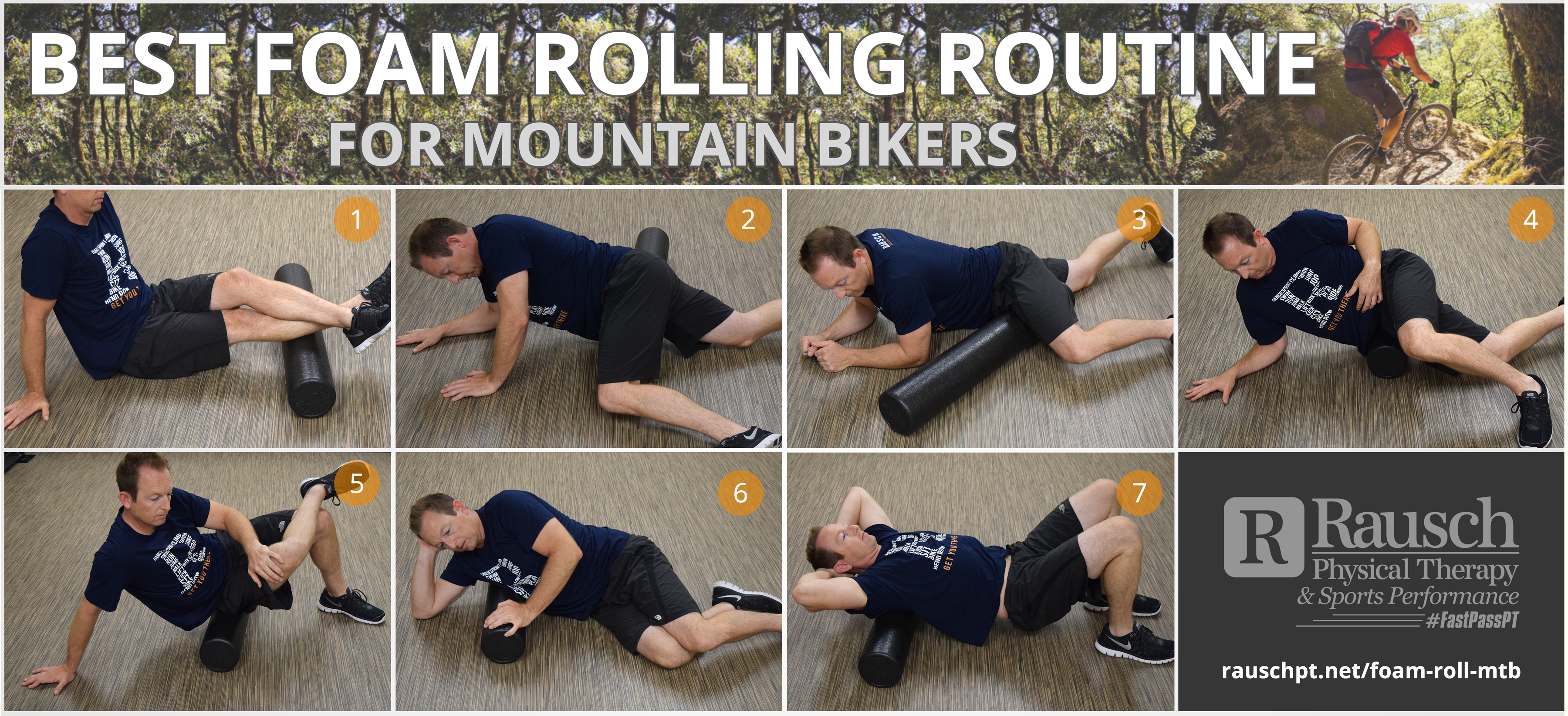
Here are the muscles I specifically attack with the foam roller after every mountain bike ride:

rauschpt.net/foam-roll-mtb
Click to enlarge
  1. Calf muscles
  2. Quadriceps
  3. Groin
  4. Tensor fasciae latae (TFL). Helps work the IT band and hip flexor complex)
  5. Gluteals/piriformis
  6. Latissimus dorsi
  7. Thoracic Spine extension. Great for avoiding the dreaded Rounded Shoulder posture.


* PRO TIP: When foam rolling, focus on going across the tissue fibers (i.e. laterally rather than up and down.) This lateral rolling will emphasis on “going against the grain” and most mimics a manual therapy technique called cross friction. This will restructure the muscle fiber alignment and keeps things sliding-and-gliding freely.

By incorporating the foam roller into your daily routine, you can reduce your risk of injuries, improve recovery time and overall athleticismbest of all, it will help you feel less old! So be specific, be consistent, and respect mobility with cross friction-based foam rolling.

This post has an accompanying article, “This Soft-Tissue Maintenance Routine Will Keep You On Your Bike Longer.” Click here to read it now on the Over the Hump blog.

DustinDustin Hancock, DPT graduated from San Diego State University with a bachelor’s degree in kinesiology/nutrition. He went on to receive his doctorate in physical therapy in 2011 from University of St. Augustine, and began his career at Rausch Physical Therapy and Sports Performance in 2012. As a snowboarder and mountain bike enthusiast, Dustin specializes in treating extreme sport athletes. As a physical therapist, Dustin says he looks forward to being a companion every step of the way on his patient’s path to recovery.

Click to learn more about Dustin and our other physical therapists »

Four Strength Exercises All Baseball Players Should Add to Their Training Program

JM-BLOG
BY JONATHAN MELTZER, DPT, RAUSCH PHYSICAL THERAPY

In my blog “How to Keep Injuries from Killing Your Big League Dreams,” I discuss four ways youth baseball players can take better care of their bodies and get in the most efficient shape possible so that injuries don’t keep them from playing ball at the next level. One of these ways is to implement a global strength program into your training regimen, which emphasizes building entire body strength rather than simply focusing on your throwing arm.

The Best Exercises for Building Entire-Body Strength

A proper strength training program will not only will this improve your overall athletic performance, but it will also help you to avoid the common overuse injuries that are plaguing youth sports today. However, I’m not just talking about strengthening the arm, but rather the entire body. I really can’t emphasize enough how important it is for baseball players to work on their shoulder stabilizers to improve their back, core and lower-half strength, as well as balance.

Here are my four favorite stabilization and strength training exercises for preventing injuries:

1. Planks

Planks are great for total body stabilization and core. Perform this plank series every day to increase your strength.


Front Plank – Hold for 45 seconds.


Side Planks  – Hold for 45 seconds on each side.

2. I.T.W.Y. on Swiss Ball with Weights

For this exercise you’ll need 1, 2 and a 3 lbs. dumbbells and a swiss ball. As you move through the sequence below, keep your abs tight and lifted so your back is flat. Perform 2 sets x 15 reps (2 x 15).


” I – 3 lbs. weight”


” T – 1 lbs. weight”


” W – 2 lbs. weight”


” Y – No weight”

3. Side-Lying Dumbbell Pyramid

To perform this series, lay on your side with 1, 2 and 3 lbs. dumbbells in front of you. Place a rolled towel between on your side and top arm, just below the elbow. Grab the 3 lbs. dumbell first, and lift up and down, keeping the elbow glued to the hip and shoulder blades squeezed together. Do 30 lifts or until fatigue, then move to the next lowest weight, repeating the same movements. Once you have completed reps with each dumbbell, roll over and do the other arm.


3 lbs. weight first.

lbs. weight.


Finish up with the 1 lb. weight, then switch sides.

4. Swiss Ball Core Series

This tricky series will strengthen your core and improve your balance.


Roll down the ball until you’re in a plank position, then do a push up. (2 x 15)


Tuck knees toward your chest. (2 x 15)

Core Series

Lift your hips into the pike position. (2 x 15)

By implementing these four exercises into your current strength training program, you can begin to greatly improve your entire-body strength and stability, two very important keys to athletic success and a long, healthy baseball career.


StaffHeadshot-JonJonathan Meltzer graduated from the University of Redlands with a bachelor of arts in biology and a minor in physical education. Following graduation, Jonathan discovered his passion for physical therapy while working as a Physical Therapy Aide. After graduating top of his class from Loma Linda University in 2012 with a Doctorate in Physical Therapy, Jonathan began his career at Rausch Physical Therapy and Sports Performance. Jonathan’s goals are to identify limitations and treat his patients with the most recent and innovative techniques in order to maximize functional independence and obtain his patients’ individual goals.