
Five Exercises to Increase Surfers’ Paddling Strength and Endurance

Blog-Ash
BY ASHLEY, MPT, RAUSCH PHYSICAL THERAPY

How well did your shoulders hold up to the El Niño this winter? Building strength through your shoulders and upper back to improve paddling endurance is your key to paddling out in bigger surf, catching bigger waves, and being able to stay out for longer surf sessions.

Strengthening the rotator cuff, scapular stabilizers and upper back are all key components to improve paddling strength. The rotator cuff muscles are extremely important for stabilizing the shoulder joint, which is the most mobile joint in the body. Specifically, strengthening the external rotators of the rotator cuff act to counterbalance the more dominant internal rotators (pecs & lats), minimize muscle imbalances when paddling, and promote good shoulder mechanics. Enhancing strength and endurance of the scapular stabilizers will also help you maintain good shoulder mechanics to prevent injury during extended periods of paddling.

Exercises for paddling endurance should focus on high reps and low weight, while exercises for paddling power should focus on increased weight with lower reps to maximize overall strength. As you build strength, it’s important to maintain shoulder mobility and flexibility by stretching and foam rolling before and after every session to minimize any joint stiffness throughout the shoulder and upper back, as well as to minimize muscle fatigue and soreness. Check out my previous surfing blog for the Best Foam Rolling Exercises for Surfers’ Shoulders.

Five Exercises to Target Muscles for Paddling

While the best way to gain paddling strength is actually getting out in the water, these five exercises can help compliment the work you do in the water, on dry land:

Exercise 1: Scaps Clocks

Scap Clocks

Promotes endurance of the upper back and shoulder

  • Start with the right arm. Pull tension in the band to 1 → 3 → 5 o’clock. Repeat with left arm, pull band to 11 → 9 → 7 o’clock. Make sure to keep your shoulders down and back; standing against the wall is a good cue for upright posture.
  • Perform 10-15 reps on each side.


Exercise 2: Alternating Rows with cables or bands

Alternating Rows

Promotes stabilization and endurance of the shoulder blade while paddling

  • Keeping your elbow at your side, pull the band back while squeezing the shoulder blades together.
  • Perform 2 sets of 20, increase resistance if you’re not fatigued by the end of the set


Exercise 3: Alternating Lat Pull-Downs with cables or bands

Alternating Lat Pull-Downs

Builds paddling endurance through lats for a strong pull through the water

  • Stand in a partial squat to activate your core. Pull the band down towards your hip, keeping your elbow straight. Let the tension out of the band slowly to return to starting position. Alternate arms.
  • Perform 2-3 sets of 20 on each side alternating strokes


Exercise 4: Prone external rotation/internal rotation on swiss ball

Prone External/Internal Rotation

Promotes rotator cuff strengthening while paddling

  • Lay prone on the swiss ball, keeping your back straight and chin tucked. Start with the shoulder abducted and externally rotated in the ‘90/90 position’ (as shown in photo.) Internally rotate your shoulder to simulate paddling while keeping your shoulder and elbow aligned.
  • Perform 2-3 sets of 10, add light weight (1-3 lbs. dumbells) as strength improves


Exercise 5: Simulated paddling on swiss ball with band

Simulated Paddling

  • Keep chin tucked and shoulders back and keeping your elbow straight while pulling. Slowly let tension out of band to return to overhead position, alternate arms.
  • Perform 2-3 sets of 20 on each side alternating strokes

Training to build muscle strength to help you paddle longer and faster will improve your overall surfing endurance. The best way to practice paddling is getting out in the water; these specific paddling exercises are to help compliment the work you do in the waves. See you in the water!
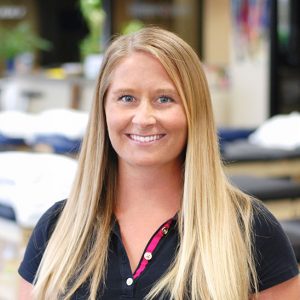


StaffHeadshot-Ashley2Ashley Heller, MPT is the newest member of the Rausch PT team. She received her Masters of Physical Therapy degree at California State University, Long Beach and is passionate about working with patients with shoulder, knee and ankle injuries. With background in orthopedic-related injuries and post-operative rehabilitation, Ashley believes that the combination of manual therapy and personalized therapeutic exercise program is vital to recovery. As a physical therapist, it’s Ashley’s goal to help her patients better understand their injuries and the plan for their road to recovery.

Click to learn more about Ashley and our other physical therapists »

Rausch Physical Therapy Celebrates 10 Years of Innovation and Growth

LAGUNA NIGUEL, CA (May 2, 2016) – Rausch Physical Therapy & Sports Performance (Rausch PT)—a leader in the physical therapy field that specializes in taking patients from injury, to recovery, to peak performance—today announces the tenth anniversary of the company’s founding.

Kevin Rausch, president and owner of Rausch Physical Therapy & Sports Performance.Rausch PT was founded in 2006 by president and licensed physical therapist Kevin Rausch when he was 27 years old. While other privately-owned physical therapy clinics have seen little-to-no growth in recent years, with many having to close their doors, Rausch PT stands out in the field thanks to its president’s unique vision for operating physical therapy practices.

Since the start Rausch has aimed to be an innovator in the field of physical therapy. Rather than rely on a broken health care system and physician referrals, Rausch wanted to provide a holistic option for rehabilitation, preventative health and wellness. After moving from a 2,000 sq. ft. suite to a 9,000 sq. ft. one, the company not only expand its physical therapy practice, but also to added an on-site, full-service Pilates studio and massage therapist wing. An on-site sports performance lab was added a couple years later, boasting the kinds of technologies that one can typically only access as a professional athlete, including an AlterG® Anti-Gravity Treadmill® and Hypoxico Altitude Training System. In ten years Rausch PT has grown from one physical therapist and 2,500 annual visits, to six licensed PTs on staff and more than 18,000 annual visits.

“Our clinic has taken the lead by not only offering the most thorough and specific rehabilitation programs in the field, but also by integrating the latest rehab technology and on-site wellness offerings that you just cannot find anywhere else under one roof,” Rausch said. “I’m proud of what we’ve been able to accomplish as a company in the past 10 years, but more importantly I look forward to continuing to expand people’s minds on what physical therapy can be.”

While most people think of hospitals and nursing homes when they think of physical therapy, Rausch PT specializes in active patients who want to get back to doing what they love, whether that be completing an IRONMAN, jogging a 5K, or simply chasing after their kids. Instead of being clinical and sterile, Rausch modeled the feel of his PT clinic after his grandfather’s sports bar—a welcoming, intimate escape for therapy.

“We’re in the business of making people feel good, and I don’t just mean their injuries,” Rausch said. “I want patients to look forward to coming here because it’s social and fun, everyone knows your name, and everyone is rooting for you to achieve your goals.”

By offering the highest quality rehab programs and latest technological advances, Rausch PT has earned its reputation as the “go-to” clinic for Orange County triathletes, runners, swimmers and cyclists, in addition to patients who live active, on-the-go lifestyles. Clients include everyone from ultra-trail runners and amateur cyclists, to weekend warriors and moms-on-the-go.


About Rausch Physical Therapy

Founded in 2006, Rausch Physical Therapy & Sports Performance in Laguna Niguel, Calif. specializes in taking patients from injury, to recovery, to peak performance. Its sport-specific, licensed physical therapists combine their expertise in human mechanics with the clinic’s innovative rehabilitation and performance technologies to help its patients stay healthy and reach their goals.

For more information, contact casey@rauschpt.net (949) 276-5401 x 106 or visit rauschpt.net.

RauschPT-Logo

May Wellness Workshop: Does Your Bike Fit?


Does Your Bike Fit? How to Be More Comfortable on Your Bike

[framedbox][one_third]

When

Wednesday, May 25
7 – 8:30 PM

[/one_third][one_third]

Where

RauschPT-Logo-2015

28202 Cabot Rd. Suite 150
Laguna Niguel, CA 92677

[/one_third][one_third_last]

Cost

$15 per person

[button link=”https://clients.mindbodyonline.com/classic/ws?studioid=18756&stype=-106&sView=day&date=05/25/16″ size=”small” color=”blue” align=”center” target=”_blank” ]SIGN UP NOW[/button]

[/one_third_last][/framedbox]
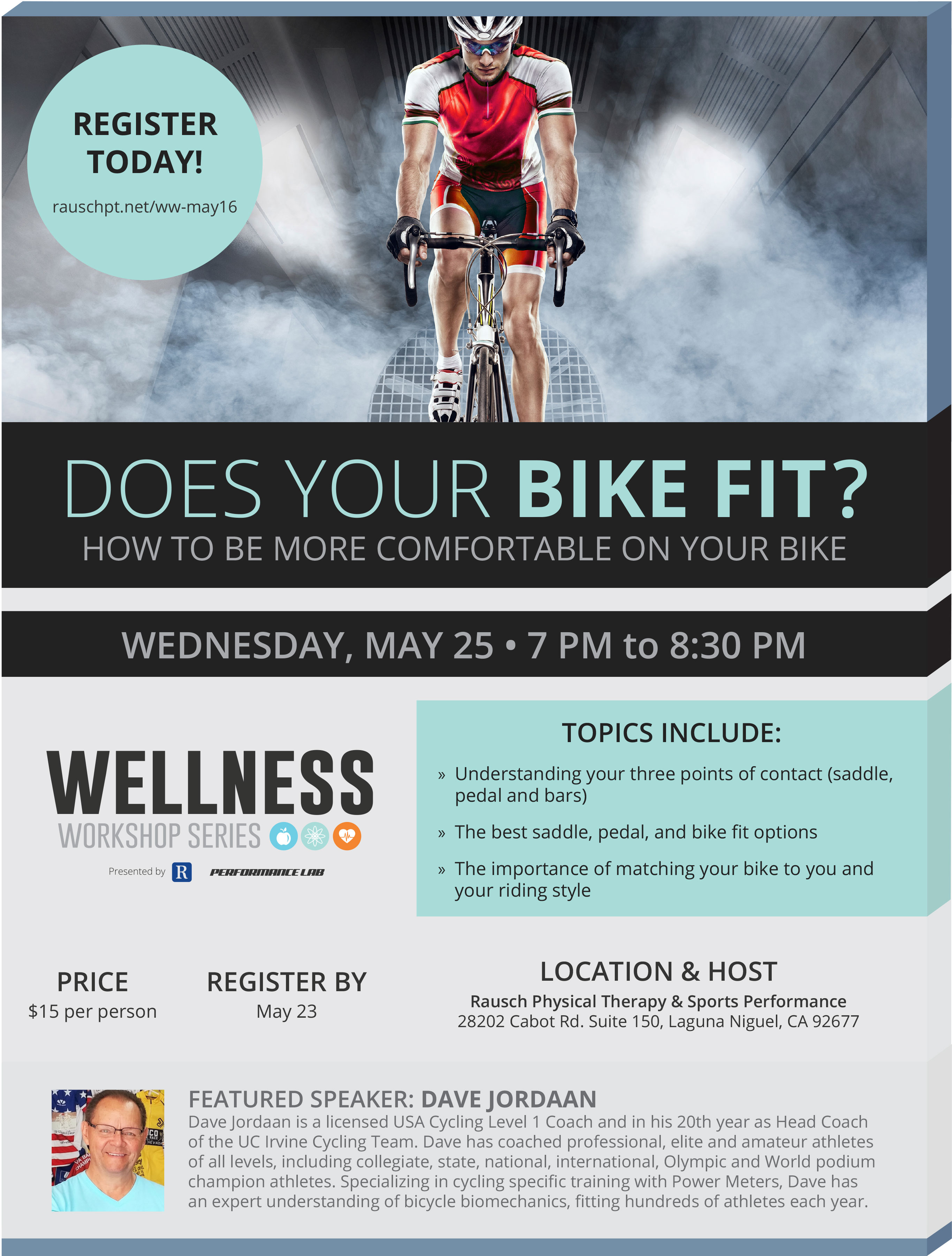
The May Wellness Workshop features Dave Jordaan, a licensed USA Cycling Level 1 Coach and the Head Coach of the UC Irvine Cycling Team. Dave has coached professional, elite and amateur athletes of all levels, including many collegiate, state, national, international, Olympic and World podium champions; and on May 25 he will be visiting Rausch PT to teach you how to be more comfortable on your bike.

WWWMay16-Flyer
Enlarge Flyer

Participants will:

  • Hear in-depth explanations about proper bike fit from Dave Jordaan, USA Cycling Level 1 Coach
  • Learn how to avoid pain from the three points of contact (saddle, pedal and bars)
  • Learn about the best saddle, pedal, and bike fit options
  • Understand the importance of matching your bike to you and your riding style

Come join us for a night of interactive learning where you will learn how to out ride the competition and have more enjoyable, pain-free rides!

 [button link=”https://clients.mindbodyonline.com/classic/ws?studioid=18756&stype=-106&sView=day&date=05/25/16″ size=”small” color=”blue” align=”center” target=”_blank” ]SIGN UP NOW[/button]


My Own Worst Patient

Blog-Jess
BY JESSICA SNYDER, DPT, RAUSCH PHYSICAL THERAPY

A college running injury is what originally introduced me to the field of physical therapy. I remember being so frustrated that I could not run and no one seemed able to “fix” it. I was bounced around between the university’s medical staff with no resolution. It wasn’t their fault; they had a lot of athletes to cover and I simply fell through the cracks. But, I was also extremely stubborn and continued running. In pain. Because no one had a better solution.

It was finally my mom who intervened. She did some research and found a physical therapist that she thought could help me. The physical therapist was the first person who took the time to listen to my symptoms, evaluate my injury, and explain to me what was going on and what needed to be done in order to get me running again. Finally! A diagnosis, an explanation, and a plan.

That’s when I knew I wanted to become a physical therapist.

On Top of the World

When I received my doctorate of physical therapy degree, I couldn’t help but think about how I’d come full circle—how I was now going to be that person that helps someone get back to doing what they love. I felt so grateful that this is what I was going to do with my life.

Flash forward, and I’ve now been working at Rausch Physical Therapy & Sports Performance for four years. I still run daily, and I haven’t really had to deal with any of the major, sidelining injuries that plagued me back in college. I’ll admit that I started to lose sight of PT from the perspective of a patient. It took a recent personal injury to remind me why I love this field so much.

Last month I was snowboarding at June Mountain when I fell on my butt and completely threw out my SI joint. That’s when I got my worst patient of all time: Me.

The Fall

I couldn’t walk, let alone run. Getting in-and-out of the car was terrible. I couldn’t bend down to wash off the dog’s muddy paws, and I also couldn’t mop up the floor. I couldn’t even chase after my best friend’s daughter when she took off running towards the street—half a step and shooting pain across my back.

At first, I was okay with it. As a PT, I was able to self-diagnose myself with a badly sprained SI joint, which I knew would require time for the inflammation to go down and scar tissue to form in order to stabilize it. But, this professional practicality quickly faded into personal distress. By the end of the first week, I was in the anger phase of my depression. I was constantly on the verge of tears, I was ready to give up trying to stay active, I had even convinced myself that I would never run again (Completely irrational! It had only been a week!)

Then, something amazing happened. One of my favorite parts of being a PT is chatting with my patients while I’m treating them, and inevitably my frustration with my injury came up. That’s when my patients started repeating all the things that I had at some point told them during their recovery:

“Jessica, you know tissue healing takes a minimum of four weeks.”

“Be patient, Jess! Why don’t you take this time to focus on strengthening?”

“Allow your body to heal properly; you don’t want to push it too early and create a chronic problem.”

I was transported back to that time in college, when someone was able to pull me out of my injury-induced spiral when I felt hopeless. But this time, that person was myself! Coming through my incredible patients! I was so grateful for their explanations and words of encouragement, and I was finally able to tell myself, “Pull it together and stop acting crazy!”

Getting Back Up

So, I made a plan. I started to focus on what I could do, and used this injury as an opportunity to be more creative with my exercise routine. I started to be grateful for the little things that I was slowly able to do, walk with less pain, finally lie down on my back, and almost lift my foot to put on a shoe.

Recovery is a process. As a patient, I think it’s important to know that your physical therapist has chosen their professional field for a reason: we’ve been there, we get it, and thanks to this recent fall of mine, I am more motivated than ever to get you back to feeling your best.


StaffHeadshot-Jessica copyJessica Snyder (PT, DPT, ATC, CSCS) received her Doctor of Physical Therapy degree at the University of St Augustine for Health Sciences – with an emphasis on orthopedics, movement science, and manual therapy. Jessica started her career as a Certified Athletic Trainer working with high school, college and professional athletes. She is also a Certified Strength and Conditioning Specialist (enhancing her ability to build custom strength, stability and performance-centered rehabilitation and return-to-sport programs) and Certified Natural Running Coach. Being a runner herself, Jessica specializes in running-related injuries, including the entire lower extremity. She is also passionate about treating headaches and neck/shoulder pain.

Click to learn more about Jessica and our other physical therapists »
Quick Fix for Dead Spots in Your Pedal Stroke

Blog-Dustin
BY DUSTIN HANCOCK, DPT, RAUSCH PHYSICAL THERAPY
When cycling, there are two things that can improve your velocity: power output and turnover cadence. However, the overall power output can be weakened if at some point during your pedal stroke, you have inconsistencies during that full, circular motion. Inconsistent torque forces, or dead spots, typically occur at the initiation of the upstroke. You can determine if you have dead spots by using a power meter or by doing a test like our Performance Lab’s Bike Right, but a simple indicator if your stroke has dead spots is smashing and hammering of the pedals.

Like most exercise movements, a healthy pedal stroke relies on the stretch shortening cycle (SSC) to be efficient. SSC occurs when a muscle stores elastic energy as a muscle lengthens; this stored-up energy is then used when the muscle immediately shortens. Since SSC is a myofascial and nervous system stretch reflex, if the body has adequate mobility and dynamic stiffness, the SSC will allow for any athlete to access free kinetic energy, i.e. more power for less work! Improving SSC can not only be a huge efficiency booster, it can also help improve joint stability and congruency to save those knees from arthritic changes.

Quick One-Legged Exercise to Improve Dead Spots

Here’s a great neuromuscular recalibration drill that you can do on a trainer to improve those dead spots.

Step 1: Hop on a trainer and warm up with the smooth circular stroke pattern focused on relaxing your legs especially your ankles.

Step 2: When you feel warm and ready, pick up the cadence to 92-95 rounds per minute (RPM) and take one foot off the pedal. Place that foot in the center frame.

Step 3: Maintain the cadence for 30-second intervals, working up to 90-second intervals for three to five rounds.

This exercise ensures the leg pulls up at the bottom of your stroke, allowing the hamstring to apply more power into the equation. It also improves the circular stroke pattern and gets you away from that less effective “smashing pedal” form. Try to apply this exercise to your warm up and see what it can do for your cycling efficiency and overall speed.

Enjoy one more thing to think about on your ride!


DustinDustin Hancock, DPT graduated from San Diego State University with a bachelor’s degree in kinesiology/nutrition. He went on to receive his doctorate in physical therapy in 2011 from University of St. Augustine, and began his career at Rausch Physical Therapy and Sports Performance in 2012. As a snowboarder and mountain bike enthusiast, Dustin specializes in treating extreme sport athletes. As a physical therapist, Dustin says he looks forward to being a companion every step of the way on his patient’s path to recovery.

Click to learn more about Dustin and our other physical therapists »