
Best Foam Rolling Routine for Mountain Bikers

Blog-Dustin
BY DUSTIN HANCOCK, DPT, RAUSCH PHYSICAL THERAPY

This post has an accompanying article, “This Soft-Tissue Maintenance Routine Will Keep You On Your Bike Longer.” Click here to read it now on the Over the Hump blog.

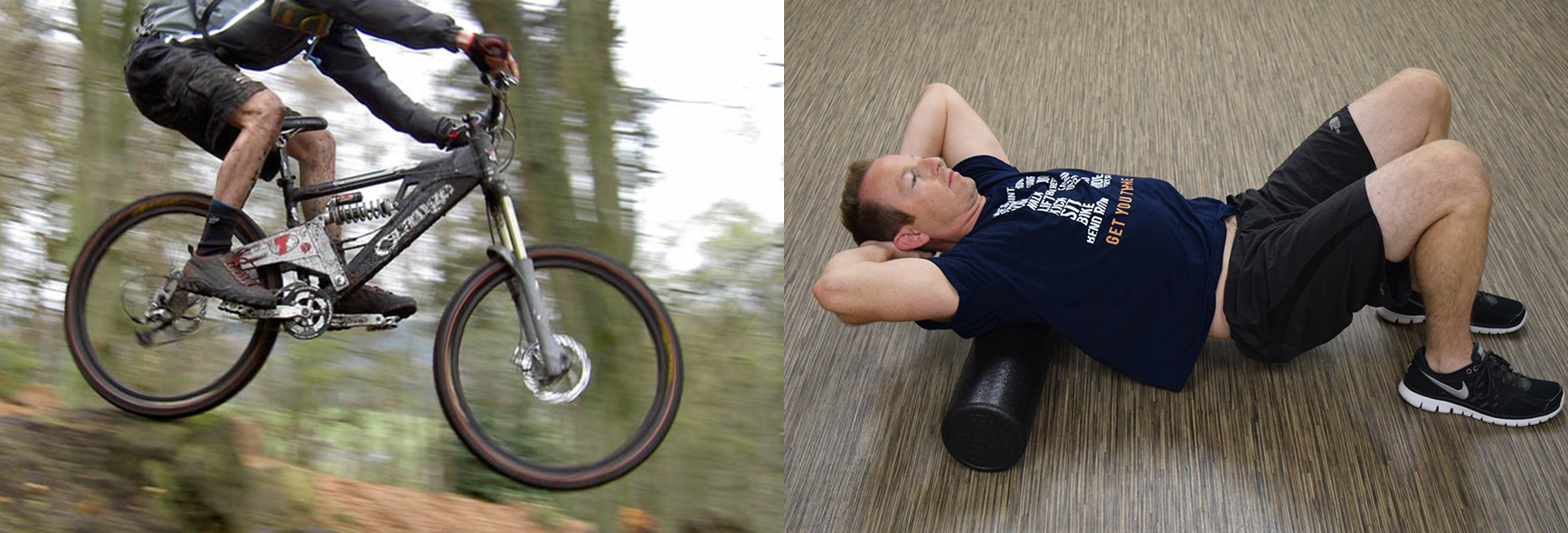
As mountain bikers, we put our bodies through the ringer. Introducing a soft-tissue mobilization technique like foam rolling can help you avoid limiting aches and pains so you can stay on the bike longer, train harder, and reduce your recovery time.

Recovery and maintenance programs aren’t always convenient, but I personally make it a point to implement them in my training to ensure I get to join the riding group every weekend and race stronger at Over the Hump. The daily grind takes a big toll on our bodies and will cause imbalances, whether it’s from poor posture at your desk, lack of cross training or focusing too much on strength training. This is why it’s critical for all MTB riders to actively pursue some form of mobility maintenance routine to keep their bodies balanced and their seat on the trails.

Best Foam Rolling Routines for Mountain Bikers

When you feel sore after you train hard or go for a long ride, it’s because your muscles are literally tearing apart to restructure fiber alignment for greater tolerance to that stress. This microfiber tearing will cause a formation of more cross-links so that you become stronger (Good!) However, if you don’t then work on those specific tissues after training—say, with a foam roller—they’ll become glued down in a mal-aligned direction, and you’ll lose mobility (Bad.)

The foam roller is one of my favorite tools for working out your muscle and tissue on a routine basis; it’s cheap, easy, and you can do it yourself. Ideally, you should spend time working out the tissues that are tight for five to 10 minutes daily, or until you feel about a 50% reduction in pain. After a long ride, you should also spend a little extra time focusing on the areas you worked hard.

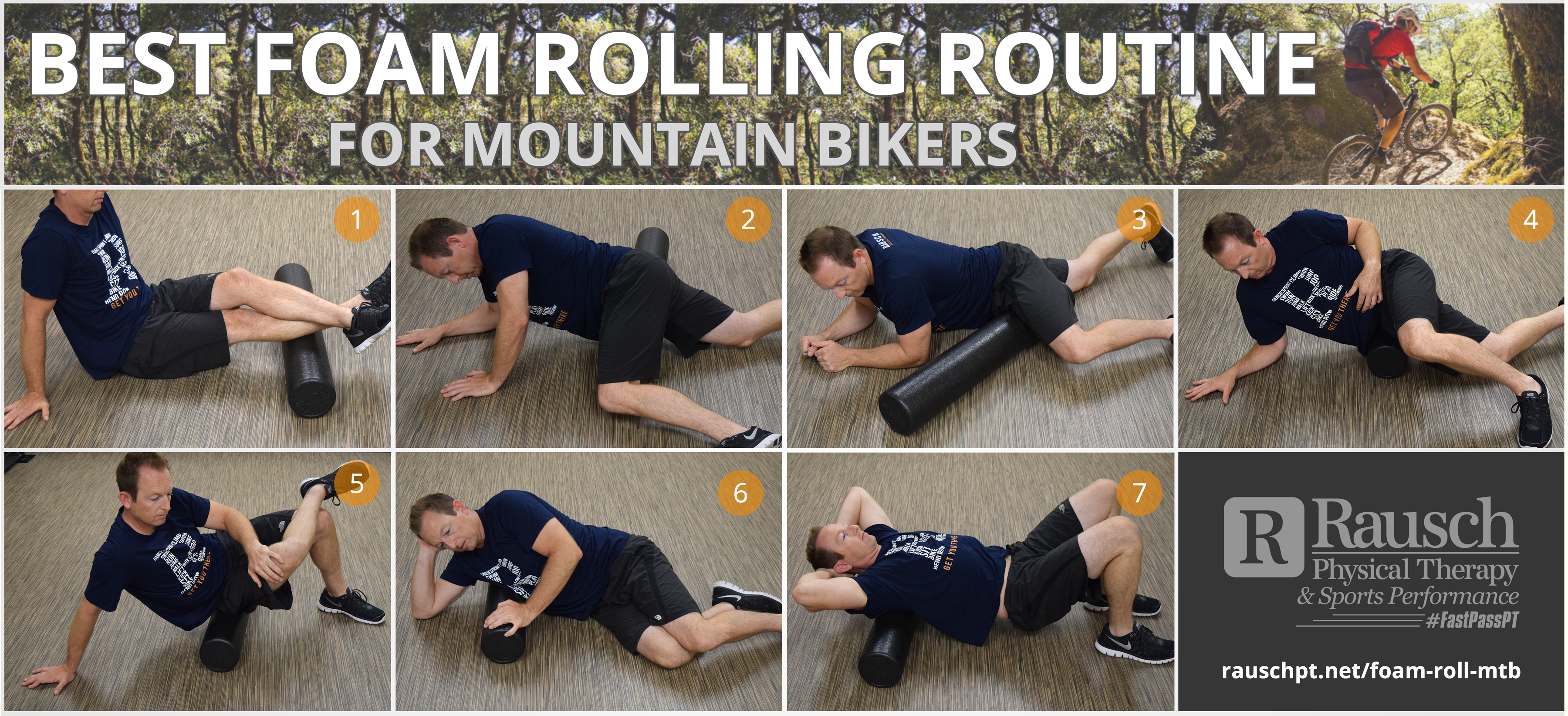
Here are the muscles I specifically attack with the foam roller after every mountain bike ride:
rauschpt.net/foam-roll-mtb
Click to enlarge
  1. Calf muscles
  2. Quadriceps
  3. Groin
  4. Tensor fasciae latae (TFL). Helps work the IT band and hip flexor complex)
  5. Gluteals/piriformis
  6. Latissimus dorsi
  7. Thoracic Spine extension. Great for avoiding the dreaded Rounded Shoulder posture.


* PRO TIP: When foam rolling, focus on going across the tissue fibers (i.e. laterally rather than up and down.) This lateral rolling will emphasis on “going against the grain” and most mimics a manual therapy technique called cross friction. This will restructure the muscle fiber alignment and keeps things sliding-and-gliding freely.

By incorporating the foam roller into your daily routine, you can reduce your risk of injuries, improve recovery time and overall athleticismbest of all, it will help you feel less old! So be specific, be consistent, and respect mobility with cross friction-based foam rolling.

This post has an accompanying article, “This Soft-Tissue Maintenance Routine Will Keep You On Your Bike Longer.” Click here to read it now on the Over the Hump blog.

DustinDustin Hancock, DPT graduated from San Diego State University with a bachelor’s degree in kinesiology/nutrition. He went on to receive his doctorate in physical therapy in 2011 from University of St. Augustine, and began his career at Rausch Physical Therapy and Sports Performance in 2012. As a snowboarder and mountain bike enthusiast, Dustin specializes in treating extreme sport athletes. As a physical therapist, Dustin says he looks forward to being a companion every step of the way on his patient’s path to recovery.

Click to learn more about Dustin and our other physical therapists »

Four Strength Exercises All Baseball Players Should Add to Their Training Program

JM-BLOG
BY JONATHAN MELTZER, DPT, RAUSCH PHYSICAL THERAPY

In my blog “How to Keep Injuries from Killing Your Big League Dreams,” I discuss four ways youth baseball players can take better care of their bodies and get in the most efficient shape possible so that injuries don’t keep them from playing ball at the next level. One of these ways is to implement a global strength program into your training regimen, which emphasizes building entire body strength rather than simply focusing on your throwing arm.

The Best Exercises for Building Entire-Body Strength

A proper strength training program will not only will this improve your overall athletic performance, but it will also help you to avoid the common overuse injuries that are plaguing youth sports today. However, I’m not just talking about strengthening the arm, but rather the entire body. I really can’t emphasize enough how important it is for baseball players to work on their shoulder stabilizers to improve their back, core and lower-half strength, as well as balance.

Here are my four favorite stabilization and strength training exercises for preventing injuries:

1. Planks

Planks are great for total body stabilization and core. Perform this plank series every day to increase your strength.


Front Plank – Hold for 45 seconds.


Side Planks  – Hold for 45 seconds on each side.

2. I.T.W.Y. on Swiss Ball with Weights

For this exercise you’ll need 1, 2 and a 3 lbs. dumbbells and a swiss ball. As you move through the sequence below, keep your abs tight and lifted so your back is flat. Perform 2 sets x 15 reps (2 x 15).


” I – 3 lbs. weight”


” T – 1 lbs. weight”


” W – 2 lbs. weight”


” Y – No weight”

3. Side-Lying Dumbbell Pyramid

To perform this series, lay on your side with 1, 2 and 3 lbs. dumbbells in front of you. Place a rolled towel between on your side and top arm, just below the elbow. Grab the 3 lbs. dumbell first, and lift up and down, keeping the elbow glued to the hip and shoulder blades squeezed together. Do 30 lifts or until fatigue, then move to the next lowest weight, repeating the same movements. Once you have completed reps with each dumbbell, roll over and do the other arm.


3 lbs. weight first.

lbs. weight.


Finish up with the 1 lb. weight, then switch sides.

4. Swiss Ball Core Series

This tricky series will strengthen your core and improve your balance.


Roll down the ball until you’re in a plank position, then do a push up. (2 x 15)


Tuck knees toward your chest. (2 x 15)

Core Series

Lift your hips into the pike position. (2 x 15)

By implementing these four exercises into your current strength training program, you can begin to greatly improve your entire-body strength and stability, two very important keys to athletic success and a long, healthy baseball career.


StaffHeadshot-JonJonathan Meltzer graduated from the University of Redlands with a bachelor of arts in biology and a minor in physical education. Following graduation, Jonathan discovered his passion for physical therapy while working as a Physical Therapy Aide. After graduating top of his class from Loma Linda University in 2012 with a Doctorate in Physical Therapy, Jonathan began his career at Rausch Physical Therapy and Sports Performance. Jonathan’s goals are to identify limitations and treat his patients with the most recent and innovative techniques in order to maximize functional independence and obtain his patients’ individual goals.

July Workshop: Preventing Running Injuries


Breaking the Cycle of Injury

How You Can Prevent Running Injuries for Good

[framedbox][one_third]

When

Wednesday, July 27
7 – 8:30 PM

[/one_third][one_third]

Where

RauschPT-Logo-2015

28202 Cabot Rd. Suite 150
Laguna Niguel, CA 92677

[/one_third][one_third_last]

Cost

$15 per person

[button link=”https://clients.mindbodyonline.com/classic/ws?studioid=18756&stype=-106&sView=day&date=07/27/16″ size=”small” color=”blue” align=”center” target=”_blank” ]SIGN UP NOW[/button]

[/one_third_last][/framedbox]

We get it; when you’re a runner, there’s nothing worse than suffering an injury that keeps you from doing what you love. Did you know 85% of runners get injured at least once during a year? Did you know you DON’T have to be one of them??

Click to enlargeThe July Wellness Workshop features two of our own, Performance Lab Director Jen Hollingsworth and running-PT Jessica Snyder. Jen is an elite ultra/trail running athlete and Healthy Running Coach, while Jessica, DPT, CSCS is a former collegiate track star and Natural Running Coach. This dynamic duo will explain how runners can break the cycle of injury and significantly reduce their risk of injuries through evaluation, assessment and intervention.

Topics include:

  • The three “non-negotiables” every runner needs to combat injury
  • Identifying any muscular imbalances that may be impacting your running
  • Specific exercise programs and run form tips to reduce injury risk and improve performance

So lace up your running shoes and join us at the clinic on July 27 and learn how you can continue to runpain free—for a long, long time.

 [button link=”https://clients.mindbodyonline.com/classic/ws?studioid=18756&stype=-106&sView=day&date=07/27/16″ size=”small” color=”blue” align=”center” target=”_blank” ]SIGN UP NOW[/button]