Reaping the Benefits of Consistent Massage Therapy

Folks often envision massage therapy in either one of two ways. In the first scenario, massages are something that is seen as opulent and excessive, to be enjoyed by the wealthy or on special occasions. In the second situation, massages are seen as a necessary healing procedure for either intense athletes or those recovering from an accident or injury. However, while the above-described scenarios may be true for some circumstances, regular massage therapy is actually incredibly helpful to all people and for all body types. Massage therapy can either be used in conjunction with your physical therapist or M.D. to help heal and relieve pain in your body, or massage can be used to help alleviate stress after a grueling week. The types of massages and the benefits of regular massages make it a great choice for everybody – from the seasoned athlete to the weekend warrior. Our membership program allows affordable access to massages on an ongoing basis, with physical therapy support if you need it, helping you to achieve the pain-free and mobile life you want to live!

Massages for Athletes:

The importance of integrating regular, on-going massages into your health care routine will have long-lasting and advantageous benefits to both your recovery and your future performance. Sports massage alongside, cupping and ART (Active Release Therapy) will allow your massage therapist to address areas in which you may have scar tissue or mobility restrictions that could be hindering your performance. By actively working on these areas on a regular basis, the demand you put on your muscles and on your body will result in shorter recovery time, allowing you the opportunity to hit your personal bests the next time you practice your sport.

Massages for Everyone:

There is no doubt we are all under an immense amount of stress, now more than ever. With the tension of daily life during a pandemic, as well as trying to balance work and family life, our bodies will let us know the ways in which it is manifesting that stress. Tension headaches, sore backs, and stiff necks are all signs of tension. Our therapeutic massage and our deep tissue massage both allow you to relieve stiffness, pain and to help you release tension and relax. This may feel like it’s “pampering” yourself, but the truth is when under stress, your body needs this.

Our membership program allows routine monthly massages to be available to everyone! Our affordable monthly rate helps to ensure you have access to the message therapy you need without worrying about opulent spending or unnecessary add-ons. We can offer you the massage therapy and physical therapy support that your body needs to thrive! Visit our Facebook page at www.facebook.com/rauschpt or give us a call at 949.276.5401 to see how we can help you in getting your body feeling its best!


Let’s talk! We are here to help. Give us a call for a complimentary consultation. We would love to meet you.

Did you know massage can massively speed up your healing, from training, injury, or surgery recovery? Massage has an overarching positive effect on so many aspects of your health. We have excellent memberships that make regular expert massages possible. Call us! (949) 276-5401



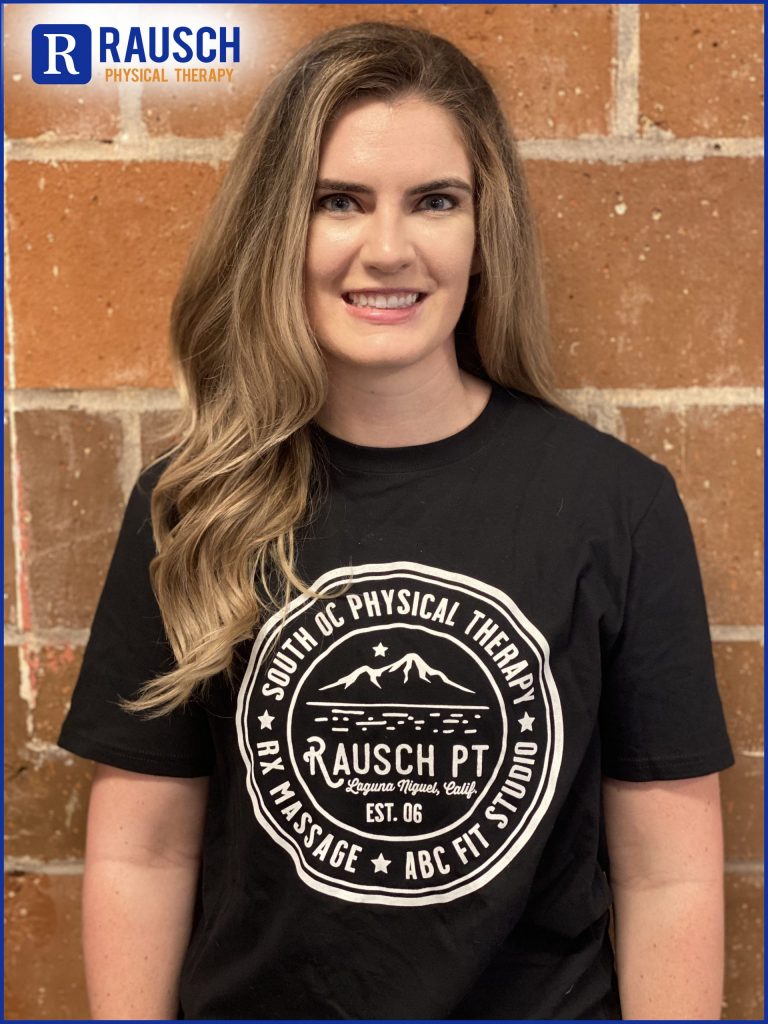
Employee Spotlight – Dr. Sarah MacMillan

Meet our “Gymnastics PT” Sarah MacMillan. 

Sarah enjoys treating a variety of orthopedic issues. Because of her involvement in gymnastics, while growing up, she has a special interest in treating athletes, especially gymnastics-related injuries. She likes being able to use her manual skills and knowledge about therapeutic exercise in order to get adults back to work and give them the ability to interact with their community again. 

Sarah treats a wide variety of issues including back pain, shoulder pain, and knee pain. Having been a gymnast for 13 years, she has had her fair share of injuries and has seen her teammates get injured as well. For that reason, she is quite familiar with how hard the gymnasts train and what it takes to recover from an injury. Sarah also enjoys working with the older population and watching their progress after attending physical therapy.

What is the first concert Sarah attended?

Miranda Lambert

The reason why Sarah became a Physical Therapist:

Because she wanted to make a difference in people’s lives. Sarah wants to be able to give people the tools they need and help them get back to their daily activities and help give them a better quality of life. 

Where’s Sarah’s favorite place in the world?

One of her favorite places is the United Kingdom. She went there on a trip with her family in 2016. Sarah thinks the history in England and Scotland is so interesting, and the countryside in both countries beautiful!


Dr. Sarah MacMillan PT

Let’s talk! We are here to help. Give us a call for a complimentary consultation. We would love to meet you.

Did you know there’s no prescription needed from a doctor to see us – but we will communicate your progress and treatment to your doctor if you’d like us too!
(949) 276-5401

RauschPT


Exercises to Help Prevent ACL Tears in Soccer Players By Dr. Renee Rinard PT, DPT, ITPT

If you’re a soccer player, you’ve probably heard the term “ACL” or most likely know someone that has torn their ACL in their soccer career. Its most commonly torn in sports involving sudden directional changes, sudden stops, and jumps; basically, the activities that are constantly performed throughout soccer practice and soccer games.

So what is an (ACL)? And what does it do? “ACL” stands for Anterior Cruciate Ligament and it is a ligament that connects your femur (thigh bone) to your tibia (shin bone) and averages about only 32 mm but is a major player in the stabilization of the knee joint. When it is torn, most complain of feeling very unstable or have episodes of “buckling” while walking or going downstairs. Surgery is usually required with a minimum of 4-6 months rehab in physical therapy; 9 months is usually recommended to return to sport with the least likely risk of re-injury at that point. If return to sport occurs earlier than 9 months, the risk of re-injury goes up.

Most ACL injuries occur in NON-CONTACT incidents, which means that the tears normally occur when the player was unable to properly control the leg while landing from a jump, a quick change of direction, sudden stop, etc. With proper strengthening, stabilization, balance, and control exercises, we have a higher chance at preventing ACL tears in soccer players.

FUN FACT:

Female high school soccer players are at the highest likelihood of tearing their ACL when compared to all other high school sports.

Below are 7 exercises aimed at the needs of soccer players to help prevent non-contact ACL tears.

  • Clamshells

    • Lay on your side with a resistance band around your knees. Bend your knees up so you have approx 45 deg angle at the hip and a knee. Keep your hips stacked on your side and your feet together. Lift your top knee just high enough so your hips stay stacked. Perform on both sides.
      • WHERE YOU SHOULD FEEL IT: side of your top hip
      • TIP: to ensure your hips are stacked correctly, position your top knee slightly in front of your bottom knee so it hangs slightly over. Can progress to clamshell in a side plank position
  • Lateral walks

    • In standing position, place a resistance band around your knees. Start in a slight squat position with tension on the band. Keep toes facing forward and knees in line with your feet/ankles (do not have knees cave in). Take a small step to the side and continue for approx 10-15 steps. Maintain a squat position throughout the activity. For increased challenge, put the band around your arches; then around both knees and arches. Perform both directions.
      • WHERE YOU SHOULD FEEL IT: sides of your hips
      • TIP: keep tension on the band throughout lateral walks; do not bring feet completely together between steps. If you are having a hard time maintaining a low enough squat because you feel like you will fall backward, hold a dumbbell or kettlebell in front of you to act as a counterweight in order to hold the position.
  • Hamstring slide outs in the bridge position

    • Lay on your back with knees bent, lift hips up off the ground into a bridge position. While maintaining the bridge position, slide feet away from the body in slow and controlled motion. During this motion, hips are still off of the ground but are lowering throughout. Slide feet out as far as you can while maintaining control and proper form. If strong enough, pull heels back towards the starting position while maintaining bridge to continue with repetitions, otherwise, lower hips down to the ground and reset at the bridge position.
      • WHERE YOU SHOULD FEEL IT: hamstrings (back of thighs), glutes
      • TIP: for sliding out, you can wear socks on a slick floor, paper towels/towels on a slick floor, sliders under your feet, or a swiss ball (tougher than feet on the floor). If your low back starts to hurt or strain, concentrate on squeezing your glutes more to take the pressure out of your low back. Once a double leg is mastered, can progress to one leg.
  • Copenhagen adductor

    • Using a chair or bench, you will be in a side plank position on the elbow with your top leg positioned on the chair/bench. Make sure your knee is supported by the chair/bench and not hanging off of it. When in the starting position, lift the bottom leg up and down toward the chair/bench.
      • WHERE YOU SHOULD FEEL IT: inside of the bottom leg, outside of the bottom hip, supporting shoulder
      • TIP: make sure the bottom hip does not sink toward the ground; maintain a straight line from torso to legs in order to get strengthening benefits of glute medius (side of the hip). Make it fun by having a teammate hold your top leg!
  • Walking lunges

    • Starting in standing position, bring one leg in front of you by taking a large step. Lower down by bending the knees and keeping the torso upright. Push up with your front heel to elevate and bring back leg to meet your front leg. Perform with the other leg. Make sure your toes are facing forward, the knee is over your foot, and hips are in line with the knee. FRONT KNEE SHOULD NOT BE CAVING INWARD NOR SHOULD YOUR HIP FALL OUT TO THE SIDE throughout the movement)
      • WHERE YOU SHOULD FEEL IT: side of hip, quadriceps, glutes
      • TIP: if walking lunges are too difficult or you are unable to keep proper form (knees are caving in) throughout the movement, can start with static lunges: Start in the lunge position and perform up/down movement continuously on one leg in the same position, then switch to the other side. Walking lunges are a more dynamic activity and tougher to perform while maintaining proper hip/knee alignment. Walking lunges should be a goal, but if they cannot be performed properly, static lunges are a good starting point. You do not need to touch the ground with your back knee.
  • Pistol Squat to Chair

    • Standing on one leg, lower down as if going to sit down in the chair. Slow and controlled. Ensure that the knee does not cave in during the movement (just as with the lunges). Place both feet on the ground to come to a standing position. Repeat.
      • WHERE YOU SHOULD FEEL IT: glutes, quadriceps, hamstrings
      • TIP: to progress this exercise, when you reach the chair at the bottom of the movement, use that one leg to return to standing position rather than both legs. Make sure to push up through the heel. Continue to make sure the knee does not cave in and the hip does not fall out to the side. To progress past this, remove the chair and perform continuously.
  • Dorsiflexion Ankle Mobs

    • **This is not a strengthening exercise, but a mobility activity to ensure proper ankle mobility. This will help to decrease improper positioning and compensation of the knee
    • Kneel down on the floor with your front foot approximately 6 inches from a wall. Lean forward, pushing knee towards the wall over toes. When you reach your max distance, hold in this position for at least 5-10 seconds. Repeat.
      • WHERE YOU SHOULD FEEL IT: you may feel a stretch in your calf/Achilles when performing or some pressure in the front of your ankle.
      • TIP: if you have a sturdy band, can place along the front of the ankle joint to assist in mobilization.

Dr. Renee Rinard PT, DPT, ITPT

Let’s talk! We are here to help. Give us a call for a complimentary consultation. We would love to meet you.

Did you know there’s no prescription needed from a doctor to see us – but we will communicate your progress and treatment to your doctor if you’d like us too!
(949) 276-5401


RauschPT