Power Training for Older Adults

One of the main issues facing older adults is balance. Falling — or fear of falling — can lead to activity avoidance, ultimately resulting in a loss of function and independence. Power training is an indispensable and often underutilized training method for older adults.

Power is strength multiplied by speed. Strength is an important focus, though if your foot is not fast enough to get into position to maintain your balance, then it doesn’t matter how strong you are. The opposite is also true; if you can move your foot fast enough to increase your base of support, but do not have the strength to keep yourself up, then a fall is likely.

A combination of strength and speed training is vital for staying upright and remaining functional. Talk to a physical therapist today if you feel unsteady or are fearful of falling.

Rausch Physical Therapy remains your caring team and can accommodate you with a specific, personalized plan that suits your needs and goals. Visit our Facebook page or call us at (949) 276-5401. 

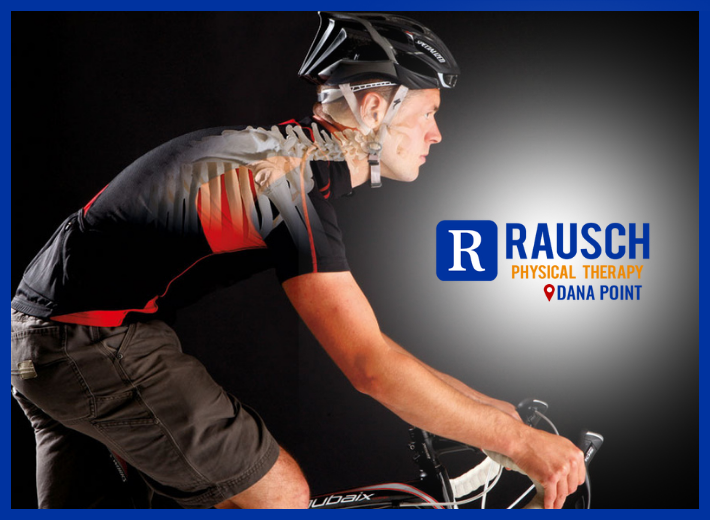
Riding is a Pain in the Neck

Do you have neck pain while riding your bike? You are not alone. Neck pain has plagued many bike riders.

While you are sitting in a chair and reading this blog article (with what I assume is good posture: sitting tall, shoulders back and head up), all the weight from your head, which is about as much as a bowling ball, is being translated down and balancing on the bones in your cervical spine. The muscles are just chilling, and there is no significant muscle contraction going on. Now imagine sitting on a bike. You lean forward to the reach for the handlebars. Your thoracic and lumbar spine round, and your shoulders flex and internally rotate. As you lean forward, so does the weight of your head, putting your neck in a more diagonal position which means that the weight of your head is no longer providing a direct axial or downward load through your cervical spine. Instead, the muscles in the back of your mid and lower neck are supporting your head. The upper part of your neck is responsible for holding your head up to see the road. These are suboccipital muscles, and they attach from the base of your skull to the top of your neck. The more your thoracic and lumbar spine round or lean forward, the more your neck must extend to lift your head. So, the lower or more drop arm the handlebars are the neck must compensate. For example, a tri or road bike will need more neck extension than a mountain bike or townie bike due to handlebar position.

When discussing the different subtypes of riding, there is also a component of time that needs addressing. A roadie or triathlete will be in a long-duration forward head posture while riding, whereas mountain biking is more dynamic and is only in the forward head posture for climbs. No matter which bike or bike activity you choose, forward head posture is a disadvantageous position of the muscles; the longer they hold, the more fatigued and overworked the muscles will become, leading to a greater chance of developing neck pain.

To increase your time on the bike with less neck pain, here are some exercises to help strengthen and improve your neck mobility and endurance.

  1. Suboccipital release: tape two tennis balls or lacrosse balls together and roll out your suboccipitals for about 2 min. Avoid the spine!
  2. Neck stretches: it is vital to maintain the mobility of the neck.
  3. Chin tucks: laying on your back with a pillow under the back of your head. Imagine a string from the top of the head pulling up, causing your chin to nod (think of making a double chin). Hold for 5-10 seconds and then repeat ten times. Once you have mastered the chin tuck, you can perform it in sitting, standing, or quadruped to make it more challenging and sports-specific.
  4. Chin tuck with rotation: perform a basic chin tuck and then slowly rotate the head to look over one shoulder and then the other. Keep that chin tucked the whole time — this will open up the joints in the neck and improve mobility.
  5. T/S extensions and doorway pec stretch: due to the flexed or rounded posture of the bike, t/s openers and chest openers are clutch. These all-around exercises will help your posture and keep you balanced.

Rausch PT professionals have the skill and expertise you need to improve and restore function and get you pain-free — with no prescription from a doctor required. Call our experts today at (949) 276-5401 and make an appointment. We would also love to have you join our Facebook community where you can get health and wellness updates and learn about what we have to offer ongoing!

7 Easy Ways Runners Actually Make Their Morning Workouts Happen

When it comes to exercise, the best time of day to get in a workout session is one time when you can get it done with any kind of consistency. The “right” time depends on factors like your preference, lifestyle, and body (and kids and work — they fall into that ‘lifestyle’ category, but they really could have their own!!). While there isn’t a one-size-fits-all answer, an early morning workout offers numerous benefits, both to your health and to your daily schedule. Let’s look at the potential perks of an early sweat session.

Runners who regularly log their miles before the sun rises may seem super motivated, super disciplined, and super human.

In reality though, most of the time they’ve just found that special sauce that makes morning workouts doable. But how? According to the a.m. runners below, there are a few things you can do to up your odds of making those sunrise sweat sessions happen.

Read on for 7 tips to motivate your own morning runs.

1. Get seriously psyched

“Get excited for life! Leap out of bed! The world is waiting! I find that if you approach your day with open energy, you’ll see how the day meets you back,” says Olivia Young, owner of Box+Flow fitness studio in New York City. “I prefer lacing up my sneakers and taking on the world while everyone else is sleeping. I get a head-start on my day, and I feel free. Remember, the only thing stopping you is you. So change that, and go.”

2. Stop telling yourself you’re too tired

“When my alarm goes off, all I can think about is resetting [it] to sleep just a little more before I go to work—which would cause me to either significantly shorten or entirely skip an early morning run,” says Emily Saul, co-leader of the November Project Boston. “So I remind myself that that small amount of sleep is not going to make me bright-eyed and refreshed! But I know for certain that starting my day with a run will make me feel more alive, awake, and ready to take on my day.”

3. Consider how the rest of your day will go

“Getting up and out of my nice, warm bed each morning to run is definitely hard,” admits Janae Baron, AKA Hungry Runner Girl. “So I remind myself that by going out for a run and doing the hard thing, my entire day will actually be a lot easier. I’m more patient with my kids, I have more energy, I feel happier, and I get in some much-needed alone time. Just knowing I’ll feel better the entire day if I get up and work out motivates me to get out there and work hard toward my goals.”

4. Change “have to” to “get to”

“Watching the day come to life is a moment most people don’t get to experience when they’re cozy in their beds,” says Saul. “And yeah, sometimes I just don’t want to. I don’t pretend I do want to—I remind myself that wanting to and choosing to are independent experiences. On the days I’ve planned to run and my alarm goes off and I just don’t want to run, I acknowledge the statement, let go of the judgment that creeps in, and shift my perspective. I don’t have to go running, and I may not want to, but I can. I get to. Running is a privilege not to take for granted.”

5. Plan, plan, plan

“I plan everything the night before,” explains Bianna Golodryga, CBS News correspondent and CNN contributor. “I check the weather forecast and I lay out my clothes accordingly so they’re easily accessible and my charged, wireless headphones out so they, too, are quick to find and put on. I’m a huge fan of podcasts, so I mentally pick the ones I plan on listening to, depending on the distance I’m running that morning. Finally, I set my alarm 10 to 15 minutes early so I can afford myself a few minutes of snooze time before I get up.”

6. Remember your why

“It’s important for me to think about why I run, and when I don’t feel like getting out there, my why helps to motivate me,” Baron says. “I also love having a coach that sends me my workouts each week. Knowing that I have somebody to report back to about getting out there and running each morning makes jumping out of bed a lot easier.” 

7. Buddy up

“I never skip the workouts I’ve agreed to do with someone,” says Saul. “When I know my friend is getting up, too, I find it easier to just commit to getting up and showing up. At November Project, we call these people our ‘accountabilibuddies’—and they work!”


Push your limits and elevate your performance  — and eliminate pain while increasing mobility — with a customized physical therapy program.  Let us help you perfect your form and increase your performance. Contact our experts today at (949) 597-0007 and join our Facebook community here. Remember — you don’t need a doctor’s prescription to see us!


Reference: [https://www.wellandgood.com/breakfast-on-the-go-walmart/]