Jon’s Youth Baseball Injury

Around the office, they call me “The Baseball Guy.” My years of clinical treatment of ballplayers at Rausch Physical Therapy and Sports Performance, coupled with my interest in biomechanical research, has motivated me to find new ways to reverse the alarming increase in youth baseball arm injuries. In fact, for the past two years I have been developing injury prevention programs for southern Orange County baseball leagues to help protect our youth’s elbows and shoulders.

And it looks like I am not the only one getting on base with this initiative. Major League Baseball and USA Baseball recently teamed up to launch their Pitch Smart program, which is designed to educate parents, coaches and young athletes about how to avoid overuse injuries. It includes information on pitching guidelines, injury risk factors, Tommy John surgery and more.


Did you know:

If you pitch more than 100 innings in a year, whether little league, club or showcase, it will increase your risk of injury by 3.5 times

If you pitch greater than 8 months in a year, it will increase risk of surgery by 5 times

The number one risk factor for injury

I have found that out of all the risk factors that can cause injury, the number one is pitching too much, both in a game and in any given year. New research is coming out every month about the correlation of throwing too much and arm injuries in little league athletes.

Kids should take off about 2-3 months of competitive pitching in a year and engage in other sports or active rest where they are still using their arms, just not in a pitching motion

As a healthcare professional, I believe that change needs to occur in the traditions and schedules of little league baseball across the nation. The Pitch Smart initiative proves to me—and hopefully to parents and coaches—how crucial injury awareness and prevention is. I want to take this information and use my skill to prevent, rehabilitate and treat the youth of little league baseball.

If you have any questions about throwing injury prevention or rehabilitation, please send me an email and I will be happy to answer them. For now, take care of those elbows and shoulders!

Sincerely, The Baseball Guy

Jonathan Meltzer, D.P.T. | jonathan@rauschpt.net


About the Author
Jonathan Meltzer graduated from the University of Redlands with a bachelor of arts in biology and a minor in physical education. Following graduation, Jonathan discovered his passion for physical therapy while working as a Physical Therapy Aide. After graduating top of his class from Loma Linda University in 2012 with a Doctorate in Physical Therapy, Jonathan began his career at Rausch Physical Therapy and Sports Performance. Jonathan’s goals are to identify limitations and treat his patients with the most recent and innovative techniques in order to maximize functional independence and obtain his patients’ individual goals.

Anthem Blue Cross To Limit Members’ PT Starting November 1


Are You a Patient with Anthem Blue Cross?

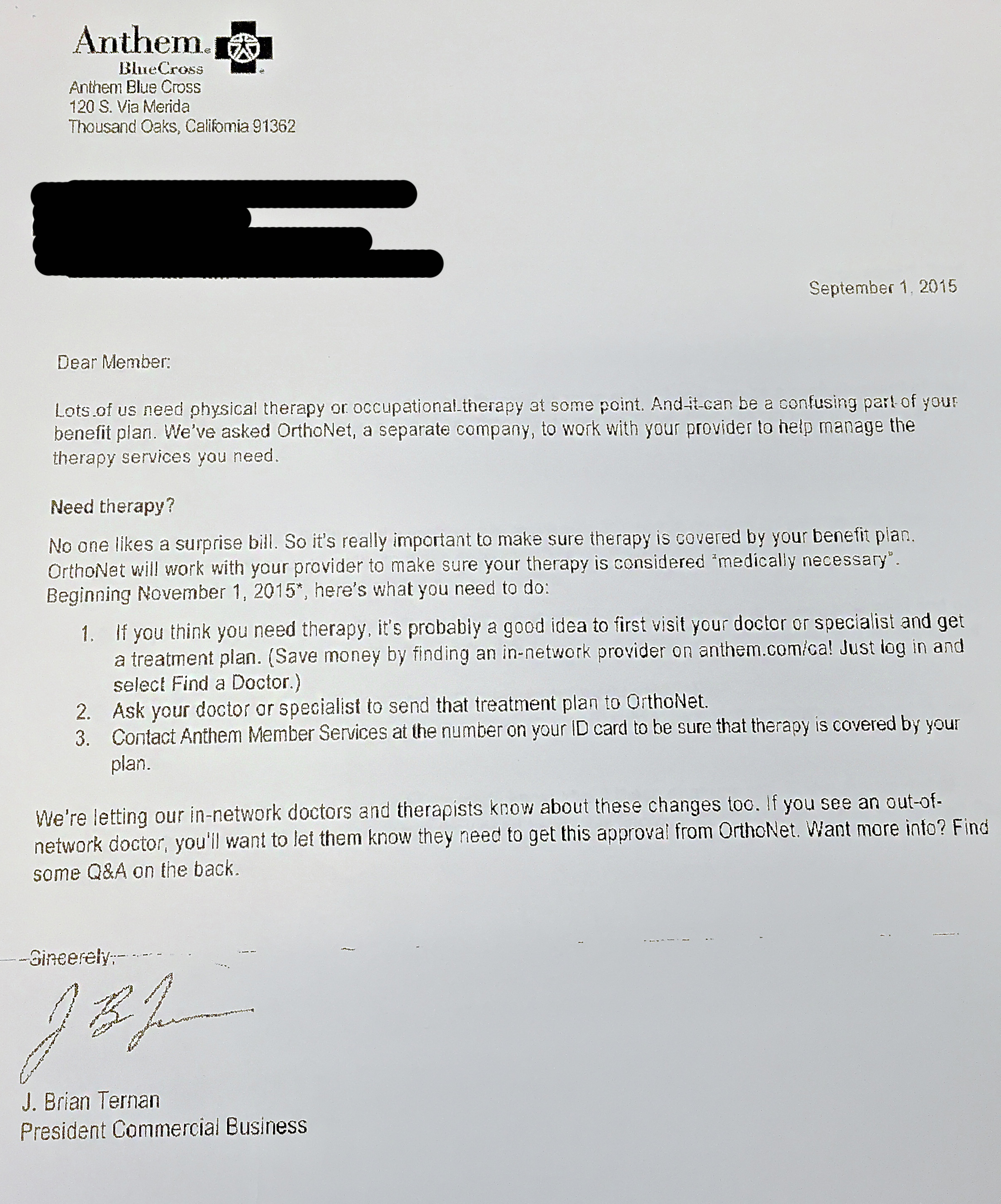
Do you use Anthem Blue Cross as your primary health insurance company? Have you received this letter in the mail?

AnthemLetter2015

Confused? Angry? You should be! Essentially, the people you pay so you can have access to medical care are telling you they’re going to start limiting your access to medical care. By hiring a third-party to decide if your physical therapy treatment is “medically necessary” (a legal term, not a medical one), Anthem Blue Cross (BC) is opening up new channels for being able to avoid paying for your medical care.

At Rausch Physical Therapy, we work hard to provide exceptional, quality care that is easily and affordably accessible, and it’s troubling that this practice of limiting your access to medical care has become the norm for medical care insurance companies.


How Rausch PT currently handles insurance companies/payment

Regardless of what that letter above implies, since the passage of the Direct Access bill in 2014 Californians have not needed a doctor’s referral/prescription before coming into a physical therapy clinic for treatment. You can come to Rausch Physical Therapy at any time for any injuries or impairments that prohibit your mobility, function, and/or quality of life. The issues only arise when it comes to figuring out who pays for this treatment.

Ever since it opened in 2006, Rausch PT has been on the leading edge of forward-thinking healthcare, and Direct Access made possible what owner Kevin Rausch had always envisioned: all people having an easy entry point onto the road to rehabilitation and recovery.

Currently, once our patients come in our door they have two options to pay for their medical treatment:

  1. Pay an out-of-pocket cash rate
  2. Have their insurance help cover the cost of their visit; once we submit their claim to and receive approval from their insurance company, the patient is only responsible for their copayment or deductible.

Whichever payment option you choose, everyone from our front office staff to your physical therapist to our billing department is dedicated to providing you with the best experience and highest quality of care possible.

How the introduction of OrthoNet affects you

Following the lead of other large health insurance companies, BC has decided to bring in a third-party management company, in this case OrthoNet, to handle the authorization of its physical therapy treatment claims. It’s OrthoNet’s job to scrutinize every claim request we submit on behalf of a patient to determine if said visit is—by OrthoNet’s definition—”medically necessary.” After we submit your claim, OrthoNet has two business days to gather all the necessary “clinical information” and either approve or deny your request. If they do approve your claim, OrthoNet will then tell you exactly how many visits it should take you to get better in and subsequently will only pay for.

Please note that this change does not affect BlueCard or Blue Cross Blue Shield members.

Why is this troublesome?

Let’s use the curious cases of Jenny and John as examples to illustrate the potential pitfalls of this increasingly-popular decision by medical care insurance companies to hire third parties to manage their physical therapy claims.

Jenny’s Case

What happens if your claim is denied?

[toggle title=”Click to read…”]Jenny loves to run, but she pushed herself a little too hard this triathlon season and now has knee pain that’s started to limit her ability to train. As an Anthem Blue Cross member, Jenny decides to take advantage of those 60 physical therapy visits she’s allotted per year and immediately makes an appointment at Rausch PT. During Jenny’s first appointment, the front desk sends a request to OrthoNet to get approval for payment for Jenny’s appointment. Jenny sees her PT, and after his initial, hands-on evaluation, he believes Jenny will be back to running pain-free after four or five visits.

Meanwhile, someone at OrthoNet is reviewing Jenny’s case and decides physical therapy treatment for her chronic knee injury is not medically necessary. She does not need surgery (yet) so they deny paying for treatment. They cover the cost of the initial visit, but Jenny now must decide if she’s going to pay cash rate to continue with her compelling treatment plan that will allow her to continue doing what she loves.[/toggle]

John’s Case

What happens if your claim is approved?

[toggle title=”Click to read…”]John is a senior in high school and has sprained his ankle playing basketball. John’s mom received the letter above, and per Anthem Blue Cross’ suggestion she makes an appointment for John to see an in-network doctor. Two days and $150 later, John comes in to Rausch PT with doctor’s approval in hand, ready to start getting better.

On his first visit, we send a request to OrthoNet to get approval for payment for John’s appointment. John sees his PT, and after her initial, hands-on evaluation, she tells John he should be 100% after four or five visits and back on the court before playoffs start in two months.

Meanwhile, someone at OrthoNet is reviewing John’s claim, and two days later they send a payment approval notification. However, OrthoNet has determined that John’s sprain isn’t that bad, so he should be able to start feeling better after a couple visits. BC will only help pay for two appointments to treat his ankle.

John and his PT work hard in those two visits, but he’s still only at about 60%. Inevitably, John is put in a difficult position: does he continue treatment by paying out of pocket so he can make it back in time for playoffs, or does he stop treatment and retire his jersey—or worse yet, try to play anyways and potentially cause lasting damage?[/toggle]

The takeaway

It’s unfortunate that even if your physical therapistor even your doctor—understands your treatment as medically necessary, an outside company can still refuse to acknowledge it as so and require you pay for treatment on your own (on top of you still paying for health insurance.) It’s even more frustrating to us as a provider that we can be limited in the amount of treatment we can give people who come to us for help.

Our patients have and always will be top priority at Rausch Physical Therapy; our sole concern is getting you feeling better so you can get back to doing what you love. Our team of licensed physical therapists spent many years in school to receive their bachelor, master and doctorate degrees and licenses so they could diagnoses and relieve chronic pain and heal injuries to give someone a better quality of life. We don’t believe you should have to live with pain for any reason, especially if that reason is because an outside management company says treatment for your pain isn’t “medically necessary.”

What Rausch Physical Therapy is doing to help

  1. During the last week of October, our front desk staff will be contacting our Anthem Blue Cross patients who are already scheduled for treatment on or after November 1. Together, we’ll work to complete the additional paperwork required to request “prior authorization” so we can continue providing you with quality treatment through the end of the year.  Again, this change is effective November 1, 2015.
  2. At Rausch Physical Therapy, we believe that everyone should have easy, direct access to PT, a physical medicine and rehabilitation specialty that we see change lives every single day. To prepare for the potential influx of BC claim denials after November 1, we are currently working on rolling out new, innovative ways to give you, our valued patient, more payment options so you will never have to rely on referrals or allow your health insurance company to limit your health.


What can you, the patient, do to help?

  1. Raise a ruckus! Be proactive. Demand access to the care you pay for and deserve. Call the Anthem Blue Cross customer service number. Then email your friends, get on Facebook, Tweet, and share this.
  2. If your claim is denied for being “medically unnecessary… Fight back and appeal. According to the U.S. Government Accountability Office, you have a 50-50 chance of getting your appeal approved if it’s an issue of medical necessity. It may take a little longer, but if the amount of money is significant or the issue important enough to you, it is worth the time you take to make it right. Get the forms you need and fill them out and send them off. Rausch PT and/or your doctor can help by providing additional medical information to the request to show exactly why it is medically necessary. Don’t be intimidated by your insurance company; we’re here to help. Click here for the forms you need to file a complaint.

If you have any questions, please feel free to call our office at (949) 276-5401 and we’ll be happy to answer any concerns you may have to make this transition as easy as possible.

Rausch PT Gets You There

[one_half]

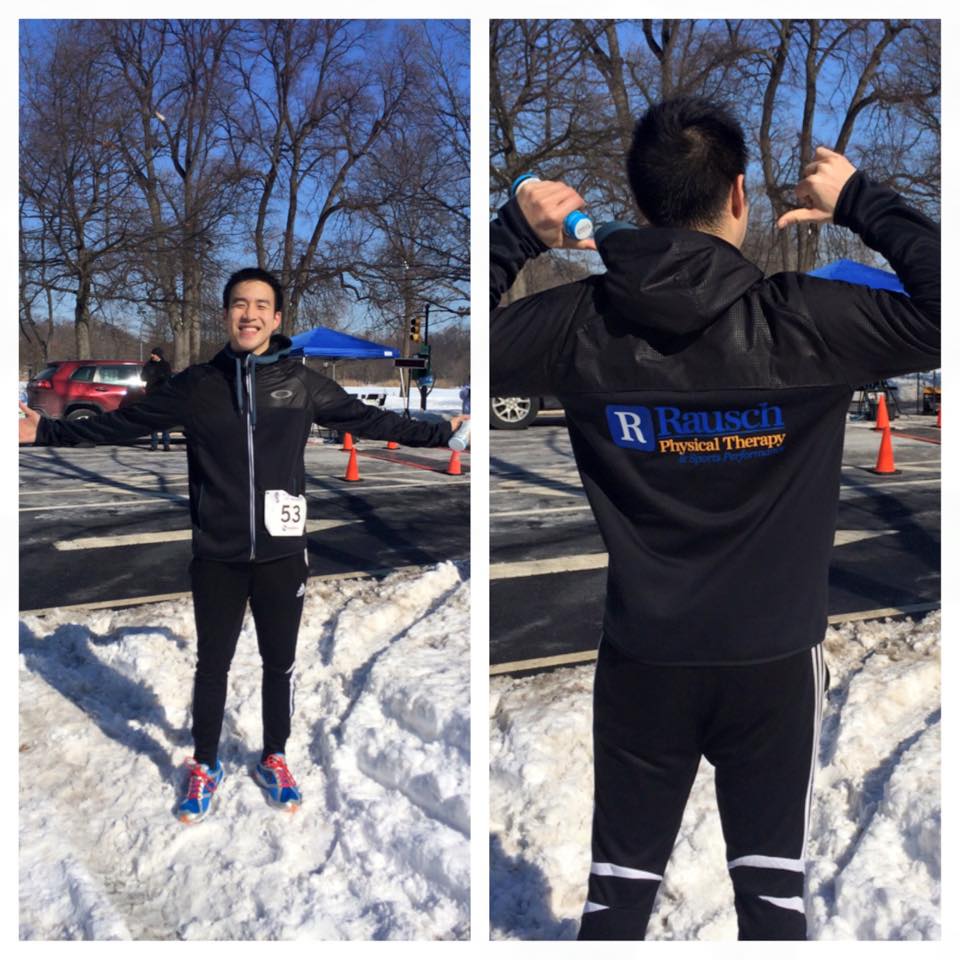
Justin: "Repping proper running mechanics and warmer weather all the way on the East Coast at the NYU Physical Therapy Annual 5k."
Justin: “Repping proper running mechanics and warmer weather all the way on the East Coast at the NYU Physical Therapy Annual 5k.”

[/one_half][one_half_last]

Kevin: "From the top at 11,053 ft to recovery from the surgery table... This team gets it DONE!"
Kevin: “From the top at 11,053 ft to recovery from the surgery table… This team gets it DONE!”

[/one_half_last]

As much as we love seeing our clients in the clinic, nothing brings us more joy than seeing them out and back to doing what they love. Whether your goal is returning to the golf course, racing your first 5k, or trying to qualify for Kona, we’re here to get you there!

Where has Rausch Physical Therapy & Sports Performance taken YOU? Share your Rausch PT #triumph photos on FacebookTwitter and Instagram, and you could be featured on our page!

Don’t forget to tag #RauschPT #getyouthere

Common Physical Therapy Treatments

Aches, pains, and injuries can sideline you from the activities you love. But physical therapy offers a path back to movement and well-being. Here, we present you with a range of techniques, from hands-on therapy and therapeutic exercises to modalities like heat and electrical stimulation. By understanding these treatments, you can approach your physical therapy journey with confidence.

Physical therapists have a range of modalities, or treatment methods, they can choose from to help reduce pain and inflammation, as well as improve your endurance, strength, and range of motion as you rehab from a musculoskeletal injury or movement dysfunction.

Heat application, electrical stimulation, traction, and massage are just a few of the physical therapy modalities that may be used at different stages of your recovery. While some modalities may only be able to be used during a treatment session, others can also be done at home.

This article explores 12 common physical therapy modalities, including how and why they are used. If your therapist recommends one for you, they should be prepared to explain the reason for using the modality and what to expect from treatment.


Exercise

Exercise is a controlled physical stress applied to the body to help improve strength, range of motion, or flexibility.

Exercise can be passive or active.

  • Passive exercise is one that requires you to simply relax while another person, like a physical therapist, applies the stress. One example of this is a hamstring stretch where a person lifts your leg to elongate the hamstring muscle on the back of your thigh.
  • Active exercise is exercise that you perform under your own power. Walking on a treadmill, hip strengthening exercises, or straight leg raising exercises are all active exercises.

If you attend physical therapy in a clinic, at home, or while in the hospital, you will likely be engaged in some form of exercise to help improve your mobility. Home exercises are often also prescribed.

The home program is a group of exercises that you perform on your own. They can be very important to helping you return to normal function.


Ultrasound

Ultrasound is a deep heating treatment used to treat many musculoskeletal conditions like sprains, strains, or tendonitis.

Ultrasound is administered by your physical therapist using an ultrasound machine. A wand called a sound head is pressed gently against your skin and moved in small circular sweeps near the site of injury. A small amount of gel is used so the ultrasound waves are absorbed into the skin and muscles.


Electrical Stimulation and TENS

Electrical stimulation is occasionally used in physical therapy to help decrease pain around injured tissue.2 Transcutaneous electrical neuromuscular stimulation (TENS) is one well-known form.

There are two theories about how the stimulation works: the gate theory and the opiate theory.

Other forms of electrical stimulation may be used to contract muscles. This is called neuromuscular electrical stimulation (NMES) and is used to help your injured muscles “relearn” how to function properly.


Traction

Traction is used in the treatment of low back pain and neck pain to help decrease pain and improve mobility in the spine.

To use lumbar traction, you must be strapped into a mechanical machine. There is a vest that helps support your ribs and another device that wraps around your pelvis. The vest and pelvic device are stabilized with straps, and a mechanical force is applied with a machine.

Cervical traction is applied in either the sitting or lying position. If sitting, a harness is attached to the head and a pulley system is used with a small weight attached. The weight provides the traction force while you sit comfortably in a chair.

In lying, or supine, traction, a specific device is used. You must lie down on your back and strap your forehead into the device. Then, a pneumatic pump is used to help provide the traction force to your neck.

Theoretically, traction helps to separate the joints and disc spaces in the low back or neck, which in turn helps to decrease pressure on spinal nerves.


Joint Mobilization

Joint mobilization occurs when your physical therapist passively moves the joints of your body in specific directions. This can help to decrease pain and improve mobility.

While you may think of your joints moving as hinges, there is a gliding motion that also occurs between the joints of the body. This gliding motion is increased during joint mobilizations. The degree to which your therapist moves each joint depends on the amount of pressure and the direction of force applied to the joint.

While joint mobilization is a passive treatment, your physical therapist can teach you self-mobilization techniques so you can manage your problem independently. This can help you return to normal function quickly and offer you a strategy to prevent future problems.


Massage

Massage is using the hands to knead the injured tissues of your body to help decrease pain, improve circulation, and decrease muscle tension.

There are many massage techniques, including effleurage, petrissage, and trigger point massage.


Heat

Moist heat, or hot packs, may be applied to your body if you have an injury or after physical therapy exercises. The heat helps to increase circulation to the injured tissues, relax the muscles, and provide pain relief.

In a physical therapy clinic, hot packs are kept in a device called a hydrocollator. This is a large tank of hot water. The hot packs are cloth packs filled with a sand, clay and silica mixture. They absorb the hot water and are wrapped in terry cloth covers and towels before being applied to your body.

The hot pack is usually kept on the injured body part for 15 to 20 minutes.

Caution must be used when using hot packs as the skin may suffer burns if insufficient toweling is used during the application of the heat.


Ice

If you have an injury, cold packs or ice may be applied to your body to help decrease pain and control inflammation. Ice is usually used during the acute or initial phase of injury to limit localized swelling around tissues.

Cold packs are usually applied for 15 to 20 minutes. Like hot packs, care must be used to prevent skin damage from getting too cold.


Iontophoresis

Iontophoresis is a form of electrical stimulation that is used to deliver medication across the skin to inflamed or injured tissues.

Most often, a steroid like dexamethasone is used in the treatment of inflammation. This steroid can help decrease pain and swelling of tissues that occurs when they are inflamed.

Iontophoresis can be used in the treatment of other conditions as well, depending upon the medication that is used during treatment. It is not a replacement for active physical therapy, but can be added as part of an overall plan.


Laser or Light Therapy

Light therapy involves using light at a specific wavelength to help improve the healing process of injured tissues.8 The treatment is painless and usually lasts for approximately one to three minutes.

To apply light therapy, your physical therapist will hold the light-emitting wand directly over your injured body part and press a button to activate the light.

Light therapy can be used in the treatment of chronic pain, inflammation, or wound healing.

The theory behind light therapy is that photons of light carry energy, and this energy applied to injured tissues can help improve cellular processes and speed healing or decrease pain.


Kinesiology Taping

Kinesiology taping, or K-tape, is often used by physical therapists to augment your rehab program. The tape is made of a flexible fabric that stretches and pulls as you move.

Kinesiology tape is applied to the skin, and it can be kept in place for a few days.

It may be used for various purposes, including:

  • Muscle inhibition
  • Muscle facilitation
  • Bruising and swelling management
  • Pain relief

Since K-tape is a newer treatment modality, it has yet to be fully tested, and gains made with it may be due to the placebo effect.


Whirlpool

Whirlpools are a form of hydrotherapy and are used to help improve circulation, maintain clean wounds, or control inflammation.

Whirlpools can be hot or cold. The usual temperature for a hot whirlpool is between 98 and 110 degrees Fahrenheit. A cold whirlpool bath is typically 50 to 60 degrees Fahrenheit.

Whirlpool baths have a motor or agitator that helps move the water around the body part that is being treated. This motion can have a soothing effect, and can also be used in the treatment of wound debridement.

A typical whirlpool session involves placing your body part to be treated into the water and relaxing while the water swirls around it. Gentle exercises can be performed to help improve motion around the body part while it is in the whirlpool.

Care must be taken to ensure that the whirlpool bath is not too cold or hot, as temperature extremes can damage your skin during treatment.

Understanding your treatment options is key to a successful recovery. Our experts are here to offer you a personalized plan to address your specific pain. Call us today at 949-276-5401. For more tips, follow us on Instagram.


Reference: [https://www.verywellhealth.com/physical-therapy-treatments-and-modalities-2696683]

Everything About Muscle Pain

Muscle pain is extremely common and will affect nearly everyone at some point. Activities like heavy lifting workouts, lifestyle factors like excessive stress, and chronic conditions can cause or worsen it. Learn how to address this problem.

Everything You Need to Know About Muscle Pain

Don’t let muscle pain hold you back! Explore the benefits of PT and get back to enjoying your favorite activities pain-free! Contact us today at 949-276-5401. You can follow us on TikTok and Instagram for more tips.


Reference: [ https://www.health.com/muscle-pain-causes-7229891 ]

Calf Pain? Here’s What You Need to Know

Calf pain can strike suddenly, leaving you sidelined and wondering what happened. Whether it’s a sharp twinge or a dull ache, calf pain can disrupt your daily routine and leave you frustrated. Let’s turn that ouch into an “all clear” and get you moving pain-free! Questions? That’s why we are here! Give us a call and let’s get you seen. Relief is a mere phone call away!

Popped or Pulled Calf Muscles: What To Know

Say goodbye to calf pain for good! Explore the benefits of PT and get back to enjoying your favorite activities pain-free! Contact us today at 949-276-5401. You can follow us on TikTok and Instagram for more tips.


Reference: [ https://www.health.com/condition/chronic-pain/pulled-calf-muscle ]

Forearm Pain Relief

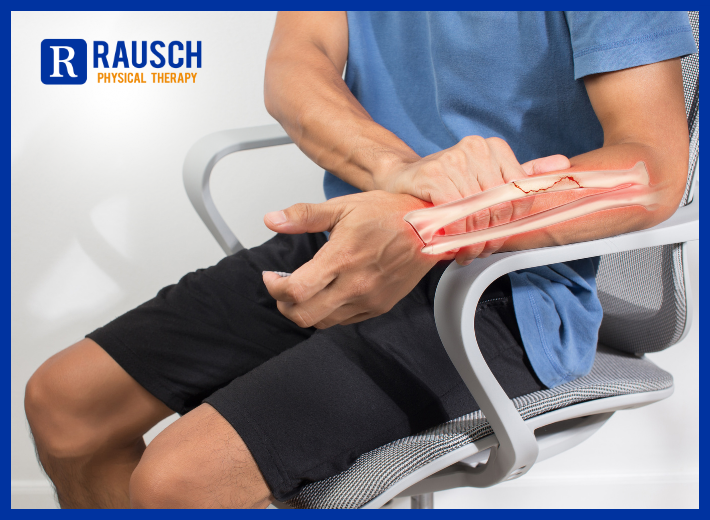
Forearm pain can be a constant companion, hindering everything from work tasks to your favorite hobbies. Here is all the information you need to understand your forearm pain and take charge. If you’d like a personalized look at what’s going on with your pain — we are here for that, along with a customized solution to make it go away! Don’t forget — you don’t have to live with pain! Sometimes we get used to it and think its a normal part of aging or injury — not so!

What To Know and Do About Forearm Pain

Need a personalized plan to address your specific forearm pain? Schedule a consultation with our licensed physical therapist and get started on your path to recovery! Call us today at 949-276-5401. For more tips, follow us on Instagram.


Reference: [ https://www.health.com/forearm-pain-8584583 ]

Say Goodbye to Hip Discomfort

Hip pain can be a real drag, putting a damper on your daily activities and leaving you feeling stiff and uncomfortable. It shouldn’t be ignored. Learn the tools you need to understand the causes of your pain and explore effective relief strategies. Questions? We are always here!

What Causes Hip Pain—and How Can You Relieve It?

Take control of your hip health! Learn how to manage discomfort and prevent it from returning with our PT experts. Contact us today at 949-276-5401. You can follow us on TikTok and Instagram for more inspiration and tips.


Reference: [ https://www.health.com/hip-pain-8426031 ]

A Beginner’s Weight Training Guide

Ready to unlock your inner strength and build a healthier you? Weight training isn’t just for bodybuilders anymore! Whether you’re a complete novice or someone curious about adding weights to your routine, here is a roadmap to success. If you have a pre-existing concern or want to know how to work this into your routine, we are here to guide you through and ensure you’re at your healthiest every step of the way!

A Beginner’s Guide to Weight Training

Some exercises, including bicep curls and squats, can support weight training at home or the gym. You can use free weights or your body weight with certain exercises to provide resistance.

Whether your goal is to build muscle mass or achieve a fitter, more toned body, lifting weights can help you get there.

Weight training, also known as resistance or strength training, builds lean, stronger muscles, strengthens your bones and joints, and can help keep your metabolism in a healthy state — meaning you’ll burn more calories even when you’re resting.

And the benefits of lifting weights aren’t just for young people. Weight training as we age can help fight the loss of muscle mass and mobility, as well as improve psychological well-being.

So even if you’ve never done any kind of weight training before — it’s never too late to start!

What’s more, you don’t even need to belong to a gym. You can simply use your body weight for many exercises or use free weights, resistance bands, or other home fitness equipment to get results.

This article will walk you through how to get started with weight training and provide suggested exercises and training advice for beginners.

What do you need to start weight training?

If you’ve never lifted weights before, consider starting out with the help of a certified personal trainer. They’ll be able to teach you the proper form for specific exercises and set up a strength training program tailored to your needs.

Many gyms or fitness centers offer introductory training sessions at little or no cost, or they have trainers available if you have questions. Additionally, there are many personal trainers who train clients online, through video platforms.

While most gyms have a combination of resistance machines and free weights, such as dumbbells and barbells, you can also get a comprehensive weight training workout at home with basic equipment.

Equipment options

You don’t necessarily need weights to build lean muscle mass and tone your body. As an example, for some strength training exercises, like pushups or lunges, you only need your body weight to provide resistance.

You can expand your at-home workout options with dumbbells. A beginner’s set of adjustable weight dumbbells starts at about $50, but the price increases as you add more weight.

Kettlebells, which are weighted balls with handles, are another popular option. Many kettlebell exercises work several muscle groups at once, which makes them effective for a full-body workout, especially if you’re short on time.

Resistance bands are also a helpful addition to your workout equipment. These color-coded elastic bands provide varying levels of resistance when pulled and stretched.

A set of resistance bands can be purchased for $10 to $60. Because they’re light and portable, you can take them with you when you travel.

What to know before you begin

Once you’re ready to get started with a weight training program, keep the following tips in mind.

Weight lifting tips for beginners

  • Warm up. Some aerobic activity, such as a 5-minute jog or brisk walk, will increase blood flow to your muscles and prime them for a good workout. Skipping rope or doing jumping jacks for a few minutes are also good warmup options.
  • Start with lighter weights. You want to start with a weight that you can lift 10 to 15 times with proper form. Begin with 1 or 2 sets of 10 to 15 repetitions, and slowly progress to 3 sets or more.
  • Gradually increase the weight. When you can easily do the recommended number of sets and reps, increase the weight by 5 to 10 percent. Check to make sure this is the right weight for you before doing a full workout.
  • Rest for at least 60 seconds in between sets. This helps prevent muscle fatigue, especially as you start out.
  • Limit your workout to no longer than 45 minutes. You can get the workout you need in this time frame. Longer sessions may not lead to better results and may increase your risk of burnout and muscle fatigue.
  • Gently stretch your muscles after your workout. Stretching can help boost your flexibility, ease muscle tension, and reduce your risk of injury.
  • Rest a day or two in between workouts. Resting gives your muscles time to recover and replenish energy stores before your next workout.

Exercises for beginners

You may be especially interested in building your biceps or toning your legs, but the best resistance training program works all the major muscle groups in your body.

In fact, overworking one muscle group at the expense of another could raise your risk of injury.

For a solid all-over workout, you may want to start off with the following exercises. Including these exercises in your weight lifting routine will work most of the large muscle groups in your body.

SETS AND REPS

Start off by doing 10 to 15 reps of each exercise. Aim for 1 to 2 sets to start. As you build strength, you can add extra sets, and also increase the weight.

  • What is a rep? A repetition (rep) is one complete exercise movement.
  • What is a set? A set is a certain number of reps. For instance, 10 to 15 reps make up 1 set.

Dumbbell single-arm rows

Targeted area: Your back and upper arm muscles.

How to do this exercise:

  1. Place your left knee on the end of a sturdy bench and place your left hand palm-down on the bench for balance.
  2. With your back parallel to the ground, reach down with your right hand and grab a dumbbell with your palm facing the bench.
  3. Slowly bring the dumbbell up to your chest. Squeeze your back and shoulder muscles and slowly straighten your arm to the starting position.
  4. Finish 1 set, then switch arms and do 1 set with your right knee and right hand on the bench.

Dumbbell shoulder press

Targeted area: Your shoulder muscles.

How to do this exercise:

  1. Sit or stand with a dumbbell in each hand, your palms facing forward, and your elbows out to your side at 90-degree angles.
  2. Without leaning back or arching your back, press the dumbbells up over your head until your arms are almost straight.
  3. Slowly return them to the starting position.

Dumbbell chest press

Targeted area: Your chest muscles.

How to do this exercise:

  1. Lie flat on a bench with a dumbbell in each hand and your palms facing forward.
  2. Slowly press the dumbbells upward until your arms are directly over the shoulders. Be careful not to lock your elbows.
  3. Slowly lower the dumbbells to the starting position. Your elbows should be a little lower than your shoulders.

Bicep curls

Targeted area: Your biceps (muscles in the front of your arms).

How to do this exercise:

  1. Sit or stand with a dumbbell in each hand in front of you, your elbows at your sides, and your palms facing up.
  2. Curl the dumbbells up toward your shoulders by bending your elbows but keeping them stationary at your sides.
  3. Reverse the curl to the starting position.

Triceps extensions

Targeted area: Your triceps (muscles in the back of your arms).

How to do this exercise:

  1. You can do this exercise sitting on a bench or standing with your feet about shoulder-width apart.
  2. Place both your hands around the dumbbell handle.
  3. Lift the dumbbell up over your head so that your arms are straight.
  4. Keeping your elbows by your ears, bend them to a 90-degree angle, lowering the dumbbell behind your head.
  5. Slowly straighten your arms so that the dumbbell is above your head again.

Resistance band pull apart

Targeted area: The muscles in your back, shoulders, and arms.

How to do this exercise:

  1. Stand with your arms stretched out in front of you at chest height.
  2. Hold a resistance band parallel to the ground and grasp it tightly with both hands.
  3. Keeping your arms straight, pull the band toward your chest by moving your arms outward, away from your body. Use your mid-back to initiate this movement.
  4. Keeping your spine straight, squeeze your shoulder blades together and “downward,” and then slowly return to the starting position.

Lunge

Targeted area: Your leg muscles, including your quadriceps, hamstrings, and calves, as well as your glutes (buttocks). If you include a dumbbell, you’ll work your biceps, too.

How to do this exercise:

  1. Stand tall with your feet shoulder-width apart (a dumbbell in each hand for the more advanced).
  2. Take a big step forward with your left leg so your heel touches down first.
  3. Lower your body so your left thigh is parallel to the floor.
  4. Pause for a second (curling the dumbbells up toward your chest and lowering them again to the starting position for the more advanced).
  5. Push off your heel and return to the starting position.
  6. Repeat, but lead with your right leg.

Squats

Targeted area: Your leg muscles, including your quadriceps, hamstrings, and calves.

How to do this exercise:

  1. Squats can be done with or without weights.
  2. Stand with your feet shoulder-width apart and slowly bend your knees, so your thighs are almost parallel to the floor.
  3. Slowly rise to your starting position.
  4. To add resistance, hold a dumbbell or kettlebell close to your chest with both hands.

Calf raises

How to do this exercise:

  1. Stand on the edge of a step with your feet parallel to each other.
  2. Slowly raise your heels a few inches above the step and hold for a few seconds.
  3. Slowly lower your heels below the edge of the step and hold for a few seconds. You should feel a stretch in your calves.
  4. You can add resistance by holding a light dumbbell in each hand down by your sides.

Plank

The plank works your entire body, but specifically targets your core. It also strengthens your arms, shoulders, back, glutes, and legs.

  1. Start on all fours, with your hands below your shoulders and your knees below your hips.
  2. Straighten your legs behind you, keeping your feet hip-width apart. Tighten your core.
  3. Hold for 10 to 30 seconds.
  4. As you get stronger, increase to holding it a minute or more

To make this exercise easier, place your knees on the floor.

Weight training schedule

If your goal is to mainly build strength, three weight training workouts a week will likely provide the results you need.

According to a 2019 studyTrusted Source, doing a weight training routine 3 times a week is as effective as more frequent workouts for strength building.

However, if you want to build up muscle mass, you’ll need to do more repetitions and more frequent workouts.

You can work all your muscle groups during a workout, doing 1 or 2 sets of each exercise to start, and working your way up to more sets or heavier weights as the exercises get easier.

Or, you can focus on certain muscle groups on specific days. For example:

Weekly weight training schedule

Monday: Chest, shoulders, tricepsand core

  • dumbbell chest press
  • dumbbell shoulder press
  • dumbbell triceps extension
  • plank

Wednesday: Back, bicepsand core

  • dumbbell single-arm rows
  • bicep curl
  • resistance band pull apart
  • plank

Friday: Legsand core

  • lunges
  • squats
  • calf raises
  • plank

As you become more comfortable with weight training, you can mix up the exercises you do for each muscle group. Be sure to add weight and more sets as you build up your strength.

Safety tips

It’s important to focus on safety when you start a weight training routine. Pay close attention to your body and resist the urge to push yourself too quickly.

To stay safe while weight training, remember to:

  • Wear proper clothing for weight lifting, like closed-toe shoes and weight lifting gloves if needed.
  • Perform each exercise slowly, paying attention to proper form.
  • Use a spotter to help you with heavier lifts, especially those that go above your head.
  • Stay hydrated throughout your workout.
  • Inhale before your lift and exhale during the lift. Never hold your breath when working out weights.
  • Stop your workout if you feel sharp or stabbing pain. If the pain doesn’t go away when you stop exercising, seek medical attention.

If you have a health condition, talk with your doctor about a weight training and exercise program that’s safe for you.

The bottom line

Weight training is also known as resistance or strength training. It involves moving parts of your body against some kind of resistance, like weights, resistance bands, weight machines, or even your own body weight.

Weight training is an excellent way to build muscle mass and make your muscles stronger. It can also keep your metabolism chugging, strengthen your bones and joints, improve your muscle tone, help you burn more calories, and keep you healthier as you age.

To make the most of your weight training routine, start with lighter weights until you master the proper form. Then increase the weight or resistance slowly to avoid injury. Be sure to work all your muscle groups for optimal strength and fitness.

Not sure where to start? Explore our qualified physical therapists who can help you embark on your weight training journey safely and effectively. Contact us today at 949-276-5401. For more tips, follow us on Instagram.


Reference: [ https://www.healthline.com/health/how-to-start-lifting-weights ]

Boost your fitness with 3 beginner-friendly plyometric moves!

These dynamic exercises harness the power of explosive jumps and bodyweight movements to skyrocket your fitness in no time. But hold on, don’t let the word “explosive” intimidate you! This post is your beginner-friendly guide to unlocking the benefits of plyometrics with 3 easy-to-learn moves.

What are plyometrics?

Plyometric training involves short, intense bursts of activity that target fast-twitch muscle fibers in the lower body. These fibers help generate explosive power that increases speed and jumping height.

“Plyometrics are used by competitive athletes who rely on quick, powerful movements, like those in basketball, volleyball, baseball, tennis, and track and field,” says Thomas Newman, lead performance specialist with Harvard-affiliated Mass General Brigham Center for Sports Performance and Research. Plyometrics also can help improve coordination, agility, and flexibility, and offer an excellent heart-pumping workout.

Who can safely try plyometrics?

There are many kinds of plyometric exercises. Most people are familiar with gym plyometrics where people jump onto the top of boxes or over hurdles.

But these are advanced moves and should only be attempted with the assistance of a trainer once you have developed some skills and muscle strength.

Keep in mind that even the beginner plyometrics described in this post can be challenging. If you have had any joint issues, especially in your knees, back, or hips, or any trouble with balance, check with your doctor before doing any plyometric training.

How to maximize effort while minimizing the risk of injury

  • Choose a surface with some give. A thick, firm mat (not a thin yoga mat); a well-padded, carpeted wood floor; or grass or dirt outside are good choices that absorb some of the impact as you land. Do not jump on tile, concrete, or asphalt surfaces.
  • Aim for just a few inches off the floor to start. The higher you jump, the greater your impact on landing.
  • Bend your legs when you land. Don’t lock your knees.
  • Land softly, and avoid landing only on your heels or the balls of your feet.

Three simple plyometric exercises

Here are three beginner-level exercises to jump-start your plyometric training. (Humming the bionic man sound is optional.)

Side jumps

Stand tall with your feet together. Shift your weight onto your right foot and leap as far as possible to your left, landing with your left foot followed by your right one. Repeat, hopping to your right. That’s one rep.

  • You can hold your arms in front of you or let them swing naturally.
  • Try not to hunch or round your shoulders forward as you jump.
  • To make this exercise easier, hop a shorter distance to the side and stay closer to the floor.

Do five to 15 reps to complete one set. Do one to three sets, resting between each set.

Jump rope

Jumping rope is an effective plyometric exercise because it emphasizes short, quick ground contact time. It also measures the coordination and repeated jump height as you clear the rope.

  • Begin with two minutes of jumping rope, then increase the time or add extra sets.
  • Break it up into 10- to 30-second segments if two minutes is too difficult.
  • If your feet get tangled, pause until you regain your balance, and then continue.

An easier option is to go through the motions of jumping rope but without the rope.

Forward hops

Stand tall with your feet together. Bend your knees and jump forward one to two feet. Turn your body around and jump back to the starting position to complete one rep.

  • Let your arms swing naturally during the hop.
  • To make this exercise easier, hop a shorter distance and stay closer to the floor.
  • If you want more of a challenge, hop farther and higher. As this becomes easier to do, try hopping over small hurdles. Begin with something like a stick and then increase the height, such as with books of various thicknesses.

Do five to 10 hops to complete one set. Do one to three sets, resting between each set.

Unlock the benefits of plyometrics safely and effectively with expert physical therapy designed for athletes! Contact us today at 949-276-5401. You can follow us on TikTok and Instagram for more inspiration and tips.


Reference: [https://www.health.harvard.edu/blog/plyometrics-three-explosive-exercises-even-beginners-can-try-202308022960]

Common Workout Mistakes (and How to Fix Them!)

We’ve all been there: feeling defeated after a workout, wondering why the results aren’t matching the effort. Maybe you’re pushing too hard, neglecting certain muscle groups, or even falling victim to some fitness myths. The good news? You’re not alone! Here’s the thing: even the most dedicated gym rats make mistakes. Together, we can unpack the “why” behind these mistakes and, most importantly, share tips on how to fix them.

Exercising is one of the best things you can do for your health, and you deserve an enthusiastic pat on the back for any amount of physical activity you’re doing. But if you’re performing your exercises the wrong way, you could be hurting, not helping your body.

One of the biggest exercise errors is using improper technique. You risk back injury if you arch your back while doing planks or push-ups, and knee injury if you bend too deeply in a lunge or squat (see “Move of the month”).

Another mistake is doing the wrong exercise. For instance, running when you have severe back or knee arthritis puts too much pressure on the joint.

But those are just a few exercise no-nos. Consider the following, and see if you need to take steps to fix them.

Skipping the warm-up

You need to warm up your muscles so they’re more flexible before you put them to work, especially when you get older. “An older person has less flexible muscles and tendons. Muscles can tear easily because they have less water content, and they’re brittle and less elastic,” says Clare Safran-Norton, clinical supervisor of rehabilitation services at Harvard-affiliated Brigham and Women’s Hospital.

Fix it: Warm up your muscles before exercising with a few minutes of repetitive motion such as marching in place or doing arm circles. That gets blood, heat, and oxygen to the muscles and makes them amenable to change.

Being inconsistent

An occasional or weekend workout is less effective than more frequent activity, and cramming a week’s exercise into a single session increases the risk for injury.

Fix it: For most people, the weekly goal should be 150 minutes of moderate-intensity exercise (that gets your heart and lungs pumping) and strength training at least twice per week. That could consist of shorter aerobic workouts (at least 20 minutes) each day or longer workouts (at least 50 minutes) three times per week.

Lifting too much weight

Lifting too much weight — especially lifting too much too soon, if you’re just starting to get back into a routine — can lead to muscle tears.

Fix it: Use lighter weights and lift them more times. “Do two or three sets of 20 lifts using 2-pound weights instead of one set of five or 10 with a 5-pound weight,” Safran-Norton says.

Not resting muscle groups

Working the same muscle groups every day can cause injury. Muscles need at least 48 hours after a strength workout to recover and rebuild.

Fix it: Alternate which muscle groups you work from day to day, such as arms and shoulders on Tuesdays and Thursdays, but not Mondays or Wednesdays.

Improper hydration

Fluids help cushion your joints and stabilize blood pressure and heart rate. Exercising causes you to lose water and electrolytes (sodium, potassium) when you sweat, and it also causes lactic acid to build up in your muscles (which can lead to muscle cramps).

Fix it: Healthy people need six to eight cups of fluid per day, and more if they’re exercising. “Some people do well with water; others do well with a sports drink to replace electrolytes,” Safran-Norton says.

Poor posture

Exercising with slouched posture and rounded shoulders puts you at risk for back and shoulder injury (such as a rotator cuff tear).

Fix it: Keep your shoulders down and back, keep your back straight, and work with a physical therapist to correct poor posture.

Struggling with form and avoiding injuries? Let’s fix those pesky workout mistakes for good! Learn from them and work smarter with our expert PT guidance. Contact us today at 949-276-5401. For more tips, follow us on Instagram.


Reference: [https://www.health.harvard.edu/staying-healthy/stop-making-these-common-workout-mistakes]

5 Stretches to Soothe Your Stiff Neck

Is your head doing the bobblehead dance on top of your shoulders? Does turning left feel like an Olympic trial in flexibility? These five stretches are ready to help you untangle knots, melt away soreness, and restore your head to its rightful, pain-free perch.

How to Stretch Your Neck

If your neck is stiff or sore, you have lots of company. Neck pain is one of the most common types of pain among Americans. But as with any other part of your body, exercises and stretches can make the muscles in your neck stronger and more limber. Try these moves to loosen a tense neck, banish pain, and gain flexibility.

Bonus: A strong neck can help prevent problems with your shoulders, upper back, and arms, too.

If you already have pain in your neck or elsewhere, talk to your doctor before you start. You will feel some tension in your neck muscles when you stretch. But you shouldn’t have pain. If you do, stop right away.

This can be done while you’re seated or on your feet. Keep your moves slow and smooth.

  • Start with your head squarely over your shoulders and your back straight.
  • Lower your chin toward your chest and hold for 15-30 seconds. Relax, and slowly lift your head back up.
  • Tilt your chin up toward the ceiling and bring the base of your skull toward your back. Hold for 10 seconds, then return to the start position.
  • Repeat the set several times. Do it every day.

Do this while standing, with your feet hip-width apart and arms down by your sides.

  • Gently tilt your head toward your right shoulder and try to touch it with your ear. Stop when you feel the stretch. Don’t raise your shoulder.
  • Hold the stretch for 5-10 seconds, then return to the start position.
  • Repeat on your left side. You can do several sets and work your way up to 10 repetitions.
  • For extra stretch, put the hand on the same side of your tilted head on top of your head, and press lightly with your fingertips.

You can do this while seated or standing.

  • Keep your head squarely over your shoulders and your back straight.
  • Slowly turn your head to the right until you feel a stretch in the side of your neck and shoulder.
  • Hold the stretch for 15-30 seconds, and then slowly turn your head forward again.
  • Repeat on your left side. Do up to 10 sets.

This is best done standing up.

  • Raise your shoulders straight up and move them in a circle going forward. Do it 6 times.
  • Return to the start position, and make another 6 circles, this time going backward.