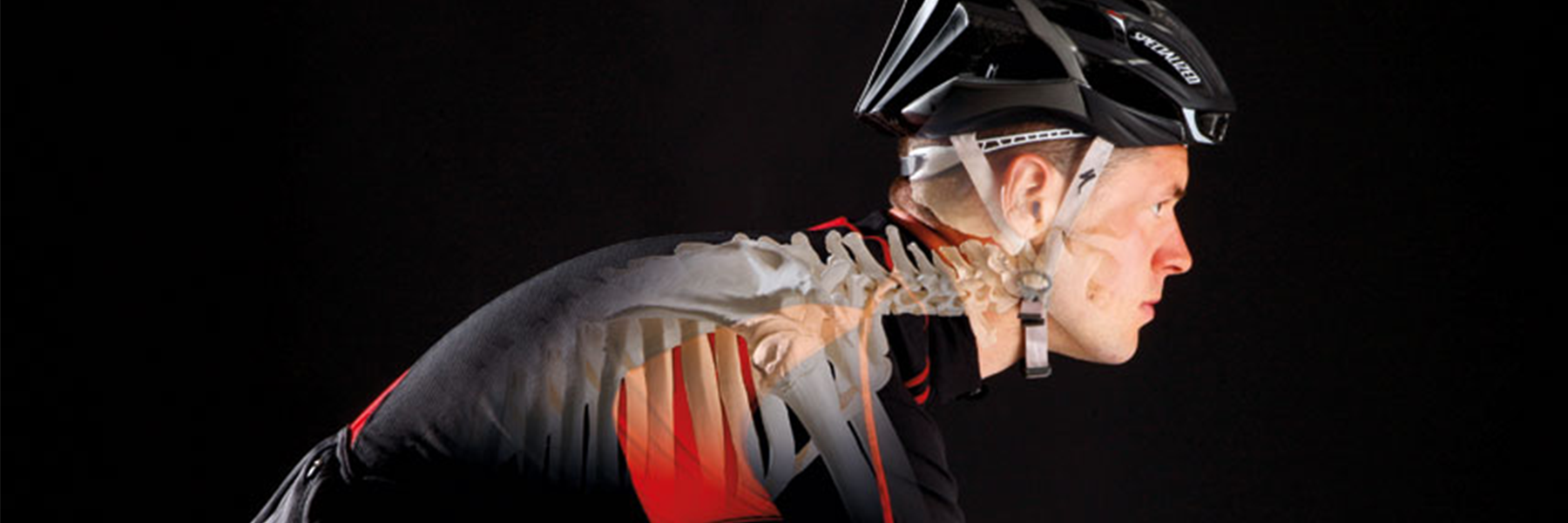
Don’t let cycling be a pain in the neck. DPT Max Biessmann shares his three quick fixes for helping alleviate and prevent pain, aches and soreness in the upper back and neck while on your bike.
 BY MAX BIESSMANN, DPT, RAUSCH PHYSICAL THERAPY
USAT LEVEL I COACH, ASCA LEVEL I COACH, USA SWIMMING COACH
Approximately 66 million Americans enjoy cycling for sport, and why wouldn’t they! It’s a great workout, social, and is perfect for cross training or for people with chronic injuries because of the reduced impact cycling has on the body. Unfortunately, many cyclists find themselves struggling with pain or discomfort, whether it’s the inability to get comfortable on the saddle or one of the most common complaints: neck/upper back pain and discomfort. Many people complain of pain ranging from soreness and aching, to numbness or tingling in their arms and hands, to sharp shooting pains in the neck and arms.
What Causes Neck Pain While Cycling
While cycling, your neck is in an extended position, doing its best to hold up your rather heavy head (the average head is 10 to 11 lbs.) Not only must your muscles do all the heavy lifting since the spine is unable to support the weight directly, but this also causes a closing down of the facet joints in your vertebrae. This constant closing can cause nerve irritation and excessive wear and tear on the joints.
As with anything you do, the longer you spend in a specific position, the more your body adapts to maintain that position. So, when you’re spending hours and hours per day hunched forward at your desk, in front of a laptop, looking at your phone, and on your bike, the more your body adapts to this position. This can cause the common posture dysfunction upper crossed syndrome, which is when your neck extenders (the muscles you use to look up) get short and tight, while the deep neck flexors (the muscles that tuck your chin down) get stretched out and relatively weakened.
Three Easy Ways to Avoid Neck Pain While Cycling
This combination of muscular imbalances and decreased nerve root space can lead to any combination of symptoms from chronic aching to shooting pains. Luckily, there are several very simple things you can do to decrease these symptoms if you already have them or prevent them from starting in the first place.
#1: Check how you’re riding your bike
- Make sure your elbows are slightly bent in order to allow your arms to absorb vibrations and impacts from the road or trail.
- Your hands should be snugly gripping the bars or hoods, but still staying relaxed in order to allow proper blood flow.
- Shoulders should be relaxed and loose to help absorb shocks your elbows can’t absorb alone.
- Make sure to look forward with your eyes as well as your neck in order to try and reduce some of the extension in your neck.
- Check your helmet; it may be sitting too low on your forehead and obstructing your view causing you to look up more.
Remember, while cycling the only part of your body that should be working really hard is your legs; make sure you’re keeping your neck, shoulders and arms in a relaxed ready to go state. If you don’t feel you’re moving correctly on the bike, schedule a Bike Right session and have a physical therapist assess how you’re moving on your bike; having someone else watch you ride can help isolate the specific movement deviations and bad habits you may have developed over time.
#2: Work your body
To help prevent some of the adaptive muscle shortening and nerve compression from cycling, try these 10 simple exercises and stretches. These are also great exercises to do if you work at a desk a lot!
Stretches/Mobility:
- Pec Stretch: Stand in a doorway and put your arms out to either side and slowly lean forward until you feel a stretch through the front of your chest into your armpit. Play with the height of your arms above, at or below your shoulders to get the various fibers of the muscle. Do 2-3x for about 30 sec each.
- Upper Trap/Scalene: Sitting in a chair, grab the bottom of the chair and side-bend away from that side. Look up for a scalene stretch and look down for a upper trap stretch. Do 2-3x for about 30 sec each side.
- Neck Extensors: While sitting, gently pull the back of your head forward while gently pushing in on your chin till you feel a stretch just at the base of your skull. Don’t crank on this one, take it easy on your jaw, it should be a fairly gentle stretch. Do 2-3x for about 30 sec.
- Pec Release: Take a tennis or lacrosse ball and place it between your chest, near the front of your armpit, and the wall. Roll the ball around until you find any tender spots and spend about 10-20 sec massaging that area. Spend about 1 min on each side
- Upper Trap Release: Place a tennis or lacrosse ball in pillow case and lean against the ball and a wall anywhere between your shoulder blade and spine up through the base of your neck. Massage out any tender or sore spots for about 10-20 sec per area; spend approximately 1 min on each side
- Foam Roll Extensions: In order to take strain off of the joints of your neck make sure your upper back can move well. Lie across a foam roller on your back with your arms supporting your head and your hips on the ground and lean back to extend your upper back. Start about halfway up your back and continue up until just short of your neck. Do about 5 extensions at each spot moving the foam roller up about an inch each time.
- Towel Rotations: Wrap a small hand towel or pillowcase around the back of your neck, grab the ends with the opposite hands. Pull down to anchor the towel with one hand and pull the towel across your chin as you rotate your head, when you get to the end of your range add a little bit of overpressure from the towel to help stretch into the movement.
- Thread the needle: Begin in quadruped position (on hands and knees), place foam roll on the outside of one arm. Once there, reach with the arm furthest away from foam roll under the body to make contact on top of foam roll and roll through, rotating upper spine.
Strengthening:
- Chin Tucks: Begin by lying flat on your back with a soft pillow under your head. First gently press the back of your head into the pillow as you tuck your chin in, as if you’re making a double chin, hold for 10 seconds then relax, repeat 10-20 times. If this is easy practice against a wall while doing a wall sit.
- I’s, T’s and Y’s: Lying flat on your stomach, across a swiss ball or end of bed or couch, place your hands at your side (I) out to the side at shoulder height with thumbs up (T’s) or above your head and out to the side (Y’s). The focus of the movement is to move your shoulder blades not so much your arms, squeeze your shoulder blades together and squeeze for 10-15 seconds and relax, repeat 10-20x in each position. The Y’s will be the hardest so start with less reps here and advance as it becomes easier. While lying on your stomach focus on good posture through your entire spine all the way to the top of your head.
#3: Get a Bike Fit
If none of these “quick fixes” seem to help, it may be time to reassess your bike fit. First off, were you ever fit? If so, how long ago? Your body changes, so you should really get a bike fit every year or so.
There are many aspects of the bike fit that can affect how much strain and what kind of strain is being placed on your neck and upper back:
- The most obvious is your handlebar height; the lower they are the more you have to look forward to see (looking at you, triathletes!)
- The length of your bike, the distance between saddle to handlebar, can also affect how much you have to reach and how you carry your weight through your arms.
- The width of your handlebars may be too wide or to narrow, which can make it difficult for your arms to rest or settle in a comfortable position.
- Triathletes, look at both bullhorn and aerobar pad positions.
- The angle of your hoods on a road bike might pitch the angle of your wrists and affect how you carry your weight through your arms.
- The tilt of your saddle can cause you to be unbalanced between handlebars and saddle.
- Nikki at Rock N’ Road Cyclery (Laguna Niguel)
- Dave Jordaan – Cyber Cycle Coach (Irvine)
- Rick Schultz – Bike Religion (Dana Point)
Conclusion
Don’t let neck pain stop you from enjoying the sport you love. By making a few quick adjustments and getting a professional bike fit, you can continue to ride hard and ride long for many years to come.
 Max Biessmann, DPT is a licensed physical therapist at Rausch Physical Therapy & Sports Performance. He received his Doctorate of Physical Therapy degree at the University of St. Augustine, San Marcos in 2016 and started his career at Rausch PT. Max is passionate about helping people achieve their goals through physical therapy and innovative rehab technologies. As the Endurance Sports PT, Max says he’s lucky to be able to combine his professional coaching experience and PT knowledge to help his patients achieve their personal bests in sports and daily life.
Learn more about Max and our other physical therapists »
Proper Lower-Body Alignment for Maximum Pedal Power
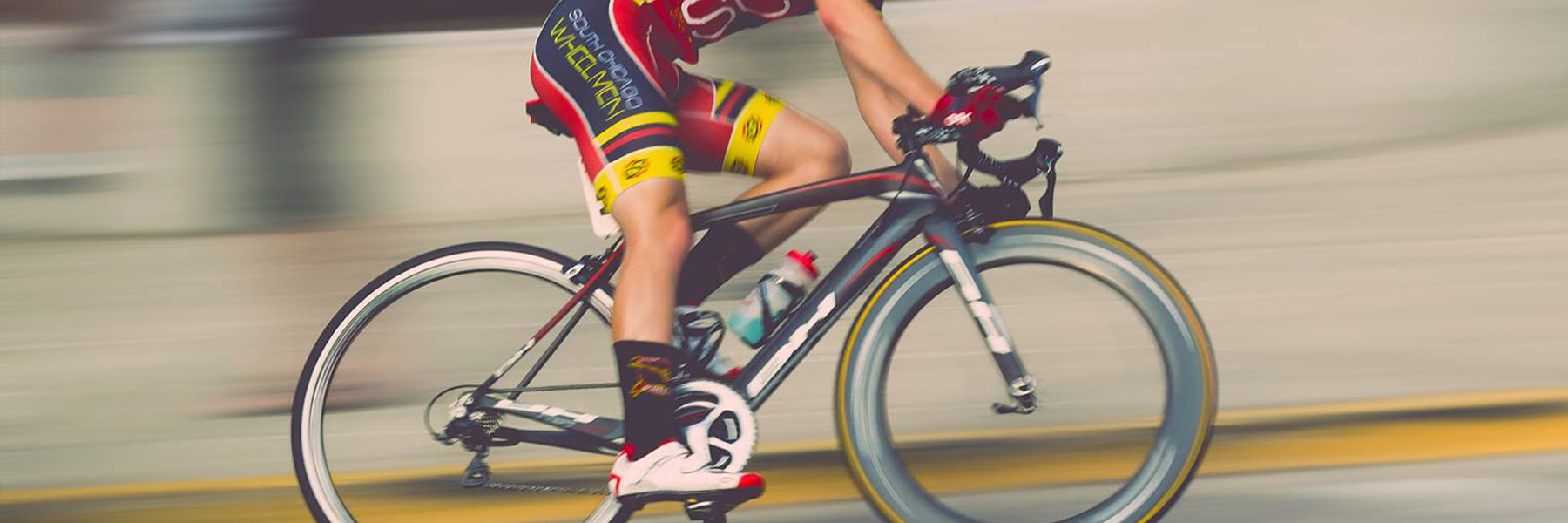
Are poor cycling mechanics effecting your power output? Dustin shares his thoughts on proper biomechanics on the bike, as well as the single exercise you need to ensure all your hard work is translating to optimum pedal power.
BY DUSTIN HANCOCK, DPT, RAUSCH PHYSICAL THERAPY
Are poor cycling mechanics robbing you of your precious pedal power? You can train long and hard to improve your performance on the bike, but if your body alignment is off, you’re putting yourself at risk for both injury and power loss.
For cyclists, proper biomechanical alignment in these three lower extremities is the key to not only avoiding injury, but also to increasing your power output levels.
Hips
As the powerhouse of the body, the hips are an important aspect of a cyclist’s biomechanics. There are several common issues cyclists face in this area, such as overuse of the quadriceps muscles while pedaling, as well as tightening of the hip flexor from sitting for too many hours in a day.
Tight hip flexors inhibit the most important hip extensor muscle, the gluteus maximus, while a lack of full flexion results in compensations at the spine, which can cause joint stress, compression of the discs, lower back pain, and saddle-related pelvic floor dysfunctions.
The “best” hip position while riding is different for each person, which is why it’s important to get a professional evaluation to figure out the natural shape of your hips (Q-angle) and ideal riding style. However, the general rule is to imagine a plumb line from the hip through the middle of the knee and finishing between your second and third toes. Since everyone is different in shape and size, the best position is usually the most natural feeling to you; so, hop on a trainer, close your eyes, and feel to the path of least resistance.
Knees
Think of your legs as pistons; as they attack a hill, they need to keep the power straight and consistent to operate effectively. As a physical therapist, I always perform a frontal plane exam on cycling patients to check that their knees are tracking correctly, as poor alignment causes power loss and puts you at risk for injury.
My frontal plane exam simply consists of having my patients stand in front of me and perform a Single Leg Squat. The squat simulates the cyclist’s foot position, and it shows me what my patient feels is comfortable. In my evaluation, I look to see if the feet are turned out, which results in a collapsed arch and can cause a deviation or torsion strain at the knee. I also check if the hips move backwards first when the patient squats, indicating it’s a gluteal-dominate movement, so the trunk of the body can stay controlled, which ensures core/hip stability. The knee should not go past the toes, and I also advocate for the shins staying as vertical as possible to take stress off the ACL—the most important ligament in the knee.
You can perform a frontal plane exam yourself at home by performing a Single Leg Squat in front of a mirror. As you squat, check that you’re keeping the knee tracking wherever the second and third toes are pointed; this ensures all your power is being transferred to the bike.
Ankles
Your ankle joint positioning is important to efficiently transfer the power into the pedal without any leaks in the system. There are generally three postures of cyclists—toe-down (stabbers), neutral/horizontal, and heel dropped—each of which has some pros and cons. The toe-down posture is designed for flexibility or compliance to the surface beneath, while the neutral/horizontal and heel-dropped ankle postures are understood to derive more power.
Heel Drop: Good
The human body is structurally designed to allow us to use muscles as pulleys and produce power to accelerate our body. When the ankle is in the heel-dropped posture, the ankle is positioned so that you have the least power transfer loss; this is known as a “closed pack” position” in medical terms, meaning the shape of the bones lock into place and all ligaments are in tension. This stiff ankle joint position allows every watt to transfer into the pedal.
Toe Down: Not So Good
If your toe is pointed down in the stabbing posture, typically you’ll lose power on the downstroke, as the ankle will suck up some watts in this “softer” ankle joint position. The analogy that helps the understanding of this concept is to think, “What is more efficient when climbing a steep hill, a bike with full suspension opened up in the rear, or a hard tail or lock out in the rear?” The full suspension example above is like having the stabbing ankle posture (too soft and springy) and as you power stroke up the hill you are leaking power.
Again, each individual is different, so I say the most comfortable, relaxed ankle posture is what’s best for you. However, biomechanically speaking, you may have an advantage dropping the heels during the power stroke to ensure all the power and hard work goes where you want it to.
Prescription for a Quick Fix
There is one particular exercise cyclists can do off the bike to ensure their lower-body biomechanics stay in check: the Single-Leg Squat on an unstable surface (such as a BOSU® Ball*.)
Correct Single-Leg Squat Mechanics:
- Hips move back first
- Toes stay relaxed while ankle stays relatively flat to the ground
- The motion down is controlled and super slow (at least six seconds) with good alignment
- Finish strong by going back up fast, squeezing the buttock at the top
Start with 10 to 15 reps focused on form, then work up to three sets of 10 to 15 reps, two to three times a week.
*If you don’t have a BOSU®, use a pillow as the unstable surface.
Applying the PAP Theory for MTB
To make this “quick fix” exercise more sport-specific, mountain bikers can apply the Post-Activation Potential (PAP) theory to help unleash greater potential power gains for exploding up those steeps hills.
PAP is a high-level training concept that combines heavy-resistance strength training with explosive plyometric, sport-specific movements. The concept of “explosion timing” and the focus on quality alignment under heavy loads is at the foundation of each movement.
[vsw id=”QmIhTkEQFsA” source=”youtube” width=”425″ height=”344″ autoplay=”yes”]
Single Leg Squat Using PAP:
- Stand on one leg. Squat in a controlled and slow downward motion (five to six seconds down) with a focus on good alignment.
- Start the upward motion slowly for one to two seconds, then explode to finish.
Applying the PAP theory to a Single Leg Squat—with a two-second delayed, explosive movement—will not only improve your cycling biomechanics, but also your climbs.
 Dustin Hancock, DPT graduated from San Diego State University with a bachelor’s degree in kinesiology/nutrition. He went on to receive his doctorate in physical therapy in 2011 from University of St. Augustine, and began his career at Rausch Physical Therapy and Sports Performance in 2012. As a snowboarder and mountain bike enthusiast, Dustin specializes in treating extreme sport athletes. As a physical therapist, Dustin says he looks forward to being a companion every step of the way on his patient’s path to recovery.
Click to learn more about Dustin and our other physical therapists »
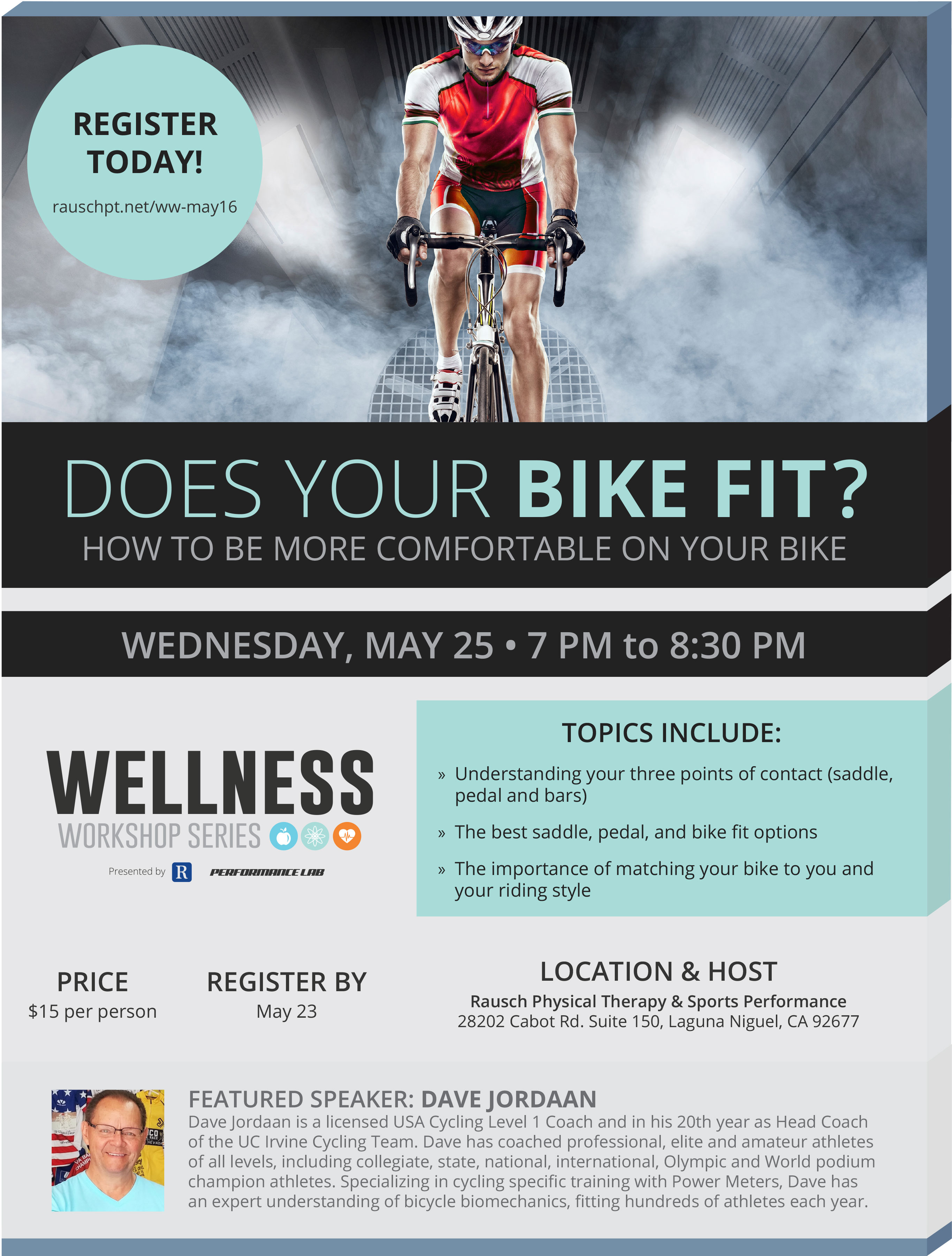
May Wellness Workshop: Does Your Bike Fit?
Does Your Bike Fit? How to Be More Comfortable on Your Bike
[framedbox][one_third]
When
Wednesday, May 25
7 – 8:30 PM
[/one_third][one_third]
Where
28202 Cabot Rd. Suite 150
Laguna Niguel, CA 92677
[/one_third][one_third_last]
Cost
$15 per person
[button link=”https://clients.mindbodyonline.com/classic/ws?studioid=18756&stype=-106&sView=day&date=05/25/16″ size=”small” color=”blue” align=”center” target=”_blank” ]SIGN UP NOW[/button]
[/one_third_last][/framedbox]
The May Wellness Workshop features Dave Jordaan, a licensed USA Cycling Level 1 Coach and the Head Coach of the UC Irvine Cycling Team. Dave has coached professional, elite and amateur athletes of all levels, including many collegiate, state, national, international, Olympic and World podium champions; and on May 25 he will be visiting Rausch PT to teach you how to be more comfortable on your bike.
Participants will:
- Hear in-depth explanations about proper bike fit from Dave Jordaan, USA Cycling Level 1 Coach
- Learn how to avoid pain from the three points of contact (saddle, pedal and bars)
- Learn about the best saddle, pedal, and bike fit options
- Understand the importance of matching your bike to you and your riding style
Come join us for a night of interactive learning where you will learn how to out ride the competition and have more enjoyable, pain-free rides!
[button link=”https://clients.mindbodyonline.com/classic/ws?studioid=18756&stype=-106&sView=day&date=05/25/16″ size=”small” color=”blue” align=”center” target=”_blank” ]SIGN UP NOW[/button]
Quick Fix for Dead Spots in Your Pedal Stroke
BY DUSTIN HANCOCK, DPT, RAUSCH PHYSICAL THERAPY
When cycling, there are two things that can improve your velocity: power output and turnover cadence. However, the overall power output can be weakened if at some point during your pedal stroke, you have inconsistencies during that full, circular motion. Inconsistent torque forces, or dead spots, typically occur at the initiation of the upstroke. You can determine if you have dead spots by using a power meter or by doing a test like our Performance Lab’s Bike Right, but a simple indicator if your stroke has dead spots is smashing and hammering of the pedals.
Like most exercise movements, a healthy pedal stroke relies on the stretch shortening cycle (SSC) to be efficient. SSC occurs when a muscle stores elastic energy as a muscle lengthens; this stored-up energy is then used when the muscle immediately shortens. Since SSC is a myofascial and nervous system stretch reflex, if the body has adequate mobility and dynamic stiffness, the SSC will allow for any athlete to access free kinetic energy, i.e. more power for less work! Improving SSC can not only be a huge efficiency booster, it can also help improve joint stability and congruency to save those knees from arthritic changes.
Quick One-Legged Exercise to Improve Dead Spots
Here’s a great neuromuscular recalibration drill that you can do on a trainer to improve those dead spots.
Step 1: Hop on a trainer and warm up with the smooth circular stroke pattern focused on relaxing your legs especially your ankles.
Step 2: When you feel warm and ready, pick up the cadence to 92-95 rounds per minute (RPM) and take one foot off the pedal. Place that foot in the center frame.
Step 3: Maintain the cadence for 30-second intervals, working up to 90-second intervals for three to five rounds.
This exercise ensures the leg pulls up at the bottom of your stroke, allowing the hamstring to apply more power into the equation. It also improves the circular stroke pattern and gets you away from that less effective “smashing pedal” form. Try to apply this exercise to your warm up and see what it can do for your cycling efficiency and overall speed.
Enjoy one more thing to think about on your ride!
Dustin Hancock, DPT graduated from San Diego State University with a bachelor’s degree in kinesiology/nutrition. He went on to receive his doctorate in physical therapy in 2011 from University of St. Augustine, and began his career at Rausch Physical Therapy and Sports Performance in 2012. As a snowboarder and mountain bike enthusiast, Dustin specializes in treating extreme sport athletes. As a physical therapist, Dustin says he looks forward to being a companion every step of the way on his patient’s path to recovery.
Click to learn more about Dustin and our other physical therapists »




What our patients are saying

Crista E.
Lynne B.
Everything Rausch has recommended involving treatment for my condition has been appropriate and top-notch!
Allison B.
Michael M.
Vincent M.
Deborah R.
Robert V
Valeria R.
Stay Connected
Sign up to receive monthly specials, events, and expert tips & tricks.