
Six Ways to Avoid Painful “Text Neck”


Your screen addiction isn’t just straining your eyes and relationships; over time, your neck muscles can become stretched out and weakened while others become tight and painful as they struggle to stabilize your head in front of your body. Poor posture due to hours of mindless scrolling and tapping could be at the root of the chronic soreness and pain in your head, neck, shoulders, and back. PT Ashley Heller shares her six tips for avoiding the painful condition “Text Neck.”

Ashley-Blog
BY ASHLEY HELLER, PT, MPT, RAUSCH PHYSICAL THERAPY

I constantly notice patients looking down at their phones—texting while in the waiting room, scrolling through Instagram while on the table, checking their work calendar to schedule their next appointment. These days, most everybody relies on their smartphone to stay connected to the world, and almost everyone is guilty of looking down at our phones.

While there’s no question that having technology at our fingertips is entertaining and convenient, it can also be a pain in the neck—literally. So, what can we do to prevent the pain associated with the dreaded “Text Neck?”

What is “Text Neck?”

What many people fail to realize is that repetitive or habitual postures over time related to texting, reading, and working on the computer may lead to long-term effects on the way we feel. Over time, the neck muscles become stretched out and weakened while others become tight and painful as they struggle to stabilize your head in front of your body. Poor posture over a prolonged period of time can lead to postural dysfunction resulting in chronic soreness and pain in your head, neck, shoulders, and back.
[one_half]

What’s the science?

  • Postural syndrome occurs when prolonged stress is placed on the neck
  • The average human head weighs 10-12 pounds in a neutral position
  • The further bent forward your head is, the more weight your neck has to support:
    • 15º =  27 pounds
    • 30º = 40 pounds
    • 45º = 49 pounds
    • 60º = 60 pounds

[/one_half][one_half_last]

Symptoms of Text Neck

  • Headaches or migraines
  • Pain in neck and or between the shoulder blades
  • Numbness or tingling down the arm
  • Shoulder pain

[/one_half_last]

Long-term effects of Text Neck

Prolonged posture strains your neck muscles and cervical facet joints, resulting in soreness and inflammation in that area. It also flattens the normal curve of your neck, which can lead to:

  • Headaches
  • Nerve pain in neck or arms
  • Disc degeneration or herniations
  • Arthritis resulting in neck stiffness, as well as arthritis in the neck joints

Text Neck also can also cause a rounded shoulders posture, which can affect the mechanics of the shoulder and may result in shoulder impingement. You’re also more susceptible to a condition called Upper Crossed Syndrome, which occurs when the muscles in the neck, shoulders, and chest become deformed causing things like a hunched back or chronic shoulder, upper back and neck pain.

Six ways to combat and avoid Text Neck

The good news is that it’s not too late to make changes to undo any damage your screen addiction may be inflicting on your body. These tips can also apply while reading or working on your computer or tablet.

    1. Be aware of your posture. Pay attention to the way you are sitting or standing and how long you have been in that position.
    2. Listen to your body. When you feel neck pain starting, correct your posture immediately by getting out of a slumped position, then find a neutral spine posture by sitting upright while aligning your ears with your shoulders.
    3. Bring your phone up to eye level to reduce strain to your neck while you are texting.


  1. Text with your arms supported to decrease strain to the neck.
  2. Don’t stay in one position for too long. You now know that prolonged postures can lead to muscle strains, so get up and move around! You should also use a foam roll, tennis ball or lacrosse ball to decrease tissue tension in your upper back.
  3. See a physical therapist. If you’re already feeling the painful symptoms of Text Neck in your neck, upper back or shoulders, schedule an appointment with a physical therapist. We’re experts in musculoskeletal dysfunction, and we can create a specific plan of care combining manual therapy and therapeutic exercises to help you find relief and change your texting habits for good.

PT-Headshots-AshleyAshley Heller, MPT is a licensed physical therapist at Rausch Physical Therapy & Sports Performance. She received her Masters of Physical Therapy degree at California State University, Long Beach and is passionate about working with patients with shoulder, knee and ankle injuries. With background in orthopedic-related injuries and post-operative rehabilitation, Ashley believes that the combination of manual therapy and personalized therapeutic exercise program is vital to recovery. Known as the Water Sports PT, Ashley says her goal is to help her patients better understand their injuries and the plan for their road to recovery.

Click to learn more about Ashley and our other physical therapists »
Let’s talk! We are here to help. Give us a call for an initial evaluation and assessment. We would love to meet you.

Did you know there’s no prescription needed from a doctor to see us – but we will communicate your progress and treatment to your doctor if you’d like us too!

(949) 276-5401

RauschPT

Disclaimer — All the information that you find on our blogs and social media pages are for informational purposes only and are not intended to be used as your personal professional diagnosis, or treatment. Come and see us for your excellent, personalized care! https://staging.rauschpt.net/
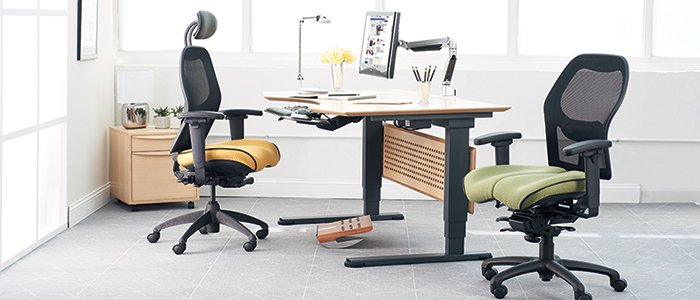
The Myth of the “Ergonomic Workplace”


BY KEVIN CAPATA, DPT, RAUSCH PHYSICAL THERAPY

Should I get a standing desk? Do I need a chair with a lumbar-support cushion? Is it okay to cross my legs? How can I keep correct posture for eight hours at work!?

As a physical therapist, my patients ask me these types of questions far too often. I can understand why; we’ve heard that sitting at a desk all day is (literally) killing us, we can feel the aches and pains of the 40-hour work week, and we want a quick fix. Enter: “The Ergonomic Workstation”—the latest “solution” to the daily grind.

We’ve all heard or read about the ideal “ergonomic” setup for your office, and people will spend hundreds of dollars on products to achieve it. Try a treadmill desk. Swap out your chair for a stability ball. Get an ergonomic keyboard. Sit up straight… no, lean back… NO, stand up! From desk accessories to office furniture, my patients are buying anything that promises to alleviate their poor posture and the pain that comes with it—but is this money well spent?

The Myth of the “Ergonomic Workplace”

Now, I believe that ergonomic products are great in theory, and yes an “ergonomic” set up at your office may help correct some “poor” posture during your workday. But as a physical therapist, I’m here to let you in on a secret: it doesn’t really matter what kind of chair you use or how you sit at your desk; what matters is YOU.

Yep, when it comes down to it, the ergonomic workstation is a myth. The truth is, being desk-bound and sedentary is what’s killing us.

When you’re at your desk for hours, it doesn’t matter how you’re sitting, or if you’re standing, or even if you’re walking on a treadmill—if you do the same movement or hold the same position for a prolonged period, it’s unhealthy. You can be sitting in the most ergonomic chair money can buy, but if you sit in it for hours at a time, your body will adapt and struggle to function when you’re no longer in that position, which is why you feel that soreness, stiffness and pain.

So yes, always sitting hunched forward at your computer is bad, BUT always sitting stick straight is not great either. Maintaining ANY position all day, every day is not good for you! As biomechanist Katy Bowman puts it in one of my favorite books, “It’s not the load that breaks you down, it’s the way you carry it.”

DID YOU KNOW? The Average American is Sedentary for 21 Hours Per Day

In fact, sitting has joined smoking and obesity as a top risk factor for chronic disease. Recent studies show that too much sitting contributes to a host of diseases—from obesity and diabetes to cancer and depression—and literally shortens your life.

Right down to the cellular level, our bodies crave frequent and varied movement. Yet I bet you can count the number of positions you are in throughout the day on one hand:

  1. Walk to your car
  2. Sit while you drive, at work, for meals, while watching TV…
  3. Lie down to sleep

In total, Americans are sitting an average of 13 hours a day and sleeping an average of eight hours, resulting in a sedentary lifestyle of around 21 hours per day. Sure, maybe you squeeze in a trip to the gym, but when you think about it, a sedentary lifestyle plus an hour of “exercise” is like eating candy and junk food all day, then deciding to have an apple for dinner!

The British Medical Journal claims that reducing the average time you spend sitting to less than three hours per day could increase your life expectancy by two years, but that’s definitely easier said than done considering that 13-hour average. So, what can we do to get—and stay—moving?

Stay Moving, Stay Healthy

It’s time to forget this notion that there’s one “best” work setup or posture; instead realize that the best position is your next position. Get up. MOVE. Change positions. Get into a new posture that you haven’t tried in a while. You don’t have to allow your environment to determine how you interact with it.
[framedbox]
[styled_title size=”2″]Kevin’s Three Rules for Avoiding Sitting[/styled_title]
Bound to your desk? Here are three rules to remember throughout your workday to help restore proper function to your tissues and muscles and combat sitting at work:

  1. For every 30 to 45 minutes of sitting, you should do five minutes of stretching or mobilization exercises
  2. Set an alarm for every 20 to 30 minutes to remind you to change positions. We all have smart phones, so no excuses!
  3. Find alternative positions to work in (e.g. kneel/stretch in front of your desk, use a headset and pace while on the phone, etc.)

EXAMPLES OF ALTERNATIVE WORKING POSITIONS:>

[one_fourth]

KNEELING

Place a towel under your knee, and alternate every few minutes.[/one_fourth][one_fourth]

<

HIGH/LOW CHAIR

Stand, then sit and hang one leg off at a time, switching sides every few minutes[/one_fourth][one_fourth]


STANDING

Try putting one leg on a small stool or box, and alternate every few minutes.[/one_fourth][one_fourth_last]


STRETCHING

Stretching while working is a great way to maintain productivity.[/one_fourth_last]

[/framedbox]

Apply this mantra to everything you do throughout your day. Been standing up for a while? Sit down. Sitting down? Stand up! Lay on your stomach while you’re watching TV, sit cross-legged while you read, stand on one foot while you brush your teeth. If you have kids, just watch how they move and how often they move, then imitate them for once.

To borrow again from Katy Bowman: “Exercise is movement, but movement is not always exercise.” Let’s change that! Make the decision to consciously create more movement in your daily life and you can exercise all day long. Instead of thinking of a 30-minute gym workout as your “exercise” for the day, recognize the fact that taking out the trash, choosing stairs over elevators, or jogging down the hall to talk to a colleague are all forms of daily “movement,” and movement is what your body truly needs to function properly.

By transforming your “exercise routine” into a daily “movement practice,” you can drastically decrease those creaks and pains that supposedly show up one morning out of nowhere. Don’t get me wrong, we are human and our bodies will breakdown. Still, I can tell you that by focusing on a daily movement practice, you’ll lower your risk of throwing out your back while doing a mundane task like taking out the trash.

Conclusion

Healing our country’s addiction to a sedentary lifestyle starts with a culture shift within the workplace. We need stop fearing that it’s taboo or unacceptable to leave our desks and move around. We shouldn’t feel weird doing exercises at our desk or standing during a long meeting. And if you are struggling to conjure up ways to get out of your chair and still maintain productivity, ask your PT for help! As movement experts, physical therapists can assess your work/home-life setup and create a personalized movement practice to help alleviate aches and “chronic” pain, and ultimately extend your life.


K2Kevin Capata, PT, DPT, CSCS is a licensed physical therapist at Rausch Physical Therapy & Sports Performance. After receiving his Doctor of Physical Therapy degree at Columbia University, Kevin started his career at Rausch PT, where he used to work as a physical therapy aide. Now, Kevin enjoys helping his patients recognize and fix movement faults to help them overcome their injury or pain, as well as empowering them with the knowledge and tools to prevent re-injury or potential new injuries.

Click to learn more about Kevin and our other physical therapists »


Proper Pitcher’s Hip Rotation and How to Get It


Remember that game Twister? Every time that spinner landed on a new color, you were forced to reach your hand behind your back, underneath a leg, and across the board, all while trying not to fall. While incredibly entertaining, this silly game can also be a valuable lesson about positional torques, balance, rotation and flexibility—especially when it comes to baseball.

Looking at the specific qualities to win this game can be related to the critical components of the throwing motion in baseball. Often times when assessing a pitcher’s mechanics, there’s a miss in relating the lower half to the upper half of the body.  It is crucial for a pitcher—no matter the age—to begin to learn the importance of max hip rotation in order to achieve full torque of the trunk and obtain maximal velocity through the pitch.

The Sling Shot Effect

The rubber band of a sling shot is wound up with so much tension so that when it’s released, a massive amount of kinetic energy hurls the rock (or projectile of your choice) forward. The pitching motion in baseball is similar in that the lower half of the body, starting with proper foot placement and maximal hip rotation, will create a buildup of kinetic energy through the trunk, shoulder blades, shoulder and finally release through the fingers.

Proper Hip Rotation and How to Get It

Without proper hip rotation, a pitcher’s hips will fly open, which creates torque at the elbow. To avoid this, we want proper hip rotation, which occurs when:

  • The hips are fully rotated just before the lead foot strikes the ground
  • The shoulders are closed with arm extended out into the cocked phase of throwing.

Proper rotation allows for maximal hip-to-shoulder separation, which in turns creates the most amount of torque and velocity possible. There are two specific keys to obtaining this position and preventing further stress on the arm, the lead leg and posture.

The lead leg

The lead leg must be relaxed from the knee down and have proper landing position. Proper landing position includes:

  • Toes pointing slightly towards the right-handers box (if a right-handed pitcher.)
  • The hips will remain closed until just before lead foot strikes the ground.
  • At this time they will lead their front hip towards the plate and really turn open the front hip at the latest possible time.
  • If done properly, the pitcher shoulder feel tightness along their oblique muscles, NOT their back.

Posture

When a pitcher transitions from early-stance phase to the cocked position, their posture can completely affect their ability to rotate through their hips and finish off a throw. For example, if a pitcher is bent too far forward when their foot lands, they will not have the ability to achieve full pelvic rotation, thus not allowing this maximal hip/shoulder separation.

The key for good throwing posture is to focus on balancing and creating extension or back-bending through the middle part of the athlete’s back. It has been statistically proven and correlated that the optimal position of posture is the thoracic spine slightly extended, slight lean towards the back leg, and non-throwing hip flexed up. Therefore, it is important to not allow early rotation of the trunk or shift the center of gravity towards the throwing arm, as both will cause the trunk and shoulders to “open early.” before the hips, and create abnormal stresses on the shoulder and arm.

Maintaining proper foot landing position and rotation of the hips will create the maximal amount of separation leading to good pitching mechanics and increased velocity. Posture is also considerably important and must be taken into account when looking at the ability to create this hip to shoulder separation.

Suggested Training and Exercises


StaffHeadshot-JonJonathan Meltzer graduated from the University of Redlands with a bachelor of arts in biology and a minor in physical education. Following graduation, Jonathan discovered his passion for physical therapy while working as a Physical Therapy Aide. After graduating top of his class from Loma Linda University in 2012 with a Doctorate in Physical Therapy, Jonathan began his career at Rausch Physical Therapy and Sports Performance. Jonathan’s goals are to identify limitations and treat his patients with the most recent and innovative techniques in order to maximize functional independence and obtain his patients’ individual goals.